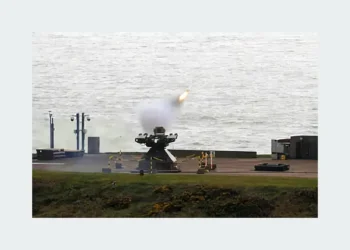
The UK Ministry of Defence (MOD) has successfully trialled a cutting-edge air defense laser system, proving its capability to protect RAF aircraft from missile threats. Held at Sweden’s Vidsel Test Range, the trials demonstrated the system’s effectiveness in detecting and neutralizing multiple heat-seeking missiles simultaneously.
Revolutionary Defense Technology for the RAF
In a landmark achievement, the UK MOD tested the laser self-protection system developed by Team Pellonia—a collaboration involving Leonardo UK, Thales UK, and the Defence Science and Technology Laboratory (Dstl). The technology aims to provide RAF pilots with a new level of defense, ensuring aircraft safety even in high-threat environments.
During the live-fire exercise, the system detected, tracked, and neutralized all missile threats with pinpoint accuracy. The trial results were nothing short of impressive, marking a significant milestone in the MOD’s efforts to modernize UK defense capabilities.
“Identifying, tracking, and defeating threats from the air in seconds is crucial to having the edge over those who try to do us harm,” said Defence Secretary John Healey.
“We’re equipping our Armed Forces with the latest technology to keep them safe and give them the advantage on operations.”

How the Laser System Works
The air defense system utilizes advanced infrared technology to detect and counter missile threats. It integrates Thales’s Elix-IR threat warning system, which identifies the launch of incoming missiles. The system employs sophisticated algorithms that filter background noise, ensuring that only real threats are detected and tracked.
Once a missile is identified, an alert is sent to Leonardo’s Miysis Directed Infrared Countermeasure (DIRCM) system. Miysis then tracks the missile and directs a jamming laser with ultimate precision to disrupt the missile’s guidance system.
As a result, threats are neutralized faster than one can read this sentence, ensuring the safety of RAF aircraft.
“The UK defensive aids system is the culmination of MOD’s detailed understanding of changing threats alongside years of sustained investment,” remarked Dstl’s Chief for Air Survivability, Mark Elson. “This capability provides long-term operational advantage to the UK and our allies.”
Job Creation and Economic Impact
The development and testing of this advanced technology are not just a military triumph but also an economic boost for the UK. Partnerships like Team Pellonia support job growth, sustaining hundreds of roles in Scotland alone.
Economic Impact Summary:
Partner |
Location |
Jobs Supported |
|---|---|---|
| Thales UK | Glasgow | 700 jobs |
| Leonardo UK | Edinburgh | 1,250 jobs |
These jobs contribute to both local and national economic growth, highlighting the importance of defense investment in stimulating industry and technology sectors. Such partnerships not only enhance military capabilities but also strengthen the UK’s industrial base.
International Recognition and NATO Involvement
The successful trials were witnessed by senior military officers from several NATO countries, showcasing the UK’s advancements in defense technology.
With NATO representatives observing the event, the laser system’s success has sparked interest from international allies, potentially leading to further collaborations and exports of the technology.
Leonardo’s Senior Vice-President of Radar and Advanced Targeting, Mark Stead, expressed pride in the team’s achievements:
“The results of these trials speak for themselves and are a testament to the skills and experience within Leonardo as a global leader in directed infrared countermeasures. Miysis DIRCM has again proven itself as a reliable, effective protection system.”
Future Developments and Applications
Looking ahead, the MOD plans to integrate this laser defense technology into various RAF aircraft, including the intelligence-gathering Shadow R2 and the A400M transporter. The system’s design ensures adaptability, providing protection for current and future platforms.
The MOD’s investment in this capability aligns with its broader defense strategy, which emphasizes the importance of technological advancements in maintaining national and allied security.
As further development continues, the system’s Spiral Development approach will allow for ongoing improvements, ensuring the RAF remains equipped with the most effective protection available.
Dstl’s research programme continues to play a crucial role in enhancing the UK’s defense capabilities, ensuring the country’s armed forces are equipped to face evolving threats.
Stephen McCann, Thales’s Managing Director of Optronics & Missile Electronics UK, noted the significance of this latest development:
“Elix-IR has again proven its world-leading capabilities during a comprehensive and complicated multi-faceted trial.”
A Bright Future for UK Defense
With the world watching, the success of these trials demonstrates the UK’s commitment to not only modernizing its defense but also maintaining a strong, technologically advanced military presence on the global stage.
In Summary
The UK’s recent success in testing its air defense laser system is a pivotal step toward equipping the RAF with state-of-the-art self-protection capabilities.
With this technology, the UK strengthens its military while driving economic growth, ensuring the safety and effectiveness of its armed forces for years to come.
Sources: THX News, Ministry of Defence, Defence Science and Technology Laboratory & The Rt Hon John Healey MP.