NVIDIA has announced a major expansion of its BioNeMo platform to support AI-driven biology and drug discovery, unveiled at the J.P. Morgan Healthcare Conference. The update introduces new models, tools, and industry collaborations designed to integrate artificial intelligence directly with laboratory experimentation.
The announcement sets out how NVIDIA is positioning BioNeMo as infrastructure for life sciences research, combining accelerated computing with real-world laboratory workflows to support drug discovery, biology research, and data-intensive experimentation across the sector.
NVIDIA expands the BioNeMo platform
NVIDIA said the BioNeMo platform has been expanded to support lab-in-the-loop workflows that connect AI model development with experimental science. According to the company, the platform is designed to help life sciences organisations generate, process, and deploy models using large volumes of biological and chemical data.
The company stated that BioNeMo is intended to improve research efficiency by shortening discovery timelines and reducing costs associated with drug development, which NVIDIA cited as reaching hundreds of billions of dollars annually across the industry.
Data snapshot
| Indicator | Recent Movement | Context |
|---|---|---|
| Life sciences R&D costs | Rising | NVIDIA estimates annual industry research and development costs at around $300 billion, highlighting pressure for efficiency |
New BioNeMo models, tools and workflows
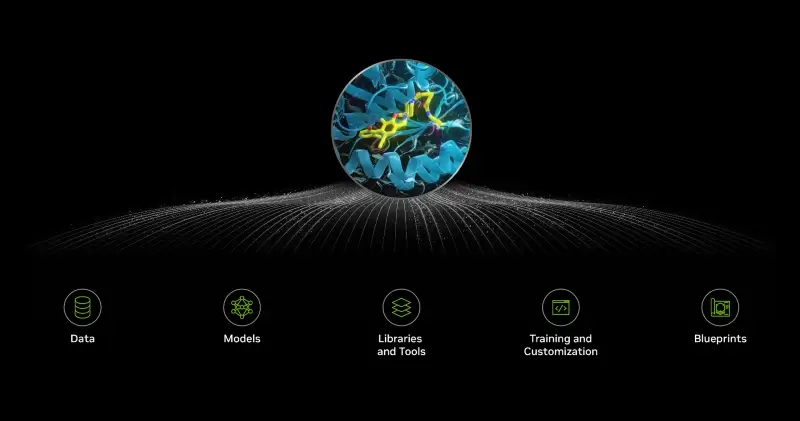
As part of the expansion, NVIDIA introduced new open models and supporting tools within the BioNeMo ecosystem. These additions are intended to support tasks such as RNA structure prediction, molecular design, and scalable model training.
The company also announced new data processing libraries and training recipes designed to help researchers customise and deploy biological foundation models more efficiently using accelerated computing.
Platform components
- Open models: NVIDIA introduced new Clara-based models for RNA and drug design applications, according to the company announcement
- Training workflows: BioNeMo Recipes were released to support scaling and deployment of biological AI models
Industry collaborations in drug discovery
NVIDIA confirmed new collaborations with major life sciences organisations to integrate BioNeMo into drug discovery and laboratory environments. Eli Lilly announced a co-innovation laboratory with NVIDIA focused on applying AI to longstanding drug discovery challenges.
Separately, Thermo Fisher Scientific said it is working with NVIDIA to combine AI computing with laboratory instrumentation, with the stated aim of making scientific laboratories more autonomous and data-driven.
Collaboration context
The partnerships are framed by NVIDIA and its partners as efforts to connect AI systems directly with experimentation. Company statements indicate the collaborations focus on applying computing, automation, and AI models across discovery and laboratory workflows rather than standalone software development.
Building autonomous and intelligent laboratories
NVIDIA said the expanded BioNeMo platform supports the development of agent-based AI systems capable of orchestrating experiments, analysing results, and refining models in near real time. The company described this approach as linking digital experimentation with physical laboratory operations.
According to NVIDIA, this model is intended to enable laboratories to operate at greater scale while maintaining consistency in data generation and analysis.
Operational indicators
| Indicator | Recent Movement | Context |
|---|---|---|
| Laboratory automation | Increasing adoption | NVIDIA and partners report growing use of AI-driven workflows to automate experiments and data analysis |
Growing AI drug discovery ecosystem
NVIDIA stated that a growing ecosystem of biotechnology, AI research, and laboratory automation companies are building tools and models on the BioNeMo platform. These organisations are using the platform to train models, analyse biological data, and design potential medicines.
The company also highlighted collaborations with firms developing AI “scientist” systems and robotics-enabled laboratories, positioning BioNeMo as a shared foundation for AI-enabled science.
Ecosystem signals
- Biotech adoption: Multiple biotechnology and AI firms are using BioNeMo to train and deploy drug discovery models, NVIDIA said
- Automation focus: Robotics and lab automation companies are integrating AI simulation and physical systems into research workflows
To Sum Up
NVIDIA’s BioNeMo expansion outlines how the company intends to embed AI more deeply into life sciences research and drug discovery. By combining accelerated computing, new models, and partnerships with laboratory operators, the platform is positioned as infrastructure for AI-enabled experimentation.
The announcement signals continued investment in applying artificial intelligence across biological research and development.
Sources: NVIDIA, J.P. Morgan Healthcare Conference.
Prepared by Ivan Alexander Golden, Founder of THX News, an independent news organization delivering timely insights from global official sources.
Combines AI-analyzed research with human-edited accuracy and context.