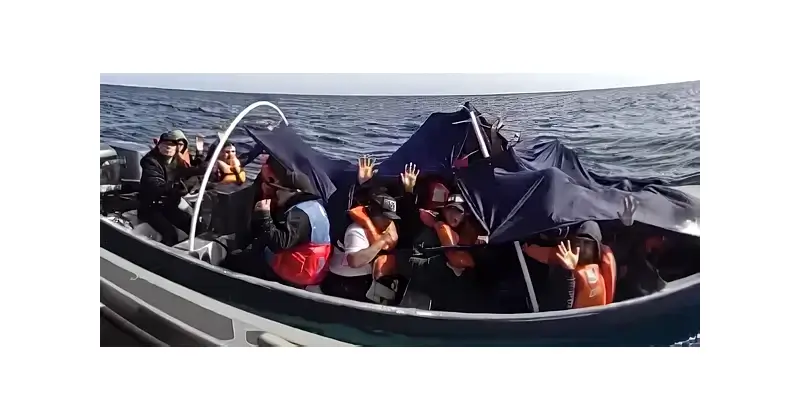
U.S. Customs and Border Protection’s Air and Marine Operations announced that crews, alongside the U.S. Coast Guard, interdicted three smuggling vessels off Southern California between April 17 and April 21, 2026, apprehending 60 individuals.
The operations, conducted in coordination with maritime partners, reflect ongoing federal enforcement efforts to detect and intercept illegal maritime crossings along the Southern California coastline, with all individuals and vessels transferred to U.S. Border Patrol for processing following each interdiction.
Overview of maritime interdictions
U.S. Customs and Border Protection’s Air and Marine Operations reported that three separate maritime smuggling attempts were intercepted over a five-day period. In total, 60 individuals were apprehended during coordinated responses involving CBP marine units and U.S. Coast Guard cutters. All individuals and vessels were transferred for processing under U.S. Border Patrol procedures.
Summary of enforcement activity timeline and agencies involved
According to U.S. Customs and Border Protection, interdictions occurred on April 17, April 18, and April 21, 2026. The operations involved CBP Air and Marine Operations crews working alongside the U.S. Coast Guard, including Cutter Florence Finch and Cutter Terrel Horne. Additionally, coordination across air and marine units enabled detection and interception far from shore.
First vessel interdiction near San Clemente Island
On April 17, CBP Air and Marine Operations detected a 24-foot vessel south of the maritime boundary line. The San Diego Marine Unit responded and intercepted the vessel near San Clemente Island at approximately 2 p.m. The interdiction resulted in 13 individuals being taken into custody.
Breakdown of passengers, vessel details, and transfer for processing
U.S. Customs and Border Protection confirmed that those apprehended included seven men, five women, and one juvenile female. The individuals and vessel were transported to Ballast Point Naval Base, where U.S. Border Patrol conducted processing. This operation demonstrated rapid response capabilities following aerial detection.
Second vessel interception near San Nicolas Island
On April 18, CBP Air and Marine Operations identified another vessel approximately 80 nautical miles southwest of Point Loma. The Long Beach Marine Unit, working with the U.S. Coast Guard Cutter Florence Finch, intercepted the vessel near San Nicolas Island. As a result, 29 individuals were apprehended during the operation.
Details of location, number of individuals, and transfer to Newport Harbor
U.S. Customs and Border Protection reported that all 29 individuals were Mexican nationals. The U.S. Coast Guard transported the group and the vessel to Newport Harbor, where custody was transferred to U.S. Border Patrol. The joint operation highlighted interagency coordination across extended maritime distances.
Third vessel interdiction off Ensenada
On April 21, the U.S. Coast Guard Cutter Terrel Horne, guided by CBP Air and Marine Operations aircrew, interdicted a 25-foot vessel first detected a day earlier. The vessel was located off the coast of Ensenada, Mexico, where 18 individuals were apprehended during the operation.
Summary of detection timeline, apprehensions, and processing arrangements
The U.S. Coast Guard confirmed that all individuals on board were Mexican nationals. They were transported alongside the vessel for processing by U.S. Border Patrol. Meanwhile, the delayed interdiction timeline reflected continued tracking following initial detection by CBP air assets.
Criminal histories and enforcement
U.S. Customs and Border Protection reported that some individuals apprehended across the three vessels had prior criminal histories. These included offenses such as driving under the influence, burglary, drug possession, and aggravated assault with a weapon. CBP did not specify how many individuals were linked to each offense category.
Explanation of reported criminal backgrounds and enforcement significance
According to U.S. Customs and Border Protection, the presence of prior offenses among some individuals underscores enforcement priorities targeting both illegal entry and criminal activity. The agency stated that maritime smuggling attempts often involve individuals seeking to evade detection through offshore routes. This context reinforces the operational focus on early interdiction at sea.
| Indicator | Recent Movement | Context |
|---|---|---|
| Smuggling vessels intercepted | 3 vessels | U.S. Customs and Border Protection reported three interdictions between April 17–21, 2026 |
| Total individuals apprehended | 60 people | Combined total from CBP Air and Marine Operations and U.S. Coast Guard operations |
| Agencies involved | CBP and U.S. Coast Guard | Operations included CBP marine units and Coast Guard cutters Florence Finch and Terrel Horne |
- Operational risk: U.S. Customs and Border Protection stated that maritime smuggling involves unsafe, overcrowded vessels, increasing risk to life at sea.
- Interagency coordination: CBP Air and Marine Operations and the U.S. Coast Guard conducted joint responses across multiple maritime zones.
- Enforcement priority: CBP emphasized stopping individuals with criminal histories before reaching U.S. communities.
Official statement from CBP Air and Marine Operations leadership
“These interdictions show the great lengths dangerous criminals will go to avoid apprehension, including taking to the open ocean in unsafe, overcrowded vessels,”
said Hunter Robinson, Southwest Region Executive Director for CBP Air and Marine Operations.
He also stated that such actions place lives at risk while reinforcing the need for continued offshore enforcement.
U.S. Customs and Border Protection and U.S. Coast Guard operations between April 17 and April 21, 2026, resulted in the interdiction of three vessels and the apprehension of 60 individuals. The coordinated actions demonstrate continued maritime enforcement to intercept illegal crossings before reaching U.S. shores.
Sources: U.S. Customs and Border Protection.
Prepared by Ivan Alexander Golden, Founder of THX News, an independent news organization delivering timely insights from global official sources.
Research combines AI-assisted analysis with human-edited accuracy and context.