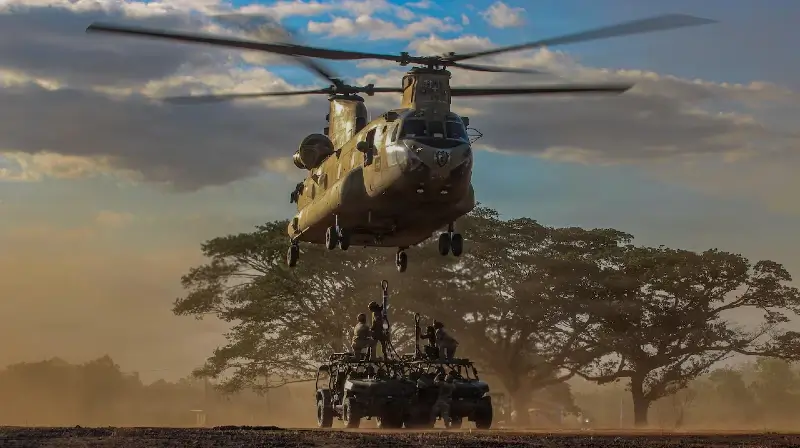
U.S. Army forces, alongside the Armed Forces of the Philippines and multinational allies, launched the second phase of Exercise Salaknib in the Philippines on May 8 through the Joint Pacific Multinational Readiness Center-Exportable Exercise to strengthen Indo-Pacific combat readiness and interoperability.
The exercise forms part of broader U.S.-Philippine alliance operations designed to improve multidomain coordination, regional deterrence, and modernization training across archipelagic terrain in the Indo-Pacific theater. The deployment also integrates allied forces from Australia, Japan, and New Zealand into combined operational scenarios through May 20.
Exercise Salaknib Enters Second Phase
The U.S. Army’s 25th Infantry Division officially launched the Joint Pacific Multinational Readiness Center-Exportable Exercise as Part II of Exercise Salaknib in partnership with the Philippine Army’s 7th Infantry Division. The training rotation is taking place across operational environments in the Philippines and focuses on combined arms readiness, interoperability, and regional coordination.
The JPMRC-X program brings a combat training center experience directly into the Indo-Pacific theater, allowing participating units to train within geographic conditions that mirror real-world operational environments. The exercise supports the wider Operation Pathways framework, which the U.S. Army uses to maintain persistent regional engagement with treaty allies and security partners.
Multinational Forces Begin Combined Operations
New Zealand Army Col. Aidan Shattock, deputy commanding general for interoperability of the 25th Infantry Division, said the exercise reflects more than 75 years of alliance cooperation between the United States and the Philippines. He stated that interoperability training demonstrates “deep trust and understanding” between allied forces operating together during Operation Pathways.
Participating multinational partners include forces from Australia, Japan, and New Zealand alongside U.S. and Philippine units. The multinational structure is intended to strengthen coalition coordination and reinforce regional security cooperation throughout the Indo-Pacific region.
Combat Training Focuses on Indo-Pacific Conditions
The training rotation emphasizes multidomain combat operations across complex and geographically dispersed terrain. According to the U.S. Army, the exercise is designed to improve tactical proficiency, command integration, and operational coordination in archipelagic environments where Indo-Pacific forces are expected to operate.
The exercise incorporates field operations that test mobility, interoperability, and command responsiveness under realistic operational conditions. The scenarios are intended to improve operational readiness and long-term alliance integration with regional partners.
Tactical Readiness Exercises Simulate Real-World Conditions
Participating units are conducting combined operational drills intended to simulate complex battlefield coordination across land-based and multidomain environments. The U.S. Army stated that the exercise supports readiness objectives tied to deterrence and rapid regional response capabilities.
| Indicator | Recent Movement | Context |
|---|---|---|
| Exercise Timeline | May 8–20 operations underway | War.gov stated the second phase of Exercise Salaknib continues through May 20 in the Philippines |
| Participating Nations | Five-country operational integration | War.gov confirmed participation from the United States, Philippines, Australia, Japan, and New Zealand |
| Operational Scope | Expanded multidomain training focus | The U.S. Army stated the exercise includes combat readiness, interoperability, and modernization training objectives |
The operational focus reflects broader U.S. military efforts to strengthen readiness across the Indo-Pacific theater through forward-positioned alliance exercises. However, the exercise remains structured as a combined training operation conducted in coordination with Philippine authorities and local officials.
Army Modernization Technologies Integrated Into Training
The 25th Infantry Division is using the exercise to test modernization capabilities during operational training scenarios. According to War.gov, units are integrating unmanned aircraft systems alongside the Army’s next-generation squad weapons, including the M7 rifle and M250 automatic rifle.
The modernization component forms part of the Army’s wider effort to improve squad-level situational awareness and operational effectiveness through human-centered technology integration. Additionally, the deployment allows units to evaluate these systems within tropical and archipelagic operating environments relevant to Indo-Pacific operations.
New Weapons and Unmanned Systems Support Operations
Unmanned aircraft systems are being used to improve operational visibility and coordination during training exercises. The deployment of the M7 rifle and M250 automatic rifle reflects continued implementation of the Army’s Next Generation Squad Weapon modernization program.
- Modernization Focus: War.gov stated the exercise integrates next-generation squad weapons and unmanned systems into operational readiness scenarios
- Regional Readiness: The U.S. Army said the exercise supports Indo-Pacific interoperability and rapid-response capability development
- Alliance Integration: Participating multinational units are conducting coordinated multidomain operations alongside Philippine forces
The modernization training also provides operational data regarding how emerging systems perform under multinational command structures and geographically dispersed conditions. However, the exercise remains centered on readiness and interoperability objectives rather than active combat operations.
Allied Cooperation Reinforces Regional Security Goals
The multinational exercise reflects ongoing U.S. and allied efforts to maintain security coordination across the Indo-Pacific region. According to War.gov, participating forces are conducting operations intended to strengthen alliance interoperability and demonstrate a collective commitment to regional stability.
The U.S. Army stated that all activities are being coordinated closely with the Philippine government and local officials to support civilian safety and operational transparency. The exercise also includes humanitarian assistance coordination elements tied to long-term regional partnership objectives.
Officials Highlight Alliance Commitments
The Philippine partnership remains one of the United States’ oldest treaty alliances in the Indo-Pacific region.
The exercise combines modernization systems, interoperability drills and multinational coordination within a single operational training framework. According to the U.S. Army, these combined exercises are intended to sustain operational cooperation among allied Indo-Pacific forces.
Exercise Supports Long-Term U.S.-Philippine Partnership
Exercise Salaknib continues to serve as a major component of the long-standing defense relationship between the United States and the Philippines. The training program combines readiness operations, multidomain integration, and humanitarian coordination efforts designed to support regional stability and operational preparedness.
The exercise reflects ongoing alliance commitments within the Indo-Pacific theater as regional security coordination expands among allied nations. The integration of multinational forces expands combined operational coordination across Indo-Pacific training environments.
Humanitarian and Readiness Missions Remain Central
According to War.gov, all operations are being conducted in coordination with Philippine authorities and local officials to ensure civilian safety throughout the exercise period. The U.S. Army also stated that humanitarian assistance coordination remains part of the broader Exercise Salaknib framework.
The combination of modernization training, interoperability drills, and alliance coordination reflects the increasing operational complexity of Indo-Pacific military partnerships. The exercise is expected to continue through May 20.
Exercise Salaknib’s second phase expands multinational military coordination across the Indo-Pacific through combined readiness operations involving the United States, the Philippines, Australia, Japan, and New Zealand. The deployment integrates modernization systems, interoperability training, and multidomain operational exercises within realistic regional environments.
The U.S. Army states that the exercise supports combined operational readiness and multinational coordination across the Indo-Pacific theater while reinforcing coordination among treaty allies and multinational partners operating in the Indo-Pacific theater.
Sources: War.gov.
Prepared by Ivan Alexander Golden, Founder of THX News, an independent news organization delivering timely insights from global official sources.
Research combines AI-assisted analysis with human-edited accuracy and context.