The Cabinet Office has updated the National Risk Register under Chief Secretary to the Prime Minister Darren Jones, adding seven risks and announcing a national resilience campaign later in 2026.
The updated register was published on 14 July 2026 alongside the Chief Secretary’s Annual Resilience Statement to Parliament. It reflects changes in the threats facing the UK, including interference in democratic processes, cyber attacks and failures affecting digital services.
The government also opened a consultation on the Civil Contingencies Act 2004 and proposed a formalised emergency planning role for regional mayors. Further measures include a major home defence exercise in 2027 and updated crisis plans for government departments.
National Risk Register Updated
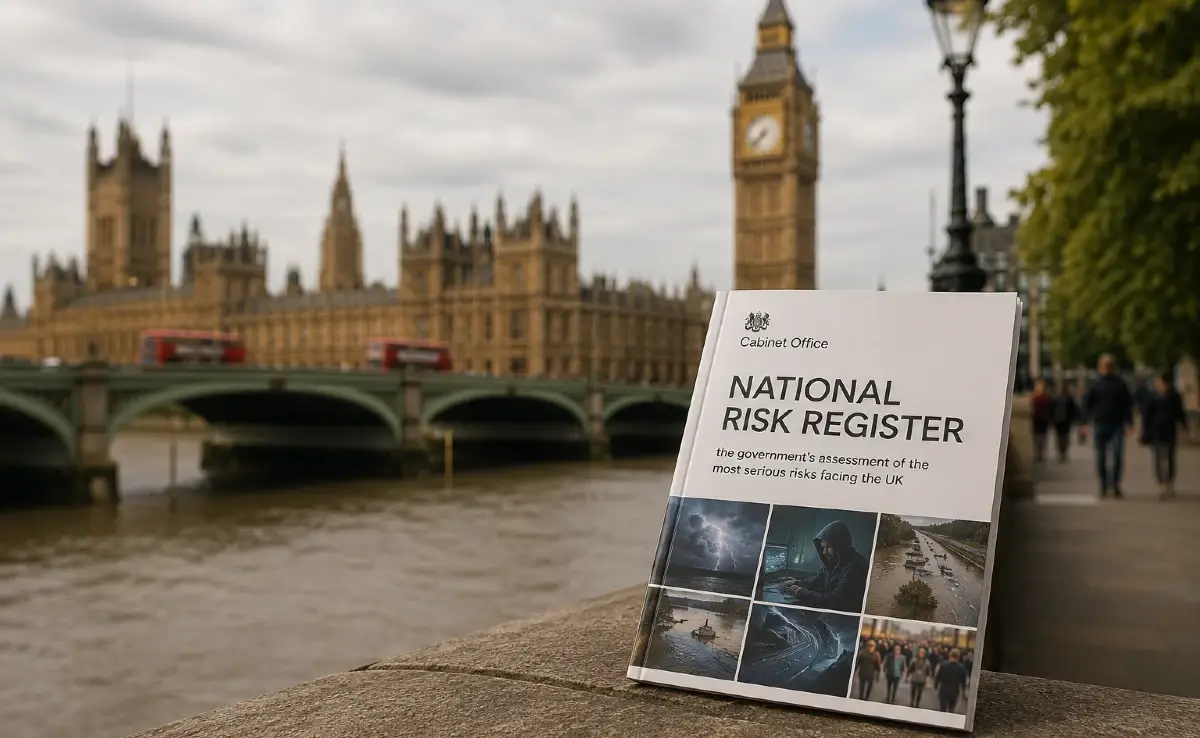
The National Risk Register is the government’s public assessment of the most serious risks facing the UK. It is based on the classified National Security Risk Assessment and is designed to support emergency planning rather than predict future events.
The latest edition reflects developments in technology, national security, infrastructure and climate-related disruption. It was published following record-breaking UK temperatures during May and June and growing concern about the use of artificial intelligence in cyber attacks.
Democratic Interference and Cyber Threats Added
Interference in the UK’s democratic process has been included as a national risk following the announcement of new safeguards covering political finance. These include stronger checks on company donations and a proposed cap on donations originating overseas.
Cyber attacks against data infrastructure, water systems and police services are also among the new entries. The government said the increasing sophistication and availability of artificial intelligence could provide criminals with additional methods of targeting public services and national infrastructure.
- Democratic process: Interference affecting UK elections and political institutions has been added to the register.
- Data infrastructure: Cyber attacks against systems holding or processing information are assessed separately.
- Essential services: Water infrastructure and police systems are included among the newly identified cyber risks.
Changes to the UK Risk Assessment
Seven risks have been added in total, including a category covering digital resilience failure. This addition draws on lessons from the CrowdStrike IT outage in July 2024, which caused disruption across organisations using affected systems.
The threat of disruption to Russian gas supplies has been removed. The government attributed the change to the UK reducing its reliance on Russian gas since the risk was previously assessed.
National Risk Register Changes
| Indicator | Recent Movement | Context |
|---|---|---|
| Democratic interference | Added | Reflects risks to UK democratic processes |
| Digital resilience failure | Added | Draws on the July 2024 IT outage |
| Russian gas disruption | Removed | UK reliance has been reduced |
National Public Resilience Campaign
A national public awareness campaign will be launched later in 2026 to help households prepare for emergencies and disruption. It will cover risks including severe weather, flooding, cyber attacks and interruptions to power, water or mobile phone services.
The campaign will build on guidance already available through GOV.UK Prepare. New resources will also be developed for schools and colleges so that children and young people can learn how to respond safely during emergencies.
- Household planning: People will be encouraged to take simple steps before disruption occurs.
- Public guidance: Advice will cover severe weather, flooding, cyber incidents and service outages.
- Education resources: Schools and colleges will receive materials supporting emergency awareness.
Regional Mayors and Emergency Planning
Regional mayors could receive a broader formal role in local and national emergency planning under proposals being considered by the government. Their responsibilities would operate alongside existing arrangements led through Local Resilience Forums.
The proposals form part of a consultation reviewing the Civil Contingencies Act 2004. The government said the legislation remains broadly fit for purpose, while the review fulfils the requirement for regular examination of the framework.
Home Defence Exercise Planned for 2027
The Home Defence Programme will deliver what the government described as the largest UK home defence exercise in decades. Operation ALBISTON SHADOW is expected to involve ministers and hundreds of officials from government departments and the wider public sector.
The classified multi-day scenario will test preparedness for hybrid attacks against the UK. It will operate alongside NATO’s CMX27 exercise and is intended to test coordination with allies and partners.
The exercise forms part of a wider resilience programme extending through 2026 and 2027. A public preparedness campaign is due later in 2026, Operation ALBISTON SHADOW will test government coordination in 2027, and departments are continuing work to update classified crisis planning documents known as the War Books.
Government Crisis Plans and Biosecurity
Classified government crisis plans commonly known as the War Books are being updated for the first time since 2004. Coordinated by the Cabinet Office, the documents support departmental preparations for threats and emergencies affecting the UK.
The government also reported progress under the 2023 Biological Security Strategy. Departments are expected to complete all medium-term commitments by 2028, including a new Pandemic Preparedness Strategy supported by around £1 billion in health protection measures.
Plans also include a Network of National Biosecurity Centres backed by £1.83 billion. The centres form part of the government’s programme for strengthening national preparedness against biological threats.
Ministerial Comments
Darren Jones, Chief Secretary to the Prime Minister said;
“It is right that we consistently evaluate the risks we could face and plan for what may come. The government will do all it can and we are well prepared, but we can all play our part to keep ourselves and our loved ones safe.”
Louise Sandher-Jones MP, Minister for the Armed Forces said;
“Today’s announcement is a clear demonstration of how we are working across government, with the military, government departments, agencies, and the whole of society, to strengthen Britain’s homeland defence and resilience.”
Professor Dame Angela McLean, Government Chief Scientific Adviser said;
“The science is clear that taking simple, practical steps in advance can strengthen our collective resilience and help keep people safe if disruption occurs.”
Mhairi Sharp, Chief Executive of the National Emergencies Trust said;
“This is a significant opportunity to strengthen preparedness across the country, helping people and communities build the knowledge, confidence and resilience they need to prepare for emergencies before they happen.”
Laura Scott, British Red Cross Director for UK Resilience said;
“We can’t control when emergencies happen, but we can all take some simple steps to be prepared, so that when they do, we are ready to help our friends, families and neighbours.”
The revised National Risk Register expands the UK’s public assessment of threats affecting democracy, infrastructure and digital services. Alongside the updated risk picture, the government is preparing a household awareness campaign, consulting on the role of regional mayors and planning a large-scale defence exercise. Updated crisis documents and biosecurity programmes will support wider preparations across departments, emergency planners and local communities.
Sources: Cabinet Office, Dame Angela Eagle DBE MP, Louise Sandher-Jones MP and The Rt Hon Darren Jones MP.
Prepared by Ivan Alexander Golden, Founder of THX News, an independent news organisation delivering timely insights from global official sources. Combines AI-analysed research with human-edited accuracy and context.