



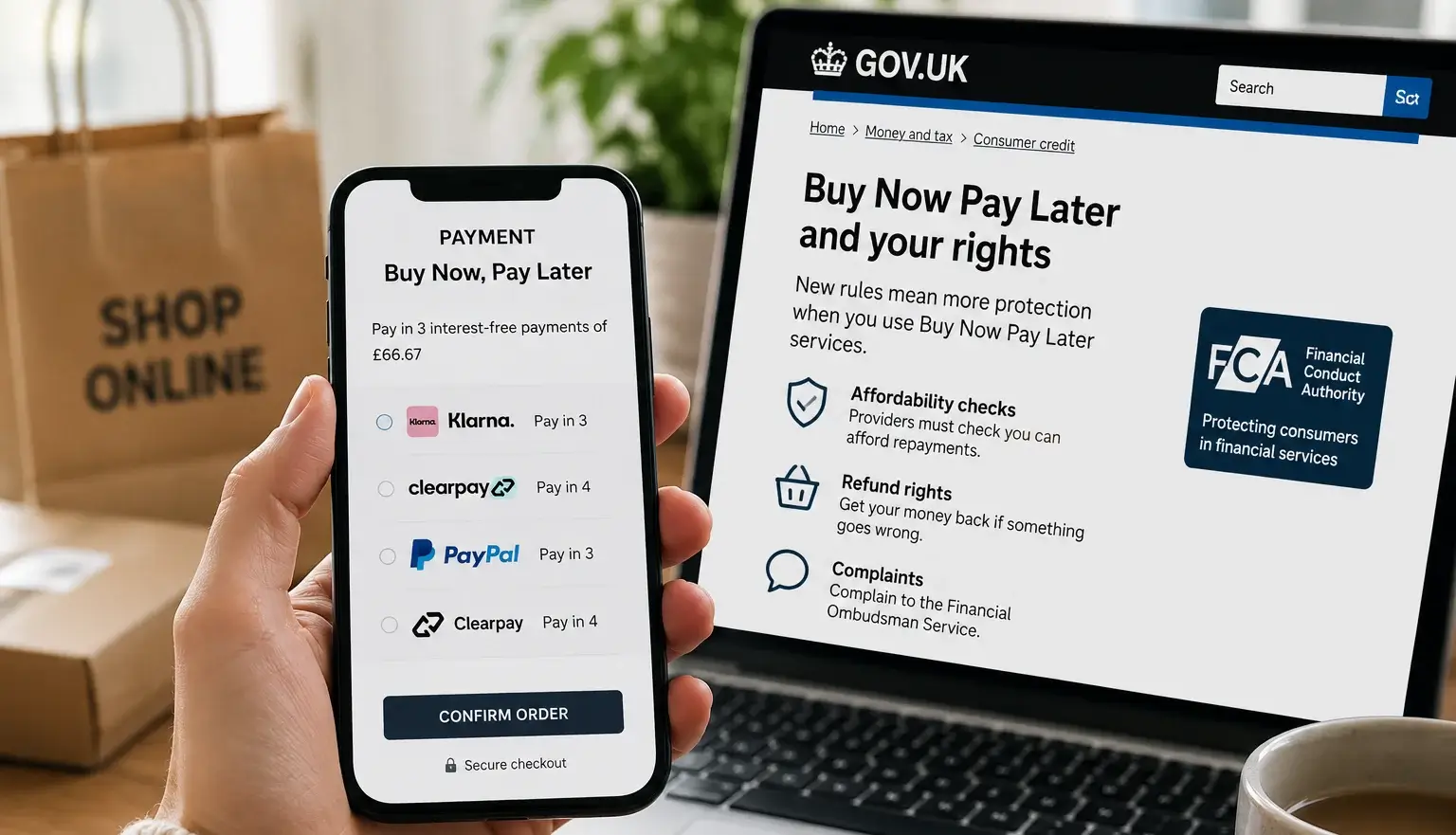
HM Treasury and Economic Secretary Rachel Blake have brought Buy Now Pay Later products under Financial Conduct Authority regulation from 15 July 2026, extending protections to millions of UK shoppers.
The rules apply to services offered by providers including Klarna, PayPal and Clearpay, which allow shoppers to spread purchase costs through interest-free instalments. These products are commonly offered during online checkout and are now regulated alongside other forms of consumer credit.
Providers must assess affordability before offering credit, while customers gain clearer refund rights and access to independent complaints procedures. People experiencing financial difficulty must also be directed towards debt advice and support before debt collection action is pursued.
Buy Now Pay Later Rules Take Effect
The regulations place affected Buy Now Pay Later agreements under FCA supervision. Providers must follow standards covering the sale of credit, information supplied to customers and the treatment of borrowers who encounter repayment problems.
The government said regulation has been designed to preserve quick checkout processes for people who use the products responsibly. The change addresses differences between Buy Now Pay Later agreements and regulated products such as credit cards and personal loans.
- Start date: The rules took effect across the UK on 15 July 2026.
- Regulator: The Financial Conduct Authority now oversees affected providers.
- Coverage: The protections apply to millions of people using instalment-based payment services.
New Regulatory Requirements
| Requirement | Consumer Benefit |
|---|---|
| Affordability checks | Lower risk of unaffordable borrowing |
| Clear checkout information | Better informed decisions |
| Refund rights | Stronger protection |
| Ombudsman access | Independent complaints |
| Debt support | Help before collection |
Stronger Rights for Shoppers
Customers seeking refunds for faulty goods now have enforceable rights more closely aligned with those available through other regulated credit products. The protections give consumers a formal route to challenge providers when a purchase or credit agreement is mishandled.
Users can refer eligible complaints to the independent Financial Ombudsman Service. This can include disputes involving incorrectly recorded credit information or concerns that a product was sold without being properly explained as debt.
Affordability Checks and Debt Support
Buy Now Pay Later firms must examine whether applicants can realistically meet repayments before approving credit. The assessment is intended to reduce cases in which customers accumulate several agreements without being able to manage the combined cost.
Providers must respond differently when a borrower enters financial difficulty. Customers should be directed towards suitable advice and support rather than being transferred immediately to debt collection.
- Repayment assessment: Providers must consider whether proposed instalments are affordable.
- Debt assistance: Struggling borrowers must receive information about available support.
- Complaint rights: Eligible disputes can be taken to the Financial Ombudsman Service.
- Consumer information: Checkout material must make the nature of the borrowing clearer.
Financial Conduct Authority Oversight
The FCA is responsible for supervising the regulated sector and checking that firms meet the new consumer credit standards. Its oversight covers affordability assessments, customer information, complaints and support for borrowers facing payment difficulties.
FCA consumer finance director Alison Walters said the framework would allow people to continue using Buy Now Pay Later while receiving stronger safeguards. The regulator also expects providers to supply the information customers need to make informed borrowing decisions.
Regulation Follows Sector Growth
Buy Now Pay Later use has expanded rapidly, with millions of people incorporating instalment agreements into everyday spending. The government said the services are also widely used by people on lower incomes, increasing the need for consistent consumer protections.
Martin Lewis said the products can help consumers who deliberately choose to spread a one-off cost and understand the agreement. He warned that repeated use can create a collection of debts that becomes unaffordable, particularly where customers do not recognise the product as borrowing.
Which?, StepChange Debt Charity and the Money and Pensions Service welcomed the introduction of stronger safeguards. Their statements emphasised clearer information, careful use of multiple agreements and the need for borrowers to check repayment dates and affordability.
Government Commitment Delivered
The government announced its intention to regulate the sector in October 2024. Legislation was passed in July 2025 to establish the framework and allow the new requirements to take effect in 2026.
HM Treasury said implementation completes its commitment to bring Buy Now Pay Later protections into line with other consumer credit products. The FCA now has responsibility for applying the rules and overseeing provider compliance.
Stakeholder Comments
Ministerial Comments
Rachel Blake, Economic Secretary to the Treasury said;
“We made a clear promise to give consumers the protections they deserve and today we are delivering.
It is not fair that people using these products have had fewer rights than if they had paid by credit card. These new rules protect the consumer — with proper checks before credit is offered, real rights when things go wrong, and support rather than pressure if someone falls into financial difficulty.”
Martin Lewis, Founder of MoneySavingExpert.com said;
“Most people won’t notice any difference. These changes are primarily to ensure BNPL is sold responsibly and that there are protections for when things go wrong, which can be hugely damaging.”
Rocio Concha, Director of Policy and Advocacy at Which? said;
“Regulation should make those decisions easier by ensuring people have clearer information and stronger consumer rights.”
Vikki Brownridge, Chief Executive Officer at StepChange Debt Charity said;
“Bringing BNPL products into line with other consumer credit products is an important step that will give borrowers stronger safeguards and greater confidence.”
Alison Walters, Director of Consumer Finance at the FCA said;
“Consumers will benefit from affordability checks, clearer information, and greater support if they get into difficulty. They’ll also be able to complain to the Financial Ombudsman Service if something goes wrong.”
Lilly Aaron, Senior Policy Manager and Buy Now Pay Later Lead at the Money and Pensions Service said;
“Buy Now Pay Later can be a useful way to manage spending, but it is still a form of borrowing so should be used carefully.”
The new framework brings Buy Now Pay Later agreements within FCA supervision and gives users protections already associated with regulated credit. Providers must assess affordability, explain agreements more clearly and direct customers experiencing financial difficulty towards support before debt collection.
Consumers also gain enforceable refund rights and access to the Financial Ombudsman Service, while firms remain able to offer interest-free instalment products through streamlined checkout processes.
Sources: HM Treasury and Rachel Blake MP.
Prepared by Ivan Alexander Golden, Founder of THX News, an independent news organisation delivering timely insights from global official sources. Combines AI-analysed research with human-edited accuracy and context.