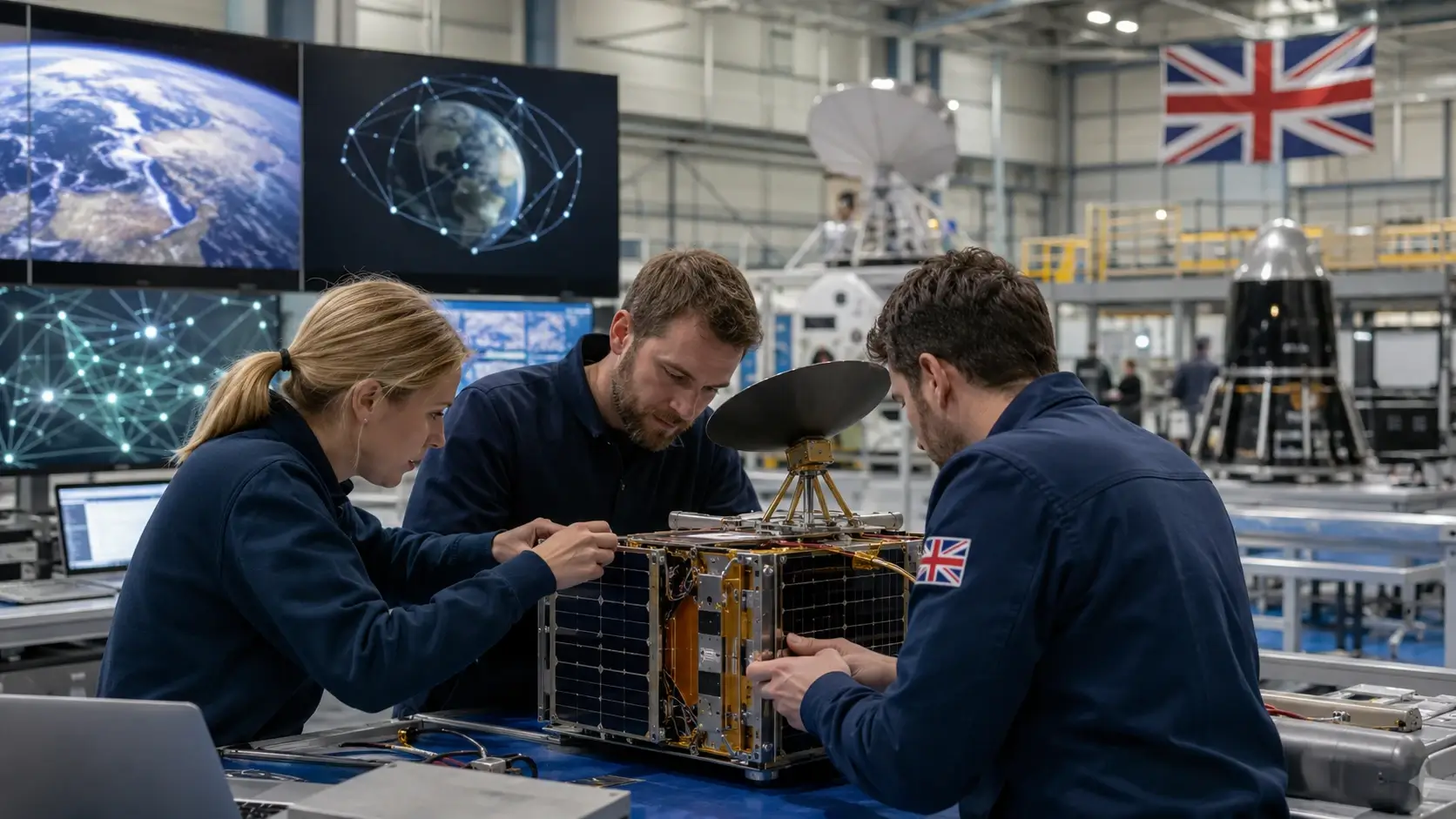
The UK Space Agency and Space Minister Liz Lloyd have announced more than £62 million for British satellite communications and space technology projects. The funding includes £42 million for communications development and £20 million for innovation across businesses, universities and research organisations.
The investment was unveiled on 20 July 2026 at the Farnborough International Airshow. It will support technologies used to provide connectivity, monitor activity in orbit and protect access to space-based services.
Separate government programmes will fund projects ranging from early-stage research to commercial product development. A further infrastructure funding call is also planned for autumn, with grants expected to be awarded through 2030.
Government Announces £62 Million Space Investment
The funding is intended to expand the UK’s domestic ability to design and commercialise space technologies. Ministers said stronger national capability would reduce reliance on overseas systems while supporting economic resilience and national security.
The package brings together two funding programmes administered through the UK Space Agency. Applicants will include established companies, emerging businesses, universities and research organisations working across the national space sector.
- Satellite communications: £42 million will be available through the Connectivity in Low Earth Orbit Programme.
- Space innovation: £20 million will support technology projects through the National Space Innovation Programme.
- Eligible organisations: British businesses, universities and research organisations may seek support.
Satellite Communications Programme Receives £42 Million
The third funding round of the Connectivity in Low Earth Orbit Programme will support the development of new British satellite communications technologies. The government said these systems can provide broadband and mobile connectivity in places where conventional networks are limited or unavailable.
Projects must address at least one of five designated technology areas. The new round will bring the total value of C-LEO funding awarded to UK organisations to as much as £77 million.
The programme covers technologies used within satellites, communication links, network management and ground-based equipment. Funding is open to collaborative development involving industry and academic research organisations.
C-LEO Funding Priorities
| Technology Area | Project Focus | Programme Context |
|---|---|---|
| On-board processing | Satellite data handling | Eligible C-LEO area |
| Active antennas | Communication equipment | Eligible C-LEO area |
| Optical links | Light-based connections | Eligible C-LEO area |
| Networking and routing | Data movement systems | Eligible C-LEO area |
| User terminals | Ground access equipment | Eligible C-LEO area |
Space Innovation Projects Gain £20 Million
The National Space Innovation Programme is opening a £20 million call for projects across UK industry, universities and research organisations. Successful projects are scheduled to begin in April 2027.
Funding will be offered through two application routes designed for different stages of development. Kick Starter will support early ideas, while Major Projects will focus on organisations seeking to expand and commercialise technologies.
Up to 40% of the programme budget will be directed towards Space Domain Awareness and In-Space Assembly and Manufacturing. The government identified both areas as important to understanding activity in orbit and developing products or structures beyond Earth.
- Kick Starter: support for early-stage concepts and initial technology development.
- Major Projects: funding for businesses preparing to grow and commercialise space products.
- Priority capabilities: part of the budget will support orbital monitoring and in-space manufacturing.
Regional Space Infrastructure Funding Planned
The Space Clusters Infrastructure Fund is inviting organisations to register interest before a new funding call opens in autumn. The programme is expected to award £37 million in grants by 2030.
The forthcoming round follows a pilot phase that supported 13 projects across the UK. Funding will be used to develop regional facilities and capabilities that can support local space businesses, researchers and technology programmes.
The UK Space Agency said stronger regional infrastructure would help companies gain access to specialist facilities while expanding domestic capacity. Full application information will be issued when the call formally opens later in 2026.
Accelerator Programme Reports Business Growth
Since launching in 2021, the UK Space Agency’s Accelerator programme has supported 289 founders. Participating businesses have raised £102.2 million in investment, created 209 jobs and recorded an 89% continuing-operation rate.
The programme provides leadership, customer-development and investment support while connecting businesses with investors, commercial partners and regional space networks. The figures provide wider context for the government’s effort to turn early-stage space technologies into commercially sustainable British businesses.
Accelerator Programme Results
| Indicator | Reported Result | Context |
|---|---|---|
| Founders supported | 289 | Since the 2021 launch |
| Investment raised | £102.2 million | Reported by the agency |
| Jobs created | 209 | Across supported businesses |
| Businesses trading | 89% | Still operating after support |
Ministerial Comments
Liz Lloyd, Space Minister said;
“Space is not just a scientific frontier, it is a strategic one. If we do not build national capabilities at home, we become overly dependent on others for technologies we cannot afford to be without.”
“That is why today we are announcing £62 million for satellite communications and space innovation, investing in the British businesses and researchers who will make that capability real.”
The funding package combines communications research, commercial technology development, regional infrastructure and business support. Funding will be awarded through separate UK Space Agency programmes, with innovation projects expected to begin in April 2027 and an infrastructure call due in autumn. The announced measures will provide British organisations with several routes to develop, test and commercialise technologies used across the domestic space sector.
Sources: UK Space Agency and Baroness Lloyd of Effra CBE.
Prepared by Ivan Alexander Golden, Founder of THX News, an independent news organisation delivering timely insights from global official sources. Combines AI-analysed research with human-edited accuracy and context.