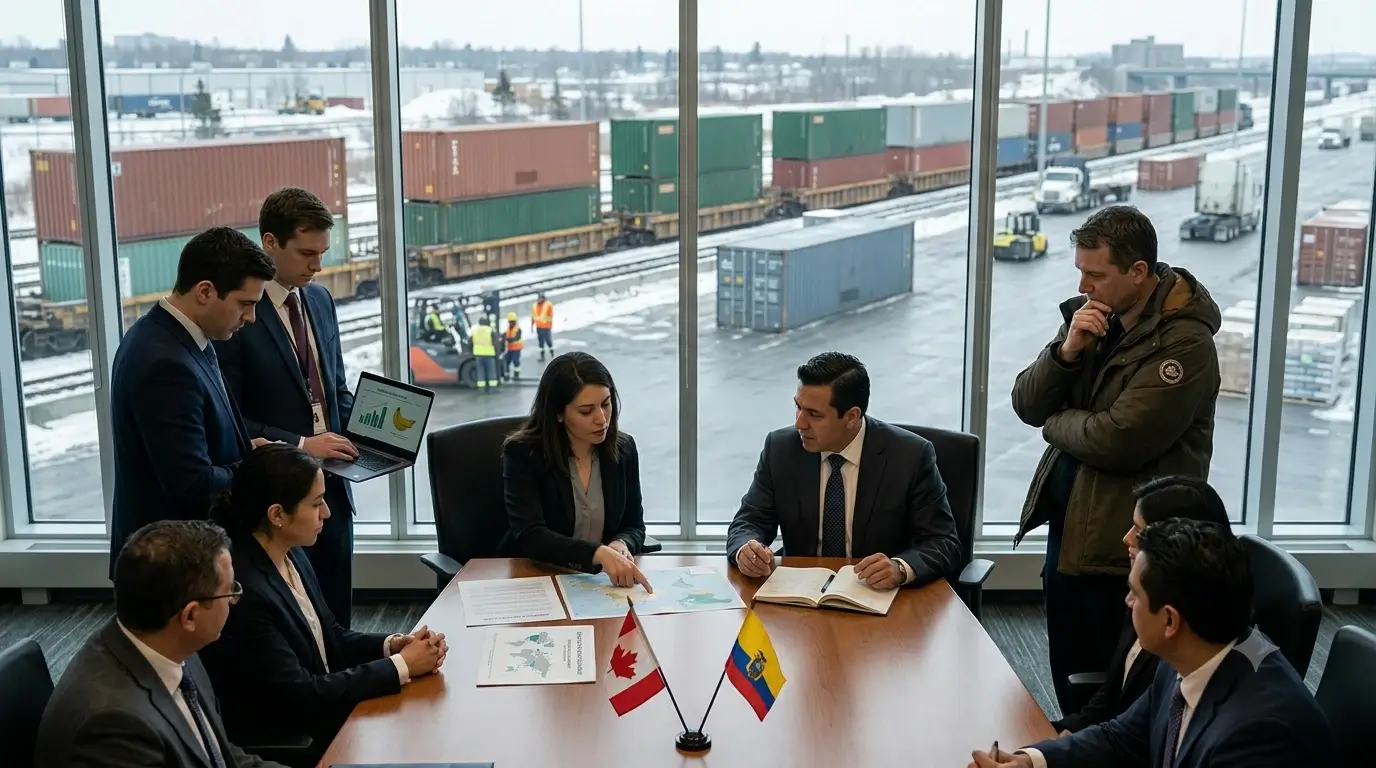
Canada and Ecuador have signed a free trade agreement designed to reduce tariffs, improve market access and create new commercial opportunities in both countries.
The agreement marks another step in Canada’s effort to diversify trade beyond its largest traditional markets as businesses navigate shifting global supply chains and economic uncertainty.
However, the deal will not take effect immediately. Canada and Ecuador must first complete their respective domestic ratification processes before its provisions enter into force.
The agreement was signed in Ottawa by International Trade Minister Maninder Sidhu and Ecuadorian Minister of Production, Foreign Trade and Investments Luis Jaramillo.
The federal government said the deal should support exporters, workers and consumers by removing tariffs and reducing other barriers that can make international trade slower or more expensive.
The agreement aims to reduce tariffs, improve market access and help Canadian businesses diversify into Ecuador, although both governments must complete domestic ratification before the deal can take effect.
Canada and Ecuador Formalize Trade Agreement
The signing follows the conclusion of free trade negotiations in January 2025. Since then, officials from both countries have prepared the negotiated agreement for formal approval and eventual implementation.
Ecuador is Canada’s sixth-largest merchandise trading partner in South America. Two-way merchandise trade reached CAD$2 billion in 2025, representing an increase of 2.9% from the previous year.
Although the bilateral relationship remains smaller than Canada’s trade with its principal global partners, it gives Canadian companies another foothold in a South American market.
Moreover, the agreement supports Ottawa’s broader attempt to spread commercial risk across more countries. For Canadian exporters, having more destinations can provide a measure of stability when demand, tariffs or political conditions change elsewhere.
For businesses already trading with Ecuador, the agreement could lower costs and improve commercial predictability once it enters into force.
Tariff Reduction Targets Export Costs
The central economic feature of the agreement is the reduction or elimination of tariffs on eligible traded goods. By eliminating or lowering duties on traded goods, Canada and Ecuador intend to make each other’s products more competitive.
Canadian exports to Ecuador currently include cereals, mineral fuels and oils, edible vegetables and fertilizers. Therefore, agricultural producers, energy suppliers and other exporters could gain from lower border costs.
Canada, meanwhile, imports cocoa, bananas, shrimp, fresh-cut flowers, petroleum oils and precious metals from Ecuador. Consequently, importers and consumers may also benefit if tariff reductions lower costs or support more reliable supply.
However, lower tariffs do not automatically produce immediate sales. Canadian businesses will still need local knowledge, competitive pricing, dependable logistics and commercial partners to expand successfully in Ecuador.
- Canadian cereals and agricultural products could face lower tariff barriers in the Ecuadorian market.
- Fertilizer, energy and vegetable exporters may face fewer trade-related costs.
- Ecuadorian food and agricultural products could become more competitive in Canada.
- Reduced barriers may encourage smaller businesses to explore bilateral trade opportunities.
CAD$2 Billion Trading Relationship Offers Room to Grow
Canada and Ecuador recorded CAD$2 billion in two-way merchandise trade during 2025. While this represents established commercial activity, the federal government believes the agreement can generate additional long-term growth.
The countries have complementary trading profiles. Canada supplies products such as cereals, fertilizers and mineral-related goods, while Ecuador exports tropical agricultural goods, seafood, flowers and natural resources.
As a result, the deal is not solely about competition between similar industries. Instead, it may allow both economies to build on existing supply relationships and serve demand that domestic producers cannot always meet.
For middle-class Canadians, the effects may appear gradually rather than arriving as a dramatic change at the checkout. Trade agreements generally influence supply chains, investment decisions and business planning over several years.
Nevertheless, more stable access to goods can matter. More diversified supply relationships may help businesses manage disruptions affecting transportation, production or international trade.
Canada-Ecuador Trade Snapshot
| Trade Measure | Current Position |
|---|---|
| Agreement signed | July 24, 2026 |
| Signing location | Ottawa, Ontario |
| Two-way merchandise trade | CAD$2 billion in 2025 |
| Merchandise trade growth | 2.9% year over year |
| Ecuador’s regional position | Canada’s sixth-largest merchandise trading partner in South America |
| Next procedural step | Domestic ratification in both countries |
Agreement Expands Canada’s Pacific Coast Trade Network
Once the agreement enters into force, Canada will have trade agreements with every country along South America’s Pacific coast. That gives Canadian companies a wider network of preferential markets across the region.
The development may be particularly useful for businesses seeking alternatives to familiar export destinations. Although entering a new market takes time and resources, trade agreements can make the process less daunting by establishing clearer rules and reducing border costs.
Furthermore, the agreement may support companies that already operate across several Latin American countries. A broader network of trade arrangements can help those firms coordinate production, distribution and investment more efficiently.
The federal government expects the agreement to generate opportunities for Canadian workers and businesses. Still, the benefits will depend on whether companies can convert formal market access into actual contracts and sustained sales.
- Exporters will need to assess demand, regulations and distribution options in Ecuador.
- Small and medium-sized firms may require financing and market intelligence before expanding.
- Reliable shipping and customs processes will remain important after tariffs decline.
- Businesses must wait for ratification before relying on the agreement’s final trade preferences.
Trade Diversification Shapes Ottawa’s Strategy
Canada has long depended heavily on a limited number of major trading partners. Therefore, successive federal governments have pursued agreements intended to open additional markets and make the economy more resilient.
The Canada-Ecuador Free Trade Agreement fits that strategy. It adds a new bilateral framework in South America while reinforcing Canada’s trade links along South America’s Pacific coast.
International Trade Minister Maninder Sidhu described the signing as an important chapter in the countries’ partnership.
Maninder Sidhu, Minister of International Trade, said:
“This FTA will significantly increase Canadian exports to Ecuador, creating new opportunities for our businesses and workers. By advancing agreements with partners like Ecuador, we are diversifying our trading relationships while building a stronger and more resilient economy.”
The government’s forecast reflects the usual purpose of a free trade agreement: lower barriers, encourage investment and give exporters a more predictable operating environment.
However, broader economic conditions will also shape the results. Currency movements, transportation costs, consumer demand and political stability can all influence whether trade grows after an agreement takes effect.
Ratification Must Precede Implementation
The signing is a major procedural milestone, but it does not complete the process. Canada and Ecuador must now undertake the domestic steps required to ratify the agreement.
In Canada, that process normally includes parliamentary review and implementing legislation where legal changes are required. Ecuador must also complete its own constitutional and legislative procedures.
Accordingly, businesses should not assume that reduced tariffs apply from the signing date. The existing trade rules will remain in place until both governments finish ratification and formally bring the agreement into force.
The governments have said they want to complete those procedures as soon as possible. Even so, no specific implementation date was included in the July 24 announcement.
That distinction matters for importers and exporters planning shipments or pricing agreements. Companies will need to monitor official notices and confirm when new tariff treatments become available.
The Canada-Ecuador Free Trade Agreement gives both countries a framework for expanding merchandise trade and investment. For Canada, it also advances a wider effort to build commercial relationships beyond its largest established partners.
Still, the real economic impact will emerge only after ratification and implementation. Canadian businesses will then need to decide whether trade opportunities in Ecuador justify the cost of entering or expanding within the market.
For consumers, any changes will likely be gradual and product-specific. For exporters, however, lower tariffs and clearer trading conditions could provide a useful opening in a region where Canada continues to deepen its commercial presence.
Ultimately, the agreement adds another instrument to Canada’s trade-diversification strategy. Whether it delivers substantial growth will depend on how quickly it takes effect and how confidently Canadian and Ecuadorian businesses use the access it provides.
Sources: Global Affairs Canada, “Canada and Ecuador sign a free trade agreement,” published July 24, 2026; Government of Canada summary of negotiated outcomes for the Canada-Ecuador Free Trade Agreement.
Prepared by Ivan Alexander Golden, Founder of THX News, an independent news organization delivering timely insights from global official sources. Research combines AI-assisted analysis with human-edited accuracy and context.