
The Foreign, Commonwealth & Development Office and Foreign Secretary Yvette Cooper have completed a three-day visit to China and India, covering UK security, maritime resilience, Ukraine, artificial intelligence and supply chains.
The visit concluded on 6 June 2026 and included engagements in Beijing, Shenzhen and New Delhi. Meetings were held with senior Chinese and Indian leaders, including Vice President Han Zheng, Foreign Minister Wang Yi, Prime Minister Narendra Modi and External Affairs Minister Dr S Jaishankar.
The programme included discussions on Ukraine, Iran, maritime security, artificial intelligence, health innovation and critical minerals supply chains. It also resulted in new UK-India initiatives on maritime security and critical minerals monitoring.
Foreign Secretary Concludes China And India Visit
Yvette Cooper used the visit to strengthen UK engagement with two major world powers. The Foreign, Commonwealth & Development Office said the agenda focused on issues affecting security, growth and international stability.
The Foreign Secretary set out the UK position that engagement with major partners is needed even where there are areas of disagreement. The visit was framed around cooperation where interests overlap and direct challenge where the UK takes a different position.
- Locations: the programme included Beijing, Shenzhen and New Delhi across the three-day visit.
- Participants: meetings included senior Chinese and Indian political leaders and ministers.
- Policy areas: discussions covered maritime security, Ukraine, Iran, AI safety, health innovation and supply chains.
China Meetings Focus On Security And Stability
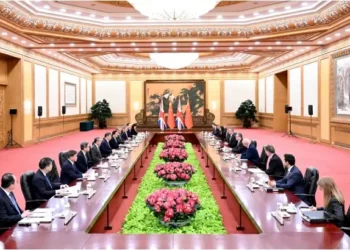
In Beijing, the Foreign Secretary met Vice President Han Zheng and Foreign Minister Wang Yi. The discussions covered global security and economic stability at a time of heightened geopolitical tension.
The Foreign Secretary raised the Strait of Hormuz, Iran, Ukraine and wider Middle East stability during the China meetings. She urged China to end economic support for Russia’s illegal war and called for an immediate ceasefire in Ukraine.
The talks also covered Sudan and international support for the response to the Ebola outbreak in the Democratic Republic of the Congo. The Foreign, Commonwealth & Development Office said these issues formed part of wider discussions on international stability.
China Visit Discussion Areas
| Indicator | Recent Movement | Context |
|---|---|---|
| Senior meetings | Held in Beijing | The Foreign Secretary met Vice President Han Zheng and Foreign Minister Wang Yi, according to the Foreign, Commonwealth & Development Office. |
| Strait of Hormuz | Raised in talks | The Foreign Secretary stressed reopening the route without tolls or charges during China discussions. |
| Ukraine | Ceasefire urged | Yvette Cooper called for an immediate ceasefire and urged China to end economic support for Russia’s illegal war. |
| Health security | Ebola response discussed | The department said coordinated international support for the outbreak in the Democratic Republic of the Congo was discussed. |
UK Health And Technology Links In China
During the China leg, the UK announced a partnership between Prudential plc and the National Innovation Centre for Ageing. The collaboration will launch local healthy ageing hubs across China and support commercial opportunities for British healthcare and life sciences businesses.
In Shenzhen, the Foreign Secretary met senior business leaders, investors and technology companies. The programme included discussion of AI, robotics and the need for international cooperation on AI safety and security as technology develops.
India Talks Cover Maritime Security And Growth
In New Delhi, the Foreign Secretary met Prime Minister Narendra Modi and External Affairs Minister Dr S Jaishankar. The talks built on the strategic direction for deeper cooperation under Vision 2035.
The India discussions focused on maritime security, growth and protecting supply chains from global economic shocks. The Foreign Secretary also raised the Strait of Hormuz and the impact its closure is having on international shipping.
- Maritime cooperation: the visit included work with India on shipping resilience and security coordination.
- Economic resilience: talks covered supply chains and exposure to global shocks.
- Technology security: the programme linked UK-India cooperation with minerals monitoring and data-led supply chain insight.
Regional Maritime Security Centre Of Excellence
The Foreign Secretary co-launched a new Regional Maritime Security Centre of Excellence with India. The centre is intended to strengthen UK-India cooperation on maritime security and resilience to international shocks.
Critical Minerals And Supply Chain Resilience
Critical minerals formed a major part of the Foreign Secretary’s discussions with Indian interlocutors. The Foreign, Commonwealth & Development Office said these minerals are needed for products including electric vehicles, wind turbines and smart phones.
During a meeting with G. Kishan Reddy, India’s Minister for Coal and Mines, the Foreign Secretary launched the Critical Minerals Global Supply Chain Observatory. The department said the observatory is a flagship part of the UK-India Technology Security Initiative and provides an AI tool for information on global mineral flows and supply chain vulnerabilities.
India Visit Supply Chain Measures
| Indicator | Recent Movement | Context |
|---|---|---|
| Maritime centre | Co-launched | The Regional Maritime Security Centre of Excellence was launched as part of UK-India maritime cooperation. |
| Critical minerals observatory | Launched during visit | The Foreign Secretary launched the Global Supply Chain Observatory during talks with India’s Minister for Coal and Mines. |
| Technology Security Initiative | Observatory included | The department described the observatory as a flagship component of the UK-India Technology Security Initiative. |
| Satellite campus | £1.2 million committed | India will fund a satellite observatory campus at the Indian Institute of Technology in Dhanbad with the University of Cambridge. |
Critical Minerals Observatory Funding
India will commit £1.2 million to establish a satellite observatory campus at the Indian Institute of Technology in Dhanbad. The campus will be developed with the University of Cambridge as part of the wider Global Supply Chain Observatory work.
Security And Technology Cooperation Expanded
The visit produced new UK-India initiatives focused on maritime security and critical minerals resilience. Officials highlighted the launch of the Regional Maritime Security Centre of Excellence and the Critical Minerals Global Supply Chain Observatory as the principal operational outcomes of the programme.
The Foreign, Commonwealth & Development Office said the initiatives are intended to improve maritime resilience, strengthen monitoring of critical mineral supply chains and support cooperation on emerging technologies linked to economic and national security.
Stakeholder Comments
Ministerial Comments
Yvette Cooper, Foreign Secretary said;
“We are strengthening our economic partnerships, and we’re also strengthening our security partnerships; on maritime security, and on AI security. We are doing a lot of joint work together because they’re the biggest powers in the world – the UK has to engage with the biggest powers.”
The visit brought together UK discussions with China and India on security, economic resilience, technology and supply chains. It included senior political meetings, new maritime cooperation with India, health innovation activity in China and a minerals observatory linked to UK-India technology security. The Foreign, Commonwealth & Development Office presented the programme as part of direct engagement with major global powers.
Sources: Foreign, Commonwealth & Development Office and The Rt Hon Yvette Cooper MP.
Prepared by Ivan Alexander Golden, Founder of THX News, an independent news organisation delivering timely insights from global official sources. Combines AI-analysed research with human-edited accuracy and context.