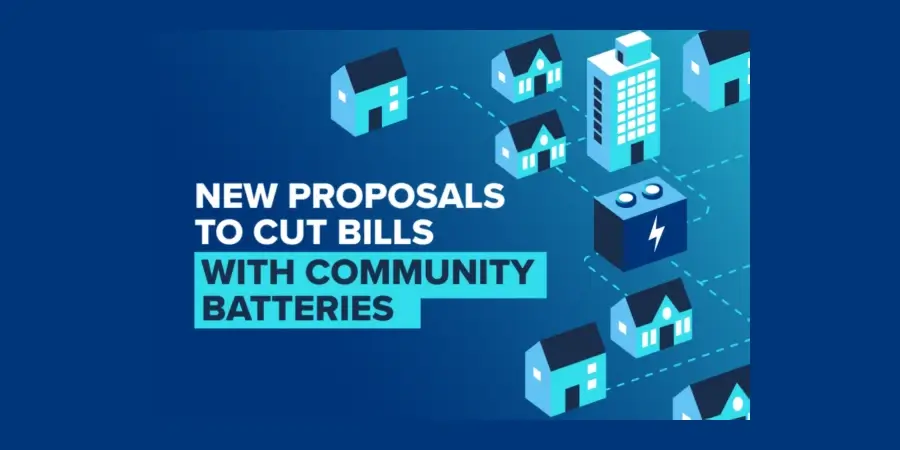
The Department for Energy Security and Net Zero and Energy Minister Michael Shanks have launched a call for evidence on community batteries, published on 4 June 2026, to explore how shared storage could help families and businesses cut energy bills.
The proposals apply across the UK and focus on shared battery storage that can be used by multiple homes, including renters and people living in flats. The call for evidence will gather views on how community batteries could be deployed more widely and safely.
The government said the UK market for community batteries is currently underdeveloped. The evidence process will examine regulatory and commercial barriers, safety considerations and how savings from locally generated clean electricity can reach more households.
Government Launches Community Batteries Evidence Call
The Department for Energy Security and Net Zero said the call for evidence will look at how community batteries can be rolled out to support working people. The proposals form part of the government’s wider investment in community energy and locally owned clean power projects.
Community batteries allow shared access to stored electricity, including power generated locally from renewable sources. The government said this could help communities use cheaper electricity when demand is high and reduce exposure to volatile fossil fuel markets.
- Evidence scope: the call will gather views on deployment, regulation, commercial barriers, safety and access for households unable to install their own batteries.
- Community access: the proposals include renters, people living in flats, families and businesses that could benefit from shared storage.
How Community Batteries Could Cut Bills
Community batteries store electricity when it is cheaper and more abundant, then release it when demand is higher. The press release said this could help households make better use of clean electricity and lower bills.
The approach could also support homes that do not have space, ownership rights or suitable property conditions for individual battery storage. The government said shared storage could pass savings from locally generated renewable electricity to a wider group of residents.
Community Energy And Local Ownership
The government said community batteries could put ownership of clean power into the hands of local people. It described the proposals as part of a broader drive to support locally owned clean energy generation, including solar on libraries, leisure centres and community buildings.
Local ownership forms part of the government’s wider community energy strategy. The proposals envisage community batteries being linked to locally generated renewable electricity, allowing participating households and organisations to store and use energy produced within their area.
- Local generation: community batteries could store electricity from nearby renewable projects, including solar power generated during the day.
- System flexibility: stored electricity could be released at higher-demand times, supporting a more flexible electricity network.
Community Battery Benefits
| Indicator | Recent Movement | Context |
|---|---|---|
| Household access | Proposals include shared storage | The Department for Energy Security and Net Zero said multiple homes could access stored electricity through community batteries. |
| Bill savings | Cheaper electricity could be stored | The press release said batteries could store renewable electricity when it is cheaper and use it when demand is higher. |
| Renter support | Access could widen | The call for evidence will consider how benefits reach renters and people living in flats. |
| Local ownership | Community energy focus | The government said local ownership could help communities retain value from clean power projects. |
Wider Clean Power Policy Context
The announcement sits alongside government plans for new homes to be cheaper to run, with solar panels and clean heating as standard. The press release also said plans to make plug-in solar available in stores within months are progressing.
Community batteries are presented as one part of a more flexible energy system. The government said countries including Australia already use community batteries at scale to help neighbourhoods store excess solar power and share benefits more widely.
Ministerial Comments
Michael Shanks, Energy Minister said;
“If households are going to feel the full benefit of clean power, we need a more flexible energy system – and community batteries can help deliver it, giving renters and people living in flats the chance to store cheaper renewable electricity and cut their bills.”
“This is about putting power back into the hands of local people and ending our reliance on fossil fuel markets driving the affordability crisis – helping communities take control of their energy, build local wealth and restore pride in place.”
Case Studies Show Existing Community Battery Models
The press release included examples from Bridport in Dorset and Brixton in south London. Both projects used shared or local energy systems to help residents access locally generated electricity and reduce costs.
In Bridport, a 54-home net zero development used a local microgrid combining rooftop solar, battery storage, EV charging and wind power. The government said the system reduced energy costs by the equivalent of around £1,300 per home per year.
At Elmore House in Brixton, a community battery was installed alongside existing solar panels at a Lambeth Council-owned block of flats. During the trial, participating households received savings through solar generation, battery use and flexibility payments, equivalent to around £180 per year.
Community Battery Case Studies
| Indicator | Recent Movement | Context |
|---|---|---|
| Bridport Cohousing | 54-home development delivered in 2023 | The press release said the Dorset project used a microgrid with solar, battery storage, EV charging and wind power. |
| Bridport savings | Around £1,300 per home per year | The government said lower electricity imports and export revenues reduced energy costs by that equivalent amount. |
| Elmore House | Battery installed in 2021 | The Brixton project combined solar generation and battery storage at a Lambeth Council-owned block of flats. |
| Elmore House savings | Around £180 per year | The press release said participating households received savings through solar generation, battery use and flexibility payments. |
The call for evidence will assess how community batteries could be deployed more widely across the UK while addressing safety, regulatory and commercial barriers. The proposals focus on expanding access to shared energy storage, particularly for renters and households unable to install their own battery systems.
Sources: Department for Energy Security and Net Zero, Michael Shanks MP.
Prepared by Ivan Alexander Golden, Founder of THX News, an independent news organisation delivering timely insights from global official sources. Combines AI-analysed research with human-edited accuracy and context.