The Department for Work and Pensions and Department for Education have published a baseline report setting out how progress under the UK Child Poverty Strategy will be monitored over the next ten years using a 2024/25 baseline.
The report was published on 9 July 2026 and covers the Government’s approach to measuring reductions in child poverty across the UK. It follows the publication of the Child Poverty Strategy in December 2025 and sets out how evidence will be gathered over time.
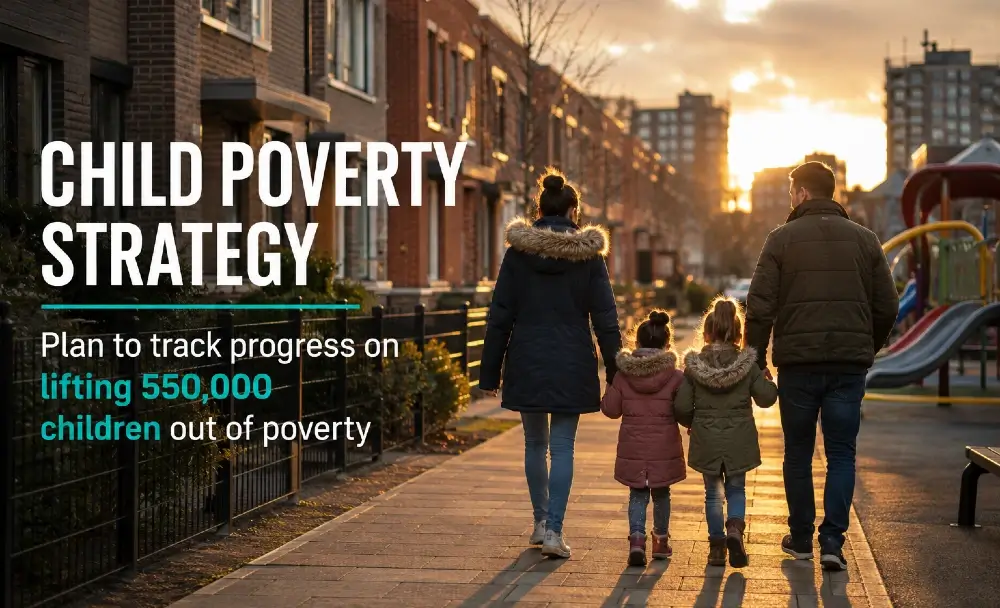
The Child Poverty Strategy baseline report also explains how early measures will be assessed, including the removal of the two-child limit, wider free school meals and the £1 billion Crisis and Resilience Fund. Ministers said the measures are expected to lift around 550,000 children out of poverty by the end of this Parliament.
Child Poverty Strategy Baseline Report Sets Out Tracking Plan
The Child Poverty Strategy baseline report establishes the 2024/25 baseline against which progress will be measured throughout the Government’s ten-year strategy.
Annual reporting is intended to provide transparency on whether action is reducing poverty and improving family circumstances. The report also sets out how statistical evidence, policy evaluation and lived experience research will be used together.
- Baseline year: 2024/25 is used as the starting position.
- Reporting cycle: annual updates will track progress over time.
- Strategy period: the programme covers a ten-year mission.
Early Measures Aim To Reduce Child Poverty
The Government has identified several early actions already in motion. These include scrapping the two-child limit, expanding free school meals from September 2026 and launching the Crisis and Resilience Fund.
The report states that these measures are expected to lift around 550,000 children out of poverty by the end of this Parliament. The final statistics showing the number of people affected by the two-child limit were published the day before the baseline report.
Early Child Poverty Measures
| Measure | Timing | Context |
|---|---|---|
| Two-child limit | Being scrapped | Named as early action |
| Free school meals | From September 2026 | Expansion planned |
| Crisis Fund | £1 billion | Supports resilience |
Child Poverty Strategy Progress Will Be Measured Over Ten Years
Progress will be assessed against two headline metrics: relative low income after housing costs and deep material poverty. Deep material poverty is defined in the report as lacking at least four of 13 essential material deprivation items.
The monitoring programme will include a new four-year study of parents and carers in or near poverty. It will examine how family circumstances, incomes, sources of support and experience of the strategy change over time.
- Family research: a four-year study will follow parents and carers.
- Lived experience: children, young people and families will remain part of the process.
- Policy evaluation: departments will assess how actions affect poverty drivers.
Headline Poverty Metrics
| Metric | Measure | Purpose |
|---|---|---|
| Relative low income | After housing costs | Tracks household income |
| Deep material poverty | Four of 13 items | Tracks deprivation |
Cross-Government Work Will Support Delivery
The report says delivery will require action across departments and levels of government. A new Interministerial Group on child poverty will provide cross-government support as the strategy moves into implementation.
The UK Government said it will continue working with devolved governments, regional and local partners, civil society, business, faith groups and people with lived experience of poverty. The strategy is UK-wide, while powers to tackle child poverty vary across Scotland, Wales and Northern Ireland.
Child Poverty Strategy Links Poverty to Housing, Education and Employment
The Child Poverty Strategy brings together actions across housing, employment, education and cost of living. The report states that no single measure alone will end child poverty, so progress will be considered across a wider set of policy areas.
It also sets out a place-based focus across England, with local areas expected to strengthen anti-poverty work and support families where they live. The Government said children, young people and families will remain central to the strategy during delivery.
Government Response
Pat McFadden, Work and Pensions Secretary said;
“Tackling child poverty is one of the most important things this Government can do, giving the next generation their best chance of secure jobs and healthier lives.”
“This baseline report shows we are taking a serious, evidence-led approach to tackling child poverty, driving forward the change that gives every child the security and opportunity to thrive.”
Bridget Phillipson, Education Secretary said;
“I understand the very real hardship families face when money is tight – and the pain of wanting to give your child every opportunity to succeed, while struggling just to get by.”
“This report sets out how we will measure the impact of that support and hold ourselves accountable, so that every child, whatever their background, has the foundation they need to flourish.”
The Child Poverty Strategy baseline report establishes the Government’s starting point for measuring progress against its ten-year child poverty mission. It combines annual reporting, long-term research and policy evaluation to assess whether measures such as ending the two-child limit, expanding free school meals and wider anti-poverty reforms reduce child poverty over time.
Sources: Department for Work and Pensions and Department for Education, Work and Pensions Secretary Pat McFadden, Education Secretary Bridget Phillipson.
Prepared by Ivan Alexander Golden, Founder of THX News, an independent news organisation delivering timely insights from global official sources. Combines AI-analysed research with human-edited accuracy and context.