



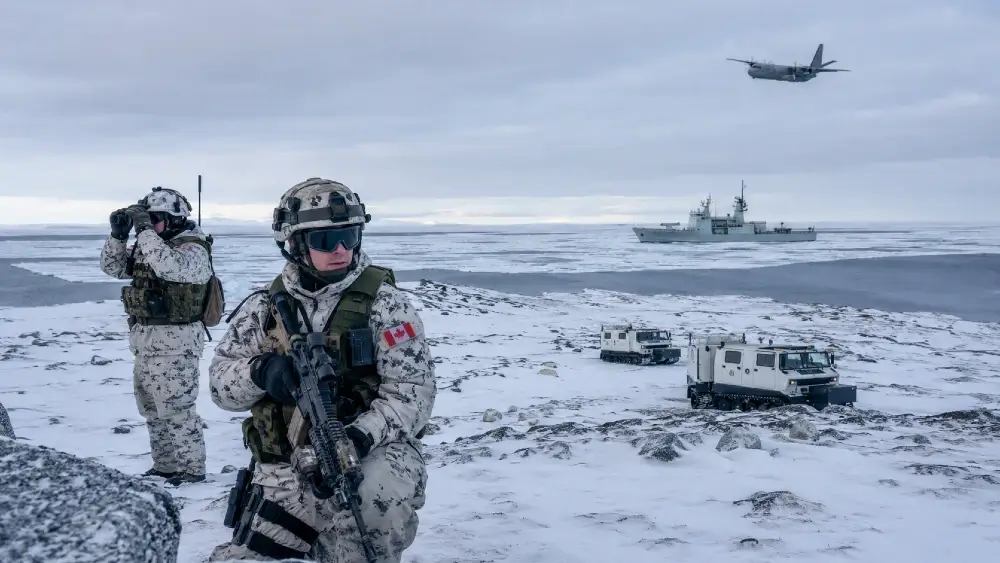
Prime Minister Mark Carney used the 2026 NATO Summit in Ankara to announce new Canadian defence partnerships, procurement moves and expanded support for Ukraine.
The package links Arctic security, NATO Eastern Flank commitments, defence procurement and military assistance for Ukraine within a broader effort to strengthen Canada’s role in the Alliance.
Canada Expands Defence Role at NATO Summit
Canada entered the Ankara summit with a clear message: the country intends to take a larger role in defending North America, supporting Allies and strengthening NATO’s long-term security base.
Accordingly, the Prime Minister highlighted Canada’s plan to meet NATO’s target of investing 5% of GDP in defence by 2035. The government also pointed to major capability areas, including submarines, icebreakers, aircraft, missiles and cyber defences.
This is not a small adjustment around the edges. Rather, the announcement presents Canada’s defence policy as a generational shift, with the Arctic, NATO’s Eastern Flank and Ukraine all treated as connected priorities.
New Defence Partnerships and Procurement
The summit included several procurement decisions and defence partnerships intended to strengthen Canadian and Allied military capability.
First, Canada reached an agreement-in-principle with Telesat for the ESCP-P program, using Telesat Lightspeed to provide sovereign, reliable and continuous military satellite communications in the Arctic. The government said this is expected to result in a multi-billion-dollar investment in Canada’s defence sector.
In addition, Canada announced an approximately $800 million contract with Norwegian company Kongsberg Defence and Aerospace to procure Joint Strike Missiles. These long-range missiles are expected to be integrated into future fighter aircraft for the Royal Canadian Air Force.
Meanwhile, Ottawa also updated the procurement strategy for the Light Utility Vehicle project. The tender will be immediately limited to two Canadian defence industry suppliers to deliver 1,600 to 2,100 vehicles and 400 to 500 light utility trailers for the militarised portion of the Canadian Armed Forces’ fleet.
For Canadians, the key point is that defence partnerships are being tied directly to domestic industry, Arctic capability and NATO readiness.
Major Summit Announcements
| Area | Announcement | Strategic Purpose |
|---|---|---|
| Arctic security | Telesat Lightspeed agreement-in-principle | Sovereign military satellite communications |
| Air capability | Joint Strike Missile procurement | Long-range missile capability for future fighters |
| Army mobility | Light Utility Vehicle procurement update | Canadian supply and fleet renewal |
| NATO innovation | Talks to join NATO Innovation Sub-Fund | Access to capital and advanced technology networks |
Innovation, Industry and Trade Links
Beyond immediate defence procurement, Canada also moved to strengthen its place in NATO’s industrial and innovation networks.
Canada agreed to open technical negotiations to join the NATO Innovation Sub-Fund. The fund is intended to support emerging and advanced technologies important to NATO defence and security, while giving Canadian innovators access to capital, strategic networks and transatlantic markets.
Furthermore, Canada will host the 2027 NATO Industry Forum. That event is expected to focus on cooperation between Allies and industry, including defence innovation and industrial capacity.
The Prime Minister also announced new economic negotiations with Germany and Türkiye. Canada and Germany will begin talks on a Strategic Partnership Agreement covering security and defence, technology, investment, supply chains, raw materials, energy and space. Canada and Türkiye will also launch negotiations on a comprehensive free trade agreement.
These trade measures matter because defence policy increasingly depends on supply chains, industrial depth and trusted partnerships. Modern defence capability increasingly depends on resilient industrial supply chains, advanced manufacturing and trusted international partnerships.
Operation REASSURANCE Extended to 2031
Canada also announced a major extension of Operation REASSURANCE, the Canadian-led mission supporting NATO deterrence on the Eastern Flank.
The mission will now continue until 2031. Moreover, Canada plans to increase its persistently deployed personnel to up to 2,600.
The government described Operation REASSURANCE as Canada’s largest overseas mission. It was launched in 2014 after Russia’s initial invasion of Ukraine and remains central to Canada’s contribution to NATO deterrence in Europe.
In another significant move, Canada will join Latvia and Denmark as the third Framework Nation of Multinational Division North. As a result, Canada will take on greater responsibility for protecting NATO’s Eastern Flank.
Ukraine Support and Defence Financing
Ukraine support also remained a central part of Canada’s summit announcements.
Prime Minister Carney announced that part of Canada’s previously announced approximately $2 billion in military assistance for Ukraine will be directed toward urgent and critical requirements.
This includes $475 million for ammunition, with $75 million to deliver extended-range rounds through the Czech Ammunition Initiative and $400 million to source more than 39 million rounds of various calibre ammunition from Canadian industry.
Additionally, nearly $400 million will support 35 Canadian-made armoured combat support vehicles for Ukrainian frontline combat units. Canada will also provide $50 million for critical information technology and engineering equipment.
Since 2022, Canada has committed more than $25.5 billion in multifaceted assistance to Ukraine, including more than $8.5 billion in military assistance.
Defence, Security and Resilience Bank
The Prime Minister also welcomed support from eight countries for the Defence, Security and Resilience Bank.
Canada is helping lead the establishment of the new multilateral financial institution. The bank is intended to mobilise and deploy private capital quickly for defence, security and resilience initiatives.
As the future host of its headquarters, Canada expects the bank to provide long-term, low-cost financing across defence supply chains. The government also said it could help small and medium-sized enterprises address financing gaps.
Therefore, the announcement connects defence readiness with industrial growth, jobs and emerging sectors such as AI, quantum, space and cyber.
Arctic Security Remains Central
Arctic security runs through the full announcement.
Canada said it is focused on taking full responsibility for the security of its Arctic as threats to North America evolve. The government also pointed to more than $40 billion in investments to defend, build and transform Northern and Arctic regions.
The Telesat agreement, icebreaker investments, submarine plans and radar projects all sit within this larger Arctic security frame.
For many Canadians, this reflects a practical reality. The Arctic is not a distant map feature. It is a strategic region tied to sovereignty, defence, climate, infrastructure and Canada’s place in the world.
Canada’s 2026 NATO Summit announcements place defence partnerships, Arctic security, Ukraine support and industrial capacity at the centre of a broader shift in national security policy.
The measures combine new procurement, industrial cooperation, Arctic capability and expanded NATO commitments into a single long-term defence strategy. Their success will depend on implementation over the coming years, including delivery of new equipment, industrial investment and Canada’s expanded Alliance commitments through 2031.
Sources: Government of Canada press release, “Prime Minister Carney secures new defence partnerships at the 2026 NATO Summit.”
Prepared by Ivan Alexander Golden, Founder of THX News, an independent news organization delivering timely insights from global official sources. Research combines AI-assisted analysis with human-edited accuracy and context.


