
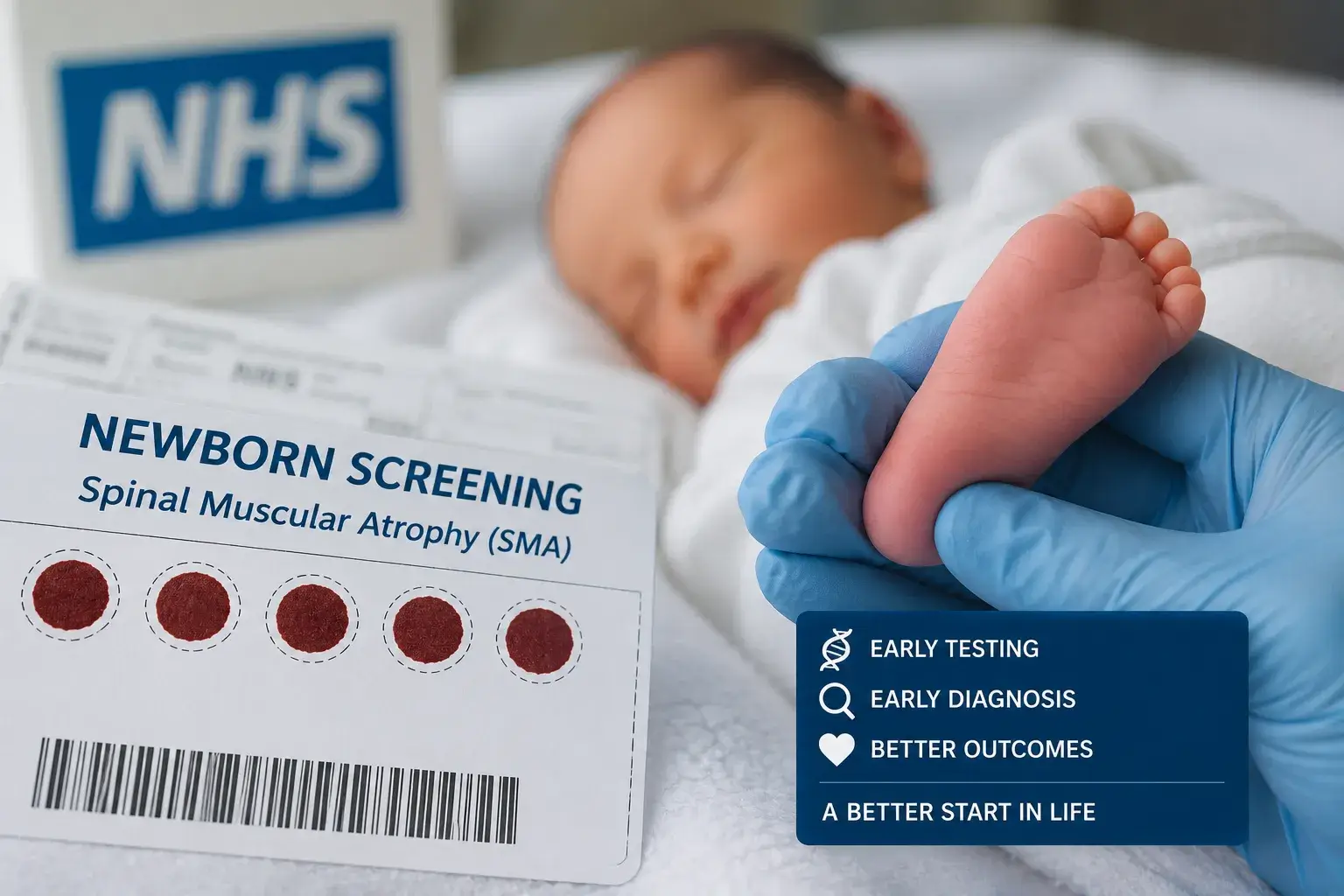
The Department of Health and Social Care and NHS England will expand newborn screening for spinal muscular atrophy across England, with laboratory testing beginning in October 2026.
The national evaluation programme will use blood collected through the established heel-prick test shortly after birth. Hundreds of thousands of babies are expected to be screened as participating laboratories introduce the additional test.
Implementation will continue throughout 2027, with the remaining six newborn screening laboratories expected to begin testing from October 2027. The initial laboratory launch is taking place three months earlier than previously planned.
Newborn SMA Screening Expands Across England
The programme will test babies for spinal muscular atrophy before symptoms develop. Although rare, the condition can cause severe problems affecting movement, breathing and swallowing.
The expansion forms part of an evaluation rather than an immediate permanent addition to the national screening programme. Evidence gathered through NHS services will be considered before future screening recommendations are made.
- Initial testing: Participating laboratories will begin screening babies from October 2026.
- National coverage: Implementation will continue until all newborn screening laboratories in England offer the test.
- Evaluation approach: Researchers will assess how screening operates in routine NHS settings.
Early Diagnosis Improves Treatment Opportunities
Spinal muscular atrophy affects the nerves that control muscle movement. Babies with severe forms of the condition may be unable to sit, crawl or walk and can experience difficulties with breathing or swallowing.
Treatment provided before symptoms appear can improve outcomes because the condition may progress quickly. Earlier identification allows babies diagnosed through screening to be referred for specialist assessment and treatment at an earlier stage.
The government said the programme is intended to give affected children the best available opportunity to live full and healthy lives. It will also reduce differences in access caused by laboratory location during the rollout.
Heel-Prick Tests Will Support National Screening
Screening will use a small blood sample already collected from babies through the newborn heel-prick procedure. The sample is normally taken shortly after birth and will be tested for indicators of spinal muscular atrophy by participating laboratories.
The additional screening will be introduced through existing newborn laboratory services. Parents will therefore not need to arrange a separate blood collection solely for the SMA evaluation.
- Blood collection: A small sample is taken from the baby’s heel shortly after birth.
- Laboratory testing: Screening laboratories examine the sample for the genetic condition.
- Clinical referral: Babies identified through screening can be directed towards specialist care.
Screening Rollout Timeline
| Stage | Timing | Scope |
|---|---|---|
| Evaluation launch | Autumn 2026 | England-wide programme begins |
| Laboratory testing | October 2026 | Testing starts ahead of schedule |
| Continued rollout | Throughout 2027 | More laboratories join |
| Remaining laboratories | October 2027 | Six laboratories begin screening |
Evaluation Will Inform Future Screening Policy
The National Institute for Health and Care Research has provided £4.1 million for the evaluation. Scientists at the University of Oxford will lead the study and examine the feasibility and effectiveness of screening newborn babies for SMA in NHS settings.
The research will assess whether the condition can be identified consistently through the heel-prick blood sample and how screening supports timely clinical action. Its findings will inform future recommendations from the UK National Screening Committee.
The evaluation will also provide evidence from a national programme covering babies born in different parts of England. NHS England said this will help independent experts consider whether SMA testing should become a standard part of newborn screening.
- Research funding: £4.1 million through the NIHR.
- Research lead: University of Oxford scientists.
- Evaluation setting: Routine NHS newborn screening.
- Future policy: Findings will inform UK National Screening Committee recommendations.
Funding and Delivery Arrangements
The Department of Health and Social Care will seek investment to support the rollout across England. The government said it will work collaboratively with delivery partners as laboratories introduce testing ahead of the earlier timetable.
A related programme has already been established in Scotland with private-sector funding. The department will consider a comparable funding approach for England while maintaining the evaluation through NHS screening services.
Delivery will require laboratories, researchers and specialist clinical services to coordinate the testing and referral process. The phased approach will allow additional laboratories to join while the national study continues to collect evidence.
Stakeholder Comments
Ministerial Comments
James Murray, Secretary of State for Health and Social Care said;
“No parent should have to watch their child lose the ability to move or breathe, knowing that earlier treatment could have made all the difference.
This expansion means babies across England will be tested from birth, giving them the best possible chance of a full and healthy life, and another step in the right direction as we do all we can to reduce health inequalities.”
Professor Lucy Chappell, NIHR Chief Executive and Department of Health and Social Care Chief Scientific Adviser said;
“By testing this screening in a real-world NHS setting, our researchers will gather the vital evidence needed to translate early detection into rapid, life-saving action, offering babies the very best start in life.”
Michelle Kane, Director of Screening and Vaccination at NHS England said;
“Spinal muscular atrophy can progress quickly, and identifying it before symptoms appear means babies can get specialist treatment when it can make the biggest difference.”
Jesy Nelson, campaigner said;
“Knowing that future families will have access to early diagnosis and the opportunity for the best possible outcomes is something I’m incredibly proud to have supported.”
Giles Lomax, Chief Executive Officer of Spinal Muscular Atrophy UK said;
“When newborn screening for SMA begins later this year in October, thousands of babies will benefit from earlier diagnosis and access to life-changing treatment.”
Andy Fletcher, Chief Executive of Muscular Dystrophy UK said;
“We know that with a condition like SMA, time is everything, and this development will be life-changing for future generations of children born with the condition.”
England’s newborn SMA evaluation will begin through participating laboratories in October 2026 before expanding throughout 2027. The programme will use existing heel-prick blood samples to identify affected babies earlier and support specialist treatment. Evidence from the £4.1 million University of Oxford-led study will inform future national screening recommendations, while the Department of Health and Social Care seeks investment for wider delivery.
Sources: Department of Health and Social Care, NHS England, National Institute for Health and Care Excellence(NICE), National Institute for Health and Care Research (NIHR) and The Rt Hon James Murray MP.
Prepared by Ivan Alexander Golden, Founder of THX News, an independent news organisation delivering timely insights from global official sources. Combines AI-analysed research with human-edited accuracy and context.