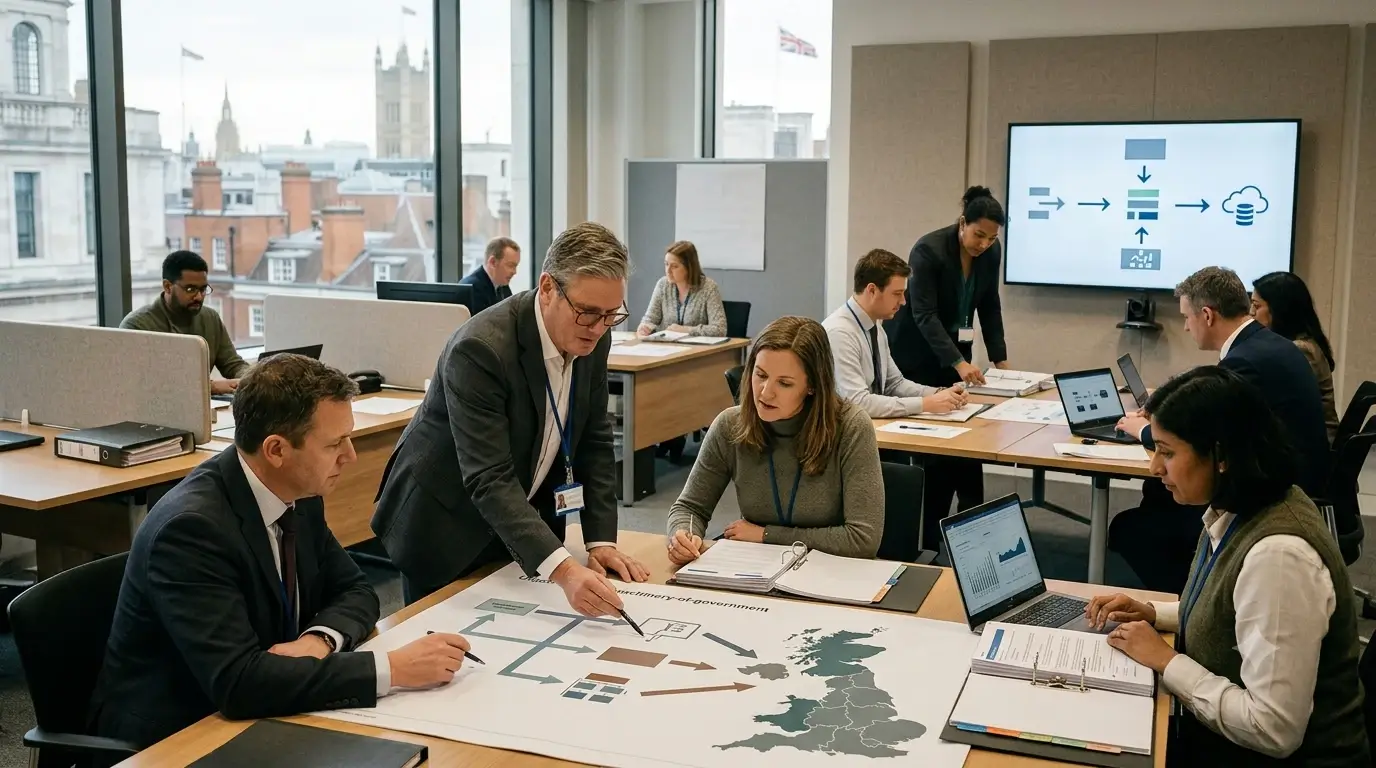
The Cabinet Office said the Prime Minister has approved machinery of government changes affecting central offices, departmental responsibilities and public services from 22 July 2026. The restructuring creates Number 10 North, an Office for the Prime Minister and Cabinet, and a OneGov Delivery Agency.
The changes were published in a Cabinet Office fact sheet covering the organisation of the centre of government and the distribution of responsibilities across Whitehall. Responsibilities covering regional growth, artificial intelligence, digital services, equality, fraud prevention and investment security will move between departments.
The Department for Science, Innovation and Technology will have its responsibilities redistributed, while two departments will receive expanded remits. The Department for Business and Trade will be renamed, and the Department for Digital, Culture, Media and Sport will take on additional technology and digital responsibilities.
Prime Minister Reshapes Central Government
The restructuring changes how the Prime Minister, Cabinet Office and government departments coordinate strategic policy and operational delivery. It separates several shared services from central policy functions while relocating responsibilities to departments with related remits.
The Cabinet Office said the changes are intended to create a more strategic centre of government and give local economic growth a stronger position within national decision-making. The revised structure also places artificial intelligence adoption and selected digital functions within new departmental arrangements.
- Central coordination: Number 10 and core Cabinet Office functions will sit within the new Office for the Prime Minister and Cabinet.
- Operational delivery: Shared government services will be managed through the OneGov Delivery Agency.
- Departmental alignment: Policy functions will move to departments responsible for connected areas of government activity.
Number 10 North Coordinates Regional Growth
Number 10 North has been established to coordinate devolution and economic growth policy across government. It will bring local and regional considerations into the development of national economic strategy.
Local economic growth and devolution strategy will transfer from the Ministry of Housing, Communities and Local Government. Responsibility for local economic growth policy will also move from HM Treasury, combining the two areas within the new office.
The Cabinet Office described Number 10 North as the government’s central structure for connecting regional empowerment with economic policy. Its work will cover growth across different parts of the country and coordination with local leaders.
New Office Supports Prime Minister and Cabinet
The Office for the Prime Minister and Cabinet will house Number 10, Number 10 North and core Cabinet Office functions serving the Prime Minister and Cabinet. The new organisation will focus on coordinating the Government’s stated strategic priorities.
The arrangement changes the structure of the centre of government without moving every Cabinet Office responsibility into the new office. Operational services and several policy functions will instead be transferred to other organisations.
AI Strategy Moves to Cabinet Office
A new AI Taskforce will be created within the Office for the Prime Minister and Cabinet. It will be supported by a prime ministerial adviser on artificial intelligence and will coordinate the Government’s overall AI strategy.
Responsibility for national AI strategy, public sector AI adoption and the AI Security Institute will move to the Cabinet Office. The department will also lead the adoption of artificial intelligence across the Civil Service.
The changes place policy development, government adoption and security oversight within the same departmental structure. The Cabinet Office fact sheet links this arrangement to economic growth, public sector transformation and the wider use of AI across government.
OneGov Agency Will Manage Shared Services
The OneGov Delivery Agency will be established within the Cabinet Office family as an arm’s-length organisation. It will manage shared operational services supporting departments and public servants across central government.
Its remit will include recruitment, pensions, shared services, official transport and security vetting. Moving these services into a dedicated agency separates operational management from the Cabinet Office’s central strategic functions.
OneGov Operational Responsibilities
| Service | Responsibility | Arrangement |
|---|---|---|
| Recruitment | Government Recruitment Service | Managed by OneGov |
| Workforce services | Pensions and shared services | Managed at arm’s length |
| Government operations | Cars and security vetting | Placed within the agency |
Cabinet Office Functions Move to Departments
Several functions will leave the Cabinet Office and transfer to departments whose existing work is more closely connected to those responsibilities. The moves cover equality policy, digital identity, fraud prevention and investment security.
The Office for Equality and Opportunity will move to the Ministry of Housing, Communities and Local Government. The Office for Impact Economy and digital identity policy will transfer to the expanded Department for Digital, Culture, Media and Sport.
The Public Sector Fraud Authority will move to the Department for Work and Pensions while retaining sponsorship from HM Treasury. The Investment Security Unit will transfer to the renamed Department for Business, Innovation, Science and Trade.
Departmental Responsibility Transfers
| Function | Receiving Department | Scope |
|---|---|---|
| Equality and opportunity | MHCLG | Office transfers from Cabinet Office |
| Impact economy and digital identity | DCMS | Policy responsibilities combined |
| Public Sector Fraud Authority | DWP | Treasury sponsorship continues |
| Investment Security Unit | DBIST | Investment security responsibility |
Expanded DCMS Combines Culture and Technology
The expanded Department for Digital, Culture, Media and Sport will bring together responsibilities for culture, telecoms, media and the Government Digital Service. Through the Government Digital Service, it will retain responsibilities connected to the modernisation of government and public services.
The department will provide combined oversight of telecommunications, print and broadcast media, social media and online safety. It will also take responsibility for digital identity policy and the Office for Impact Economy.
- Digital services: The Government Digital Service will remain responsible for supporting public service modernisation.
- Online policy: Telecoms, media, and online safety will sit within the expanded department.
- Youth responsibilities: The department will retain its existing role in youth policy alongside its wider digital remit.
Business Department Adds Science and Innovation
The Department for Business and Trade will be renamed the Department for Business, Innovation, Science and Trade. Its expanded remit is intended to connect scientific research and technological development more directly with business and industrial policy.
The department will support emerging sectors from foundational research through the establishment and expansion of innovative companies. It will also develop stronger links with the British Business Bank and the National Wealth Fund for business and infrastructure support.
The Cabinet Office said the department will connect science and technology capabilities with businesses, local economies and workers. Its responsibilities will form part of the Government’s reindustrialisation agenda and economic growth programme.
DSIT Responsibilities Redistributed Across Government
The responsibilities of the Department for Science, Innovation and Technology will be distributed across other government departments. The fact sheet does not provide a complete function-by-function breakdown but identifies the Cabinet Office, DCMS and DBIST as recipients of related responsibilities.
AI strategy, public sector adoption and the AI Security Institute will move to the Cabinet Office. Technology, digital services and communications responsibilities will be integrated into the expanded DCMS, while science and innovation functions connected to business growth will sit within DBIST.
The redistribution removes technology and innovation from a single standalone departmental structure. Those responsibilities will instead be incorporated into government organisations covering central coordination, public services, culture, communications, business and industrial development.
The machinery of government changes reorganise central coordination, regional growth policy, artificial intelligence responsibilities and shared public services. Number 10 North, the Office for the Prime Minister and Cabinet and the OneGov Delivery Agency will become new parts of the central government structure. Other responsibilities will move to expanded departments covering digital policy, culture, business, science, equality, fraud prevention and investment security.
Sources: Cabinet Office — Machinery of Government changes: Fact Sheet.
Prepared by Ivan Alexander Golden, Founder of THX News, an independent news organisation delivering timely insights from global official sources. Combines AI-analysed research with human-edited accuracy and context.