
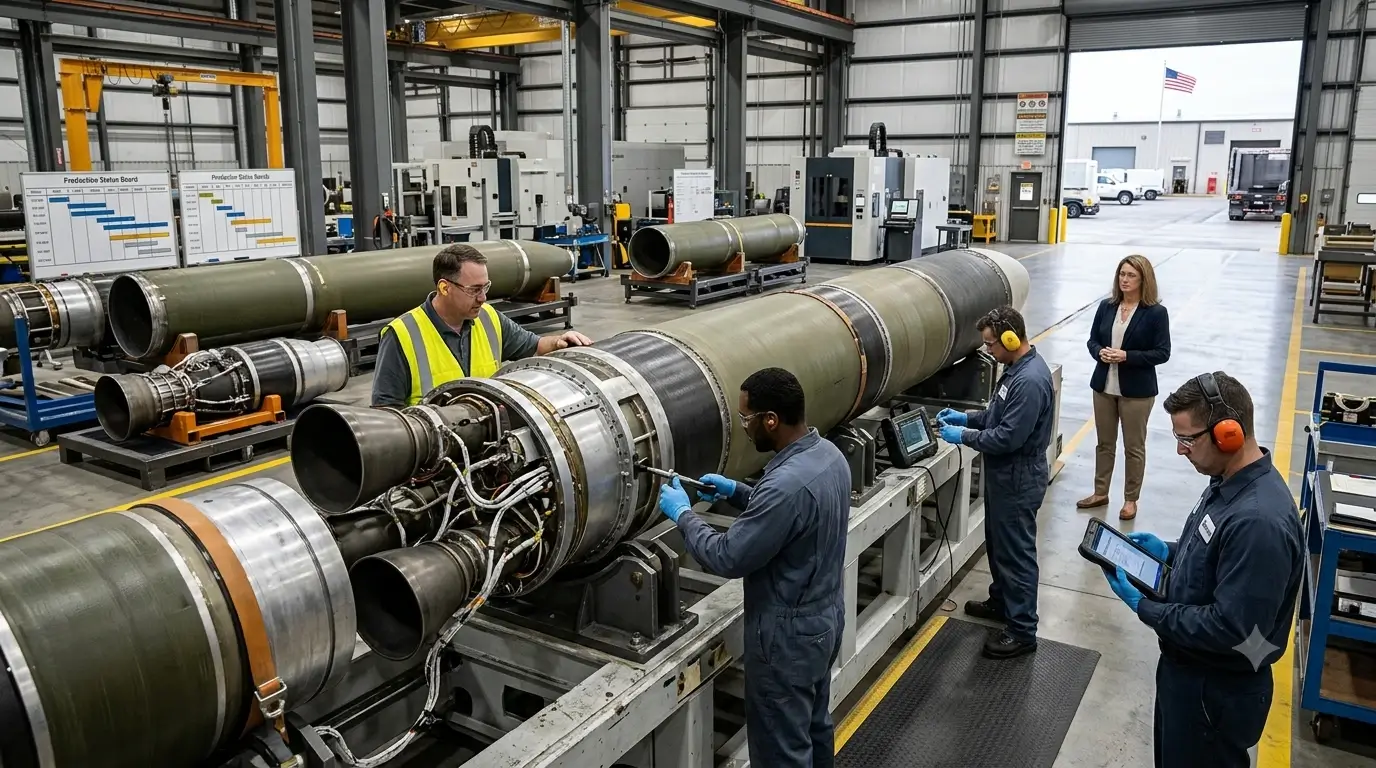
The Department of War, L3Harris and Lockheed Martin announced two seven-year framework agreements in Washington on July 27, 2026, to expand propulsion-component production for PAC-3 MSE and THAAD interceptors. The agreements are intended to increase manufacturing capacity, provide stable demand to suppliers and strengthen the US missile defense industrial base.
The agreements cover propulsion, maneuvering and lethality components used by two major US missile defense systems. According to the Department of War, the arrangements form part of its Acquisition Transformation Strategy, which seeks to accelerate procurement by establishing longer-term production expectations across the defense supply chain.
Pentagon Signs Seven-Year Production Agreements
The Department of War said the two framework agreements will support expanded production capacity for components used in the Patriot Advanced Capability-3 Missile Segment Enhancement and Terminal High Altitude Area Defense systems. Each framework spans seven years, giving L3Harris and participating suppliers a longer planning period for facilities, equipment and workforce requirements.
Additionally, Lockheed Martin is involved as the prime contractor associated with both interceptor programs. The agreements do not themselves disclose a total monetary value, and L3Harris said the underlying PAC-3 MSE and THAAD contracts are expected to be finalized later in 2026. Consequently, the immediate operational effect is a defined production framework rather than completed delivery of additional interceptors.
Agreement Scope and Participating Companies
| Agreement Area | Planned Expansion | Context |
|---|---|---|
| Agreement duration | Two seven-year frameworks announced | The Department of War said the longer period is designed to provide stable demand signals for missile-component suppliers. |
| PAC-3 MSE production | Propulsion output planned to nearly triple | L3Harris said the framework covers its two-pulse rocket motor, Attitude Control Motors and Lethality Enhancer. |
| THAAD production | Propulsion capacity planned to quadruple | L3Harris said the expansion covers the interceptor’s solid rocket boost motor and Liquid Divert and Attitude Control System. |
| Contract status | Final agreements expected later in 2026 | L3Harris described both announcements as frameworks that will enable subsequent long-term production contracts. |
PAC-3 MSE Propulsion Capacity to Expand
Under the PAC-3 MSE framework, L3Harris will expand production of the interceptor’s advanced two-pulse solid rocket motor, Attitude Control Motors and Lethality Enhancer. The company said the agreement would allow it to nearly triple production across the covered propulsion products, increasing the supply of components available to Lockheed Martin’s interceptor production line.
The Department of War said the motors provide speed, range and maneuverability used to engage tactical ballistic missiles, cruise missiles and aircraft. Meanwhile, the Lethality Enhancer increases the interceptor’s effective area against an incoming threat. Together, the three component groups support propulsion, directional control and target engagement rather than representing complete PAC-3 MSE interceptors.
L3Harris identified its Camden, Arkansas, operation as a principal PAC-3 MSE motor manufacturing site. The company reported that the facility includes dedicated processing bays and automated digital X-ray equipment intended to reduce inspection and production-cycle times. Therefore, the planned increase combines longer-term ordering expectations with manufacturing changes already introduced at the production site.
PAC-3 MSE Components and Operational Functions
The two-pulse solid rocket motor supplies propulsion during separate phases of the interceptor’s flight, supporting acceleration and extended engagement range. Attitude Control Motors provide directional adjustments, while the Lethality Enhancer supports the interceptor’s ability to neutralize a target.
Additionally, L3Harris said it has been expanding its broader solid rocket motor infrastructure across Arkansas, Alabama and Virginia. The company reported construction or upgrades involving approximately 60 facilities and nearly 1 million square feet of manufacturing and office space. Although those investments serve multiple programs, the company presented them as part of the industrial capacity supporting higher munitions output.
THAAD Manufacturing Agreement Targets Key Systems
The second framework covers two propulsion components used by the THAAD interceptor: the solid rocket boost motor and the Liquid Divert and Attitude Control System. L3Harris said the seven-year arrangement is expected to quadruple its THAAD propulsion production capacity and become its largest THAAD propulsion award to date.
The boost motor launches and accelerates the interceptor, while the Liquid Divert and Attitude Control System provides responsive maneuvering during flight. According to the Department of War, that maneuverability allows the interceptor to engage ballistic missile threats inside and outside Earth’s atmosphere. The production increase is therefore focused on the systems that place and guide the interceptor toward an incoming target.
However, the framework announcement did not state how many additional THAAD interceptors will be produced. L3Harris supplies the propulsion components to the broader program, while Lockheed Martin serves as the THAAD system’s prime contractor. The practical effect will depend on the final contract, production schedules and integration with other interceptor components.
THAAD Propulsion and In-Flight Control
The Department of War described the boost motor and maneuvering system as critical to THAAD’s interception sequence. One component supplies launch propulsion, while the other enables rapid directional corrections as the interceptor approaches a ballistic missile threat.
L3Harris said the production framework was enabled through the Department’s Acquisition Transformation Strategy. The company also stated that the final contract is expected later in 2026. Accordingly, the announced fourfold expansion is a planned capacity target tied to contract finalization rather than a report of completed production.
Agreements Extend Broader PAC-3 Supply Strategy
The Department of War said the latest arrangements follow earlier PAC-3 MSE framework agreements involving Lockheed Martin, Boeing and Honeywell. Lockheed Martin is the interceptor’s prime contractor, while Boeing supplies its seeker and Honeywell provides multiple components.
By establishing agreements with companies at different levels of the production chain, the Department is seeking to align output across several dependent suppliers. A higher rate of rocket-motor production would not independently increase completed interceptor deliveries unless seekers, electronics and other components are available at comparable rates. The broader framework approach is intended to reduce that imbalance.
Additionally, the Department said direct engagement with lower-tier suppliers gives manufacturers clearer information about anticipated government demand. The seven-year duration provides a measurable planning horizon, while the intended real-world effect is greater confidence for investments in tooling, facilities and personnel. Final production results will remain dependent on awarded orders and supplier performance.
Framework Agreement Network
The framework network includes organizations responsible for complete interceptor integration and companies producing specialized subsystems. Lockheed Martin leads PAC-3 MSE production, while Boeing, Honeywell and L3Harris contribute components required for guidance, propulsion and other functions.
This structure reflects the interconnected nature of missile manufacturing. Increasing capacity at one supplier can address a specific bottleneck, but completed interceptor output depends on coordinated delivery across the network. The Department’s stated approach is therefore to provide demand signals throughout the industrial base rather than focusing solely on prime contractors.
Acquisition Strategy Supports Industrial Expansion
The Department of War linked both agreements to its Acquisition Transformation Strategy, which it said reduces procedural delays and permits more direct engagement with suppliers. The two seven-year frameworks provide the central data point: a defined long-term period covering major components for two missile defense systems.
The Department said stable demand can encourage companies to expand factories, equipment and workforces without relying only on short-term orders. In operational terms, the intended result is a more responsive supply base capable of sustaining higher production rates. However, the release did not provide delivery schedules, funding totals or annual output targets for complete interceptors.
The agreements therefore establish an industrial and contracting direction rather than confirming immediate increases in deployed missile inventories. Their measurable impact will depend on final contract terms, appropriations, supplier execution and the rate at which propulsion components are incorporated into finished PAC-3 MSE and THAAD interceptors.
Stakeholder Comments
- Department position: Michael P. Duffey, Under Secretary of War for Acquisition and Sustainment, said the agreements demonstrate an effort to scale critical munitions production and provide clearer demand signals across the supply chain.
- PAC-3 supplier position: Ken Bedingfield, president of Missile Solutions at L3Harris, said the PAC-3 MSE framework would support production rates not previously reached by the company and allow additional preparation across its facilities and suppliers.
- THAAD supplier position: Bedingfield said the THAAD framework reflects L3Harris’ ability to increase delivery rates requested by the Department, with the company projecting a fourfold expansion in propulsion capacity.
The two seven-year frameworks establish planned production expansions for propulsion and maneuvering components used by PAC-3 MSE and THAAD interceptors. L3Harris expects to nearly triple covered PAC-3 MSE output and quadruple THAAD propulsion capacity, subject to final contracts and production execution.
The agreements also extend the Department of War’s supplier-level approach to missile procurement. Their ultimate effect will be measured through finalized awards, component deliveries and the number of complete interceptors produced over the seven-year period.
Sources: U.S. Department of War, L3Harris PAC-3 MSE Announcement, L3Harris THAAD Announcement.
Prepared by Ivan Alexander Golden, Founder of THX News, an independent news organization delivering timely insights from global official sources.
Research combines AI-assisted analysis with human-edited accuracy and context.