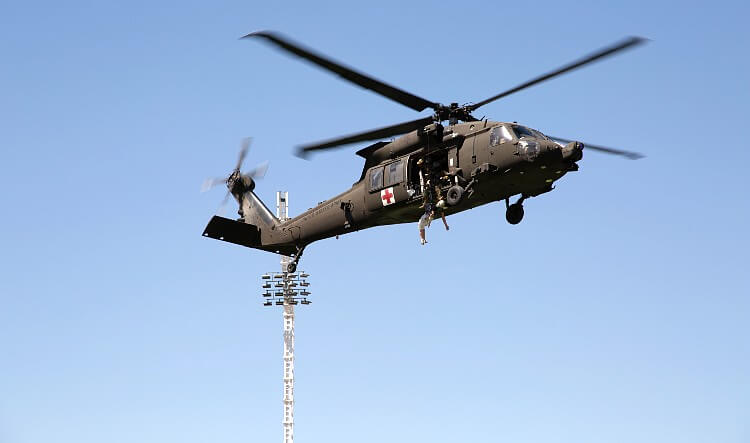
The U.S. Army announced on March 20, 2026, that it has received its first autonomous Black Hawk helicopter capable of both piloted and unmanned flight. The aircraft, developed through long-term collaboration with the Defense Advanced Research Projects Agency, will enter testing to evaluate its operational safety and mission flexibility.
The development reflects ongoing U.S. military efforts to integrate autonomy into aviation systems, with a focus on reducing pilot workload and expanding mission capabilities in complex environments.
U.S. Army Receives Autonomous Black Hawk Helicopter
The U.S. Army Capability Program Executive Office Aviation confirmed the delivery of an H-60Mx Black Hawk configured as an optionally piloted vehicle. Additionally, the aircraft supports both onboard crews and remote operation, enabling flexible deployment depending on mission requirements.
Meanwhile, the system introduces autonomy features designed to manage full flight operations, including takeoff and landing. This capability, as outlined by the U.S. Army, is intended to reduce pilot workload while maintaining operational control in high-risk environments.
Capabilities and Features of the Aircraft
The U.S. Army states that the aircraft can operate autonomously or with a crew, supported by an advanced digital flight control system. Additionally, the autonomy system functions as a co-pilot, handling complex flight tasks while allowing human operators to supervise mission execution.
However, the inclusion of remote operation capability enables missions to be conducted without onboard personnel when required. This creates operational flexibility, particularly in hazardous environments, while maintaining oversight through ground-based control systems.
Development History and ALIAS Program Origins
The Defense Advanced Research Projects Agency (DARPA) initiated the Aircrew Labor In-Cockpit Automation System (ALIAS) program more than a decade ago to develop modular autonomy kits for aircraft. Additionally, DARPA aimed to simplify flight operations and improve safety by automating complex pilot tasks.
Meanwhile, the technology was developed in collaboration with a military aircraft manufacturer, enabling both rotary and fixed-wing aircraft to operate with reduced crew requirements. According to DARPA, this long-term development resulted in a mature system ready for formal military evaluation.
Timeline of Innovation and Technology Maturation
| Indicator | Recent Movement | Context |
|---|---|---|
| Program origin | Over 10 years of development | DARPA ALIAS program initiated to create removable autonomy kits for aircraft |
| Technology maturity | Now ready for Army evaluation | U.S. Army and DARPA report successful demonstrations across commercial and military platforms |
| Aircraft integration | H-60Mx Black Hawk equipped | U.S. Army confirms integration of autonomy system into operational helicopter platform |
Technology Systems and Flight Enhancements
The U.S. Army states that the helicopter incorporates a fly-by-wire system replacing traditional mechanical controls, improving stability and handling. Additionally, the autonomy mission manager functions as the central system controlling flight operations and decision-making.
Meanwhile, the inclusion of a software development kit allows third-party integration of sensors and mission systems. This enables continuous upgrades and adaptability, supporting evolving operational requirements while maintaining a standardized platform.
Core System Components and Functions
| Indicator | Recent Movement | Context |
|---|---|---|
| Flight control system | Fly-by-wire implementation | U.S. Army reports improved stability and reduced pilot workload |
| Autonomy system | Digital co-pilot functionality | DARPA-developed ALIAS system manages complex flight operations |
| Software integration | Open SDK capability | U.S. Army states third-party systems can be integrated for mission flexibility |
Testing Phase and Operational Evaluation
The U.S. Army confirmed that test pilots and engineers will conduct a series of evaluations to assess remote control performance and autonomous mission execution. Additionally, testing will include real-world operational scenarios to measure reliability and effectiveness.
Meanwhile, the Army will evaluate safety improvements and mission outcomes resulting from reduced pilot workload and increased automation. This testing phase will determine how the system can be integrated into broader operational use.
- Autonomous performance: U.S. Army testing will measure independent mission execution and system reliability in operational scenarios
- Remote operation: Army engineers will assess ground-based control capabilities for missions without onboard crews
- Safety improvements: U.S. Army expects reduced pilot workload to enhance decision-making and mission outcomes
- Operational integration: Testing will determine scalability across existing Black Hawk fleets and future aircraft
Strategic Vision and Future Applications
The U.S. Army identified the aircraft as a key testbed for its Strategic Autonomy Flight Enabler (SAFE) program, which aims to develop scalable autonomy systems. Additionally, SAFE seeks to deploy standardized autonomy kits across the Army’s Black Hawk fleet and future platforms.
Meanwhile, collaboration with Texas-based partners, including Texas A&M University’s George H.W. Bush Combat Development Complex, supports testing in civilian and state-level missions such as firefighting. This broader application highlights the potential dual-use capability of the technology.
To Sum Up
The delivery of the autonomous Black Hawk represents a significant development in U.S. Army aviation, combining long-term research with operational testing. The program introduces a scalable approach to autonomy that could reshape mission execution and aircraft deployment.
Additionally, the outcome of upcoming evaluations will determine how widely the technology can be applied across military and civilian contexts, reinforcing its role in future aviation strategies.
Sources: U.S. Army, Defense Advanced Research Projects Agency.
Prepared by Ivan Alexander Golden, Founder of THX News, an independent news organization delivering timely insights from global official sources.
Research combines AI-assisted analysis with human-edited accuracy and context.