
Canada and Ontario have signed a new federal–provincial agreement designed to speed up major infrastructure projects while maintaining environmental and Indigenous protections.
The deal introduces a “one project, one review” approach that aims to cut duplication in environmental and impact assessments, a long-standing concern for governments, businesses, and workers across Ontario.
Announced in Ottawa, the agreement comes as Canada’s new government moves to strengthen economic resilience amid global trade disruption and rising competition for investment.
The agreement reflects a broader federal push to build major projects faster, diversify Canada’s trade relationships, and reduce reliance on a single economic partner. By working more closely with provinces, the government says it can unlock large-scale infrastructure while keeping environmental and Indigenous responsibilities intact.
Introduction
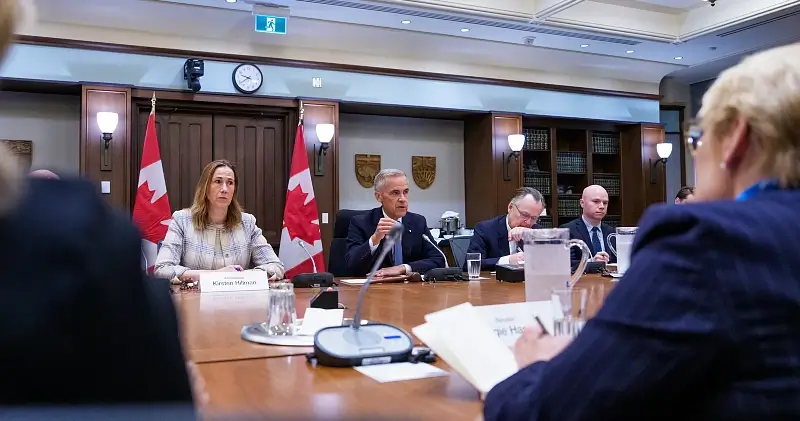
Prime Minister Mark Carney and Ontario Premier Doug Ford announced the new Co-operation Agreement on Environmental and Impact Assessment on December 18, 2025, in Ottawa.
The agreement is intended to accelerate major infrastructure construction in Ontario by streamlining reviews, reducing regulatory overlap, and aligning federal and provincial processes during a period of global economic uncertainty.
new Co-operation Agreement between Ontario and Canada on Environmental and Impact Assessment.
What the New Canada–Ontario Agreement Does
At the core of the agreement is a commitment to simplify how major projects are assessed. Instead of running parallel federal and provincial reviews, projects will now follow a “one project, one review” model wherever possible.
Under this framework, Canada and Ontario can decide, on a case-by-case basis, whether to rely on Ontario’s assessment process or use a coordinated federal–provincial review. As a result, proponents face clearer timelines and fewer procedural delays.
However, both governments emphasise that speed is not intended to come at the expense of standards. According to the federal government, environmental protection and Indigenous rights remain legally binding responsibilities under the new approach.
Reducing Duplication While Protecting Standards
The Impact Assessment Agency of Canada will continue to play a role, particularly by providing federal expertise on environmental protection, Indigenous engagement, and sustainable development. Meanwhile, Ontario retains authority within its jurisdiction, allowing assessments to reflect regional realities.
This collaborative model builds on earlier agreements signed with British Columbia in 2019 and New Brunswick earlier this week. Agreements with Manitoba and Prince Edward Island are also nearing completion, while Alberta is expected to finalise a similar deal by April 1, 2026.
Why the Agreement Matters for the Economy
Canada’s new government has framed the agreement as an economic necessity, not just an administrative reform. As global trade patterns shift, Ottawa is seeking to attract investment and move projects from proposal to construction more quickly.
According to Statistics Canada, regulatory requirements increased by an average of 2.1% per year between 2006 and 2021, a cumulative rise of 37%. Over that period, business sector investment growth was reduced by an estimated 9%, highlighting the economic cost of regulatory complexity.
Economic pressures driving the agreement include:
- Global trade disruption and reduced reliance on a single export partner
- Growing competition for capital and skilled labour
- Demand for faster approval timelines on energy, mining, and infrastructure projects
Meanwhile, Ontario has positioned the agreement as a tool to unlock projects such as those linked to the Ring of Fire, a mineral-rich region seen as strategically important for Canada’s long-term economic security.
Major Projects Office and Investment Scale
The agreement also ties into the federal Major Projects Office (MPO), created under the Building Canada Act, which came into force on June 26, 2025. The MPO is designed to coordinate large-scale projects of national significance.
Together, the first and second tranches of projects referred to the MPO represent a combined potential investment of more than $116 billion, according to federal figures. These projects are expected to create thousands of well-paying jobs across multiple sectors.
Major Projects at a Glance
| Indicator | Current Status | Context |
|---|---|---|
| Canada–Ontario agreement | Signed December 2025 | Introduces one project, one review assessment model |
| Total MPO investment | $116+ billion potential | Combined first and second project tranches |
| Indigenous engagement funding | $40 million over two years | Supports early and consistent Indigenous participation |
| Indigenous Loan Guarantee | Expanded to $10 billion | Supports long-term economic opportunities |
Indigenous Engagement and Environmental Accountability
While accelerating approvals is a central goal, the agreement places explicit emphasis on maintaining environmental safeguards and Indigenous rights. The federal government has committed $40 million over two years to support Indigenous participation in major project planning and assessment.
In addition, the Indigenous Loan Guarantee Program has been expanded from $5 billion to $10 billion. This expansion is intended to give Indigenous communities greater capacity to invest in and benefit from major infrastructure developments.
Government commitments under the agreement include:
- Early and sustained Indigenous engagement on major projects
- Maintaining federal environmental responsibilities
- Reducing administrative duplication without lowering standards
Ontario officials have echoed this position, arguing that regulatory efficiency and environmental protection are not mutually exclusive, but must be advanced together to deliver results.
Political and Intergovernmental Context
The agreement reflects a more collaborative federal–provincial tone under Prime Minister Carney’s government. Rather than unilateral federal action, the emphasis is on partnership with provinces and territories to address shared economic challenges.
Premier Doug Ford described the deal as a way to remove unnecessary red tape that has delayed “nation-building” projects. Federal ministers, meanwhile, have stressed that the approach provides certainty for businesses while respecting constitutional responsibilities.
The Takeaway
The Canada–Ontario co-operation agreement signals a shift toward faster, more coordinated infrastructure development at a time of economic uncertainty. If implemented as intended, it could reshape how major projects move from planning to construction in Ontario and beyond.
Ultimately, the success of the agreement will be measured not by announcements, but by shovels in the ground, jobs created, and confidence restored. For Canadians watching from the sidelines, the question now is whether streamlined reviews can truly deliver both speed and stewardship in a rapidly changing world.
Sources: Government of Canada press release on the Canada–Ontario Co-operation Agreement; Statistics Canada regulatory analysis; Impact Assessment Agency of Canada background materials.
Prepared by Ivan Alexander Golden Founder of THX News™ — an independent news organization delivering timely insights from official public-sector sources.