



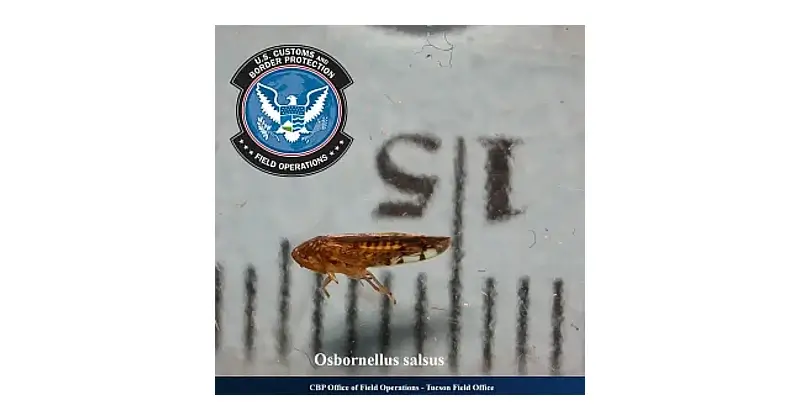
At the Port of San Luis, Arizona, agriculture specialists from U.S. Customs and Border Protection (CBP) have intercepted a pest never before detected in the United States. The find — a leafhopper known as Osbornellus salsus — was discovered during a routine inspection of a radicchio shipment arriving from Mexico.
A Landmark Detection
The discovery marks the first-in-nation identification of this insect species. During the inspection, a CBP specialist collected the specimen and sent it to the U.S. Department of Agriculture’s Animal and Plant Health Inspection Service (APHIS) for analysis. Experts at the USDA’s National Identification Service later confirmed the pest’s identity.
This collaborative detection illustrates the strength of the CBP–USDA partnership in safeguarding American agriculture. The radicchio shipment was immediately secured and returned to Mexico under federal protocol, preventing any potential introduction into the domestic ecosystem.
Why the Discovery Matters
Leafhoppers such as Osbornellus salsus pose significant agricultural risks. These insects feed by extracting sap from plants and are known carriers of plant-infecting viruses and bacteria. If established in the U.S., the pest could spread diseases affecting crops like lettuce, grapes, grains, and other high-value produce.
“CBP agriculture specialists are highly trained in detecting harmful pests,” said Guadalupe Ramirez, Director of Field Operations for the Tucson Field Office. “Working closely with USDA, our teams protect the nation from evolving threats that could harm our agriculture resources.”
Protecting Borders and Food Supply
The interception at San Luis underscores the crucial role of agriculture inspection at U.S. ports of entry. CBP’s Office of Field Operations is responsible not only for screening travelers and goods but also for protecting the nation’s food supply from invasive species, diseases, and contaminants.
With millions of shipments crossing borders each year, agriculture specialists serve as the first line of defense against biological threats. Their work helps preserve crop health, maintain export eligibility, and protect consumers from disruptions in food supply.
Biosecurity at the Frontline
Each interception provides valuable data for scientists monitoring the spread of non-native species. The emergence of Osbornellus salsus highlights how climate shifts and global trade can open new pathways for pest migration. Detecting such organisms early prevents costly outbreaks that could otherwise lead to widespread quarantines or pesticide use.
The Broader Impact
| Topic | Details |
|---|---|
| Pest Detected | Osbornellus salsus, a type of leafhopper |
| Location | Port of San Luis, Arizona |
| Origin of Shipment | Mexico |
| Commodity Inspected | Radicchio produce |
| Verification | Confirmed by USDA National Identification Service |
| Outcome | Shipment secured and returned to origin |
Collaborative Oversight in Action
The event is also an example of how federal coordination protects trade and agriculture simultaneously. Instead of halting shipments broadly, CBP and USDA isolate and manage risks case-by-case. This precision approach allows legitimate commerce to continue while preventing ecological harm.
Such responses are vital along the U.S.–Mexico border, where agricultural imports represent a major share of cross-border commerce. San Luis processes thousands of shipments weekly, balancing trade efficiency with biosecurity vigilance.
Federal Expertise and Training
CBP agriculture specialists undergo advanced training in entomology, plant pathology, and inspection techniques. Their work includes screening cargo, collecting biological samples, and applying scientific judgment to assess risk. Each interception adds to a growing body of research that helps refine federal inspection protocols and improve future detection speed.
For those interested in the career path, CBP offers detailed information about the role of agriculture specialists at cbp.gov/border-security/protecting-agriculture.
Growing Importance Amid Climate Change
Experts warn that climate change is broadening the survivable range of many invasive species. Warmer temperatures and shifting trade routes enable pests to move faster and adapt more easily. Each successful interception — especially a first-in-nation discovery — serves as an early warning signal for environmental and agricultural planners.
Invasive species are estimated to cause billions in annual crop losses globally. By identifying pests before they enter U.S. soil, CBP and USDA prevent potential devastation to farms, supply chains, and consumer markets.
| Economic Impact of Invasive Insect Pests in U.S. Agriculture | Annual Cost (USD) |
|---|---|
| Crop production losses due to invasive insect pests | $13.9 billion |
| Additional costs for insecticide application to control invasive pests | $500 million |
| Total estimated annual losses and control costs for invasive insect pests | $14.4 billion |
| Broader Costs from Non-Indigenous Pests and Weeds in U.S. Agriculture | Annual Cost (USD) |
|---|---|
| Reduction in crop yields caused by weeds (12% overall reduction) | $33 billion |
| Estimated losses due to introduced weed species (73% of weeds) | $24 billion |
| Herbicide costs for weed control | $4 billion |
| Total cost to U.S. agricultural economy from introduced pests and weeds | Around $27 billion |
Securing the Nation’s Food Future
This first-in-nation interception demonstrates that strong border surveillance and inter-agency cooperation remain the foundation of U.S. biosecurity. The rapid response at San Luis prevented what could have become a costly agricultural crisis.
Vigilance, coordination, and science — these remain the cornerstones of protecting America’s farms, consumers, and ecosystems.
As trade volumes increase, such teamwork ensures that every shipment crossing the border strengthens—not threatens—the nation’s agricultural future.
Sources: US Customs and Border Protection.
Prepared by Ivan Alexander Golden, Founder of THX News™, an independent news organization delivering timely insights from global official sources. Combines AI-analyzed research with human-edited accuracy and context.


