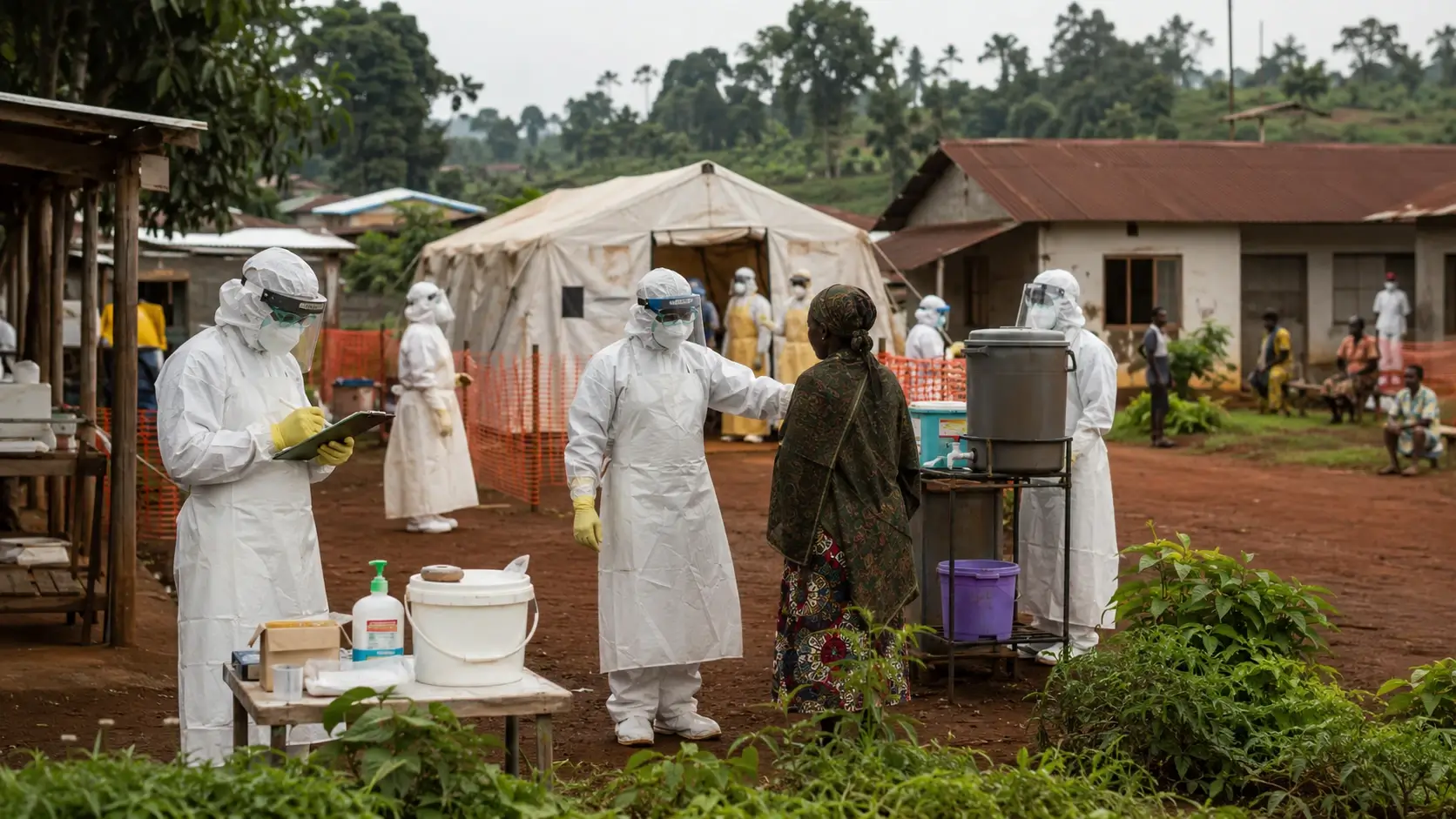
The Democratic Republic of the Congo has activated an emergency delivery roadmap aimed at breaking Bundibugyo Ebola transmission across five affected provinces.
The plan assigns deadlines and operational responsibilities for detecting cases, following contacts, expanding treatment access and protecting frontline health workers.
The DRC Ebola outbreak entered a more tightly managed phase in Bunia on 16 July 2026, as the government and response partners agreed immediate measures to reduce transmission. The Central African plan focuses on faster surveillance, treatment capacity, workforce protection, funding and community access.
Outbreak Roadmap Tightens Outbreak Management
The emergency roadmap was adopted during a strategic review chaired by Dr Roger Kamba, the DRC’s Minister of Public Health, Hygiene and Social Welfare. Dr Jean Kaseya, Director-General of the Africa Centres for Disease Control and Prevention, also attended the meeting.
National and provincial authorities joined operational leaders, United Nations agencies, technical organisations, financial partners and other groups supporting the response. Together, they agreed to move from expanding response capacity towards ensuring that available resources consistently reach affected communities.
A shared performance dashboard will track responsibilities, decisions, deadlines and results. Consequently, national and provincial teams will be able to assess where operational delays remain and determine which organisations are responsible for resolving them.
The roadmap also provides for a stronger Incident Management System, harmonised payment arrangements and clearer governance of outbreak information. These measures are intended to reduce administrative obstacles affecting surveillance teams, treatment workers and the delivery of essential supplies.
Transmission Extends Across Five DRC Provinces
As of 13 July 2026, authorities had recorded 2,011 confirmed cases, including 754 deaths and 366 recoveries. During the latest reported 24-hour period, the country registered another 54 confirmed cases and 28 deaths.
The outbreak affected 45 health zones across Ituri, North Kivu, South Kivu, Haut-Uele and Tshopo provinces. Ituri remained the epicentre and accounted for almost 90% of all confirmed infections, while transmission had recently expanded further into Haut-Uele.
Cases also continued in North Kivu and Tshopo. However, South Kivu had reached 48 consecutive days without recording another confirmed case, indicating that sustained surveillance and local response measures may be limiting transmission there.
The outbreak has wider implications for Central and East Africa because communities, trade routes and health services extend across national borders. Therefore, preparedness in neighbouring provinces and cooperation with Uganda remain central parts of the response.
Outbreak Position on 13 July 2026
| Response indicator | Reported position |
| Confirmed cases | 2,011 |
| Deaths | 754 |
| Recoveries | 366 |
| Affected health zones | 45 across five provinces |
| Registered contacts | 12,430 |
| Contacts successfully seen | 67.4% |
| Infected health workers | 114, including 36 deaths |
Expanded Capacity Must Reach Communities Faster
The DRC now has substantially greater response capacity than it had at the beginning of the outbreak. Eleven laboratories are operating, while national testing capacity has risen above 2,000 tests each day and sequencing services are available in Bunia.
Authorities and partners have also opened 22 Ebola treatment centres and seven transit centres. Together, these facilities provide more than 700 beds, while response teams have reduced average detection times and strengthened their investigation of public health alerts.
Nevertheless, access remains uneven. Treatment and isolation facilities were operating at 87.4% overall occupancy, and facilities in North Kivu faced critical saturation. Moreover, only 67.4% of the 12,430 registered contacts had been seen by follow-up teams.
The roadmap therefore concentrates immediate work on operational areas that directly influence whether infections are identified and isolated before further transmission occurs:
- Complete contact follow-up and accelerate investigations of suspected cases.
- Expand treatment, isolation and transit capacity in areas facing saturation.
- Strengthen infection prevention measures for health facilities and response teams.
- Regularise payments and supply essential equipment to frontline personnel.
- Maintain essential healthcare so communities continue seeking treatment early.
Protecting health workers is especially urgent. By 13 July, 114 health workers had been infected and 36 had died. Infections among medical personnel can reduce available staffing, disrupt routine services and weaken public confidence in health facilities.
Response Leaders Demand Faster Operational Delivery
Africa CDC said the central challenge is no longer simply establishing technical capacity. Instead, response organisations must ensure that laboratories, treatment beds, surveillance systems and trained personnel operate together at the speed required to interrupt transmission.
Dr Jean Kaseya, Director-General of Africa CDC
“The outbreak is moving fast, and we are changing the speed and discipline of the response.” He said the Bunia roadmap places financing, responsibility and deadlines behind established Ebola control measures and must bring available African expertise to every affected community quickly enough to save lives.
Regular reviews will now examine how rapidly teams investigate alerts, whether registered contacts receive daily follow-up and how quickly patients gain access to care. The reviews will also assess health worker protection and the continuity of essential medical services.
Furthermore, the plan commits the government and its partners to preserving free access to essential healthcare. Maintaining routine services is important because financial or practical barriers can delay treatment, reduce reporting and damage trust between communities and response organisations.
Uganda Supports Cross-Border Ebola Operations
Uganda’s outbreak position provides a regional example of how consistent surveillance, treatment and community cooperation can limit transmission. The country had reported 20 confirmed cases, including 17 recoveries and two deaths, while one patient remained in care.
No contacts were under active follow-up in Uganda at the time of the announcement. The country was therefore approaching the conditions required to declare the outbreak over, although it must first complete the prescribed surveillance period.
Under a memorandum of understanding between the two governments, Uganda is providing teams and technical expertise to the DRC. Cooperation covers cross-border surveillance, laboratory services, case management, investigations and engagement with affected communities.
This assistance turns regional public health cooperation into operational capacity within affected areas. It also helps both countries manage population movement and investigate alerts near their shared border before isolated cases develop into wider transmission chains.
Funding and Community Trust Remain Essential
The Congolese government and Africa CDC have called on partners and donors to release pledged resources rapidly. Reliable funding is required to sustain surveillance, treatment centres, laboratory operations, transport, health worker payments and essential supplies in the most affected locations.
Community participation is equally important. Authorities have asked residents to report suspected Ebola symptoms and deaths immediately, while cooperating with surveillance teams, treatment personnel and safe and dignified burial operations.
Early treatment can improve a patient’s prospects while reducing exposure among relatives, health workers and other community members. However, people are more likely to report symptoms promptly when health services remain accessible and response teams communicate openly and respectfully.
The response also highlights wider challenges for African public health security. Effective outbreak control depends not only on laboratories and treatment facilities but also on resilient local health systems, dependable financing, trusted public communication and practical cooperation between neighbouring states.
The Ebola response roadmap gives the DRC Ebola outbreak a clearer delivery structure at a decisive stage. Its effectiveness will depend on whether assigned organisations meet deadlines, close surveillance gaps, protect medical personnel and move patients into appropriate care without avoidable delays.
Central Africa now has considerable technical expertise and expanded response infrastructure available. However, breaking transmission will require those resources to function as one coordinated system while maintaining public confidence and reaching every affected community consistently.
Sources: Africa Centres for Disease Control and Prevention; World Health Organization Regional Office for Africa.
Prepared by Ivan Alexander Golden, Founder of THX News, an independent news organization delivering timely insights from global official sources. Research combines AI-assisted analysis with human-edited accuracy and context.