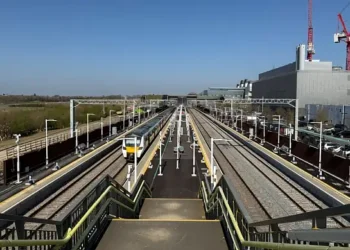

Millions of passengers travelling between Oxford and Cambridge are set to see their journeys transformed as the East West Rail expansion moves into a major new phase. The project promises more frequent trains, upgraded stations and modern low-carbon trains, reshaping how people commute, study and do business across one of the UK’s most dynamic corridors.
The latest plans, announced on 19 November 2025, confirm that up to five trains per hour will run across the route, supported by new and improved stations and better access in local communities. Additionally, East West Rail will anchor long-term regional growth by supporting tens of thousands of jobs, enabling new homes and connecting residents to a forthcoming Universal theme park and wider innovation hubs.
The East West Rail expansion is a multi-billion-pound programme to deliver a modern, high-capacity rail link between Oxford and Cambridge, with new services and infrastructure confirmed in the latest announcement. It will operate more frequent trains, add new stations along the Marston Vale Line and introduce hybrid battery-electric trains on a partially electrified route.
The project aims to support £6.7 billion of economic growth by 2050, alongside up to 100,000 new homes and tens of thousands of jobs. As a result, the railway is positioned as a transport spine for a region often compared to a European technology powerhouse.
Why East West Rail matters for everyday passengers
More frequent trains and better journeys
The most immediate change for commuters will be the increase in train frequency from three or four trains an hour to as many as five. This uplift is expected to deliver up to 70 per cent more seating across the route, easing current crowding and helping passengers find a seat even at busy times.
Moreover, shorter waiting times on platforms will make the railway more attractive for both daily commuters and occasional travellers. The higher frequency also gives the operator greater flexibility to recover from delays, which should lead to a smoother and more reliable service for passengers.
Improving comfort and resilience on the route
More seats and more options naturally translate into a more comfortable journey, particularly for passengers travelling longer distances between major towns and cities. Additionally, the extra trains allow for a more even spread of demand throughout the day, reducing pinch points that currently cause frustration.
The project team emphasises that reliability is just as important as speed, with the enhanced timetable designed to handle disruptions more effectively. As a result, commuters should experience fewer cancellations and less time spent waiting for replacement services or disrupted connections.
New stations, better access and local regeneration
Upgrading existing hubs and opening new stations
In addition to timetable improvements, East West Rail will deliver new station entrances at Bletchley, Bedford and Cambridge, helping passengers access platforms more quickly and safely. Furthermore, four entirely new stations are planned along the Marston Vale Line, representing the first major investment on that stretch since the 1960s.
These new stations are designed to serve growing communities that currently have limited public transport options. They will also support local development by making it easier for residents to reach jobs, education and leisure opportunities across the wider corridor.
Serving the Universal theme park and emerging destinations
One of the most talked-about features of the expansion is the new station at Stewartby, which will provide direct rail access to the upcoming Universal theme park. The attraction is forecast to add almost £50 billion to the economy by 2055 and to welcome more than 8.5 million visitors in its first year.
Additionally, the new station will support everyday travel for local residents, ensuring that investment benefits both visitors and the existing community. For businesses across the corridor, improved rail access is expected to boost visitor numbers, supply chains and employment opportunities linked to the park and associated developments.
Headline benefits of the East West Rail expansion
| More frequent services | Up to five trains per hour between Oxford and Cambridge, reducing waiting times for passengers. |
| Extra capacity | Up to 70 per cent more seating across the route, easing crowding and improving comfort. |
| New and improved stations | Seven new stations and upgraded entrances at Bletchley, Bedford and Cambridge to enhance access. |
| Greener trains | Hybrid battery-electric trains operating on a partially electrified route to cut emissions and noise. |
| Economic growth | Support for £6.7 billion in growth, up to 100,000 homes and tens of thousands of jobs by 2050. |
The project also includes a new Cambridge East station and an eastern entrance at Cambridge Central, both intended to reduce congestion and improve access for surrounding communities. By connecting into the newly upgraded Newmarket Line, the railway will provide faster, more reliable journeys to destinations such as Norwich, Felixstowe and Ipswich.
Furthermore, this will open up fresh opportunities for freight, logistics and regional business development, particularly in sectors tied to ports and advanced manufacturing. Local authorities and business groups argue that better rail links will help distribute growth more evenly along the corridor.
- The project will increase service frequency so passengers wait less and enjoy a more flexible timetable.
- New stations will bring rail access to communities that have been under-served for decades.
Greener trains and modern infrastructure
Hybrid battery-electric trains for a low-carbon future
East West Rail plans to run cutting-edge hybrid battery-electric trains along a partially electrified route, delivering faster and quieter journeys while keeping infrastructure costs manageable. These trains will draw power from overhead lines where possible and use on-board batteries elsewhere, reducing local air pollution around stations and built-up areas.
Moreover, the flexibility of hybrid technology makes it easier to phase in future electrification without disrupting services. For passengers, this should mean smoother acceleration, less noise and a more modern feel throughout the journey.
Supporting the government’s wider transport ambitions
The expansion aligns with the government’s broader plan to modernise the rail network and place passengers at the centre of new investment. East West Rail is a core component of ambitions to make the Oxford–Cambridge corridor a leading European hub for research, technology and high-value industries.
Additionally, ministers highlight that the corridor has already delivered tens of thousands of jobs and billions of pounds of investment over the past decade. By improving rail connections, they argue, the project will help ensure that growth benefits existing communities, new neighbourhoods and employers of all sizes.
Voices from business and passengers
Support from business groups and watchdogs
Business organisations such as the British Chambers of Commerce have welcomed the latest announcements, stressing that better rail links improve access to workers, visitors and supply chains. They point out that faster, more frequent services can ease road congestion, support local regeneration and make it easier for firms to recruit talent from a wider area.
Additionally, rail watchdogs and passenger groups have recognised the potential for smoother journeys and more reliable timetables, while continuing to press for careful handling of environmental impacts and construction disruption. Ongoing consultation is expected to shape how detailed designs respond to those concerns.
What the Changes Mean for Commuters
For everyday passengers, the benefits are expected to be felt in shorter waits, more comfortable trains and simpler connections across the region. Moreover, the combination of new stations, better entrances and improved frequencies should make rail a more attractive alternative to driving, particularly for commuters heading to major employment centres and university cities.
As a result, the project is likely to support more sustainable travel habits, reduce pressure on local roads and help shape new patterns of work, study and leisure. Over time, East West Rail is poised to become the spine of a joined-up transport system linking homes, job centres and emerging attractions along the Oxford–Cambridge corridor.
Sources: UK Government, East West Rail, British Chambers of Commerce and Universal Destinations and Experiences, Mohammad Yasin, and the Department for Transport.
Prepared by Ivan Alexander Golden, Founder of THX News™, an independent news organization delivering timely insights from global official sources. Combines AI-analyzed research with human-edited accuracy and context.