
A recent ICE operation has revealed the hidden dangers behind so-called “non-criminal” illegal aliens. Authorities confirmed that a man previously labeled as low-risk is, in fact, a wanted murderer and gang member from El Salvador.
Introduction
Earlier this month, Immigration and Customs Enforcement (ICE) officers arrested Antonio Israel Lazo-Quintanilla, an illegal alien living in the United States. Although his only U.S. violation is driving without a license, he is a known member of the 18th Street Gang and wanted in El Salvador for aggravated homicide and extortion.
Arrest Exposes Broader Criminal Networks
According to ICE, Lazo-Quintanilla’s capture underscores the agency’s ongoing mission to identify and remove dangerous individuals hiding within the country’s borders. The 18th Street Gang, designated as a transnational criminal organization, operates across Central and North America, often using illegal migration routes to expand its presence.
ICE agents located the suspect in October following coordination with Salvadoran authorities and Interpol. The operation was carried out without incident. Once identified, officials confirmed his name appeared on El Salvador’s most wanted list for multiple violent crimes.
Assistant Secretary Tricia McLaughlin stated that this arrest demonstrates how ICE targets “the worst of the worst” before they can victimize Americans.
ICE Disputes Media Narratives
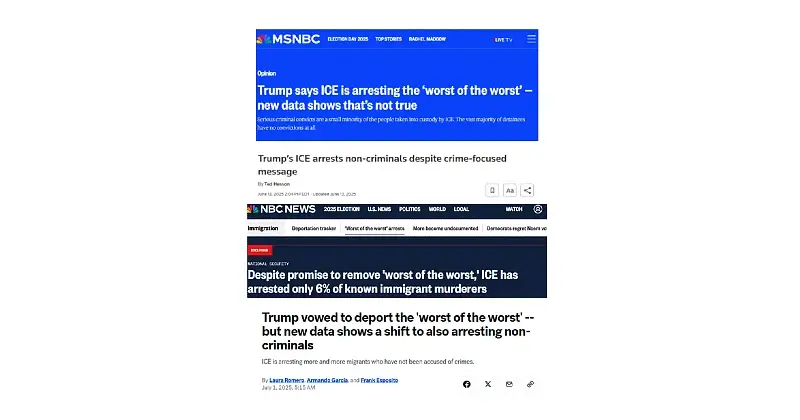
In recent months, several major media outlets have criticized ICE for allegedly detaining non-criminal migrants. However, DHS officials insist that statistics tell a different story. Roughly 70% of individuals arrested by ICE have been charged or convicted of crimes in the United States.
They argue that this figure does not include gang members, terrorists, or fugitives wanted abroad who may not have a U.S. record. The agency maintains that these individuals still represent significant threats to public safety.
Comparison of ICE Data and Media Claims
| Source | Claim or Finding | ICE Response |
|---|---|---|
| NBC News | Only 6% of known immigrant murderers were arrested by ICE | ICE calls this misleading and notes data lag and incomplete court records |
| MSNBC Opinion | ICE arrests “non-criminals” to inflate enforcement numbers | DHS states 70% of arrests involve serious crimes or foreign fugitives |
| DHS/ICE Report | 70% charged or convicted within U.S. jurisdiction | Confirms agency focus on public safety threats |

The 18th Street Gang and Transnational Crime
The 18th Street Gang, also known as Barrio 18, is one of the most violent criminal groups in the Western Hemisphere. It engages in extortion, kidnapping, human trafficking, and drug smuggling. Its network extends from Central America into multiple U.S. cities.
Law enforcement experts note that many members enter the U.S. illegally to evade prosecution in their home countries. By working with foreign partners, ICE and DHS aim to intercept fugitives like Lazo-Quintanilla before they can regroup or recruit within American communities.
Core Facts of the Case
-
Name: Antonio Israel Lazo-Quintanilla
-
Nationality: El Salvador
-
Affiliation: 18th Street Gang (FTO-linked)
-
Wanted for: Aggravated homicide, extortion, and narcotics trafficking
Balancing Enforcement and Public Perception
Critics argue that ICE and DHS sometimes frame arrests in ways that overstate security risks. Legal scholars caution that allegations of gang membership must be proven through credible evidence and international cooperation.
Supporters counter that waiting for foreign convictions or lengthy trials before acting could endanger Americans. They stress that preventive arrests, such as this one, are part of a legitimate national-security strategy.
This ongoing debate highlights the difficulty of balancing transparency with the urgency of law enforcement operations.
Broader Implications for Public Safety
The arrest of Lazo-Quintanilla strengthens ICE’s claim that its enforcement priorities focus on high-risk individuals. It also serves as a warning that some foreign fugitives exploit gaps in immigration screening systems to enter the U.S. undetected.
Officials reaffirm that ICE will continue working with international partners to track fugitives, share intelligence, and ensure that immigration enforcement aligns with both domestic law and human rights standards.
Closing Perspective
The case of Antonio Israel Lazo-Quintanilla demonstrates how complex immigration enforcement has become. While some may view ICE’s actions as politically motivated, others see them as vital to protecting public safety. What remains clear is that criminal networks like the 18th Street Gang operate across borders, and international cooperation remains essential to curbing their reach.
Sources: US Department of Homeland Security.
Prepared by Ivan Alexander Golden, Founder of THX News™
THX News™ is an independent news organization delivering timely insights from global official sources. It combines AI-analyzed research with human-edited accuracy and context.