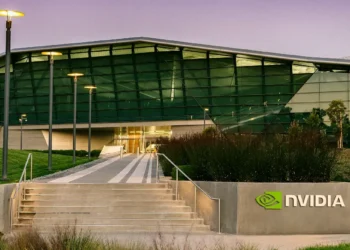

NVIDIA announced new accelerated computing platforms on March 16, 2026, designed to bring artificial intelligence processing capabilities into space-based environments. The announcement, made during the company’s GTC event, outlines new hardware systems aimed at supporting orbital data centers, satellite missions and geospatial intelligence processing.
The announcement highlights the growing demand for real-time computing in space as satellite constellations expand and generate large volumes of environmental and imaging data. NVIDIA said its platforms are designed to operate in environments where size, weight and power constraints typically limit onboard computing capacity.
Introduction to NVIDIA’s space computing announcement and its significance for orbital AI infrastructure.
NVIDIA said its new space computing strategy focuses on enabling artificial intelligence processing both on orbit and on the ground. According to the company’s March 2026 announcement at its GTC conference, the initiative aims to integrate satellite systems, orbital data centers and terrestrial infrastructure into a continuous computing environment.
Overview of the new NVIDIA Space-1 Vera Rubin Module and its role in enabling AI processing in orbit.
NVIDIA introduced the Space-1 Vera Rubin Module as a computing platform designed specifically for space-based artificial intelligence processing. According to NVIDIA’s March 2026 product announcement, the module integrates CPU and GPU components intended to support machine learning workloads directly in orbit.
Meanwhile, the company said the module is designed to operate within strict spacecraft size, weight and power constraints commonly known as SWaP limitations. NVIDIA stated that the Rubin GPU integrated into the module can deliver up to 25 times the AI compute capability of the NVIDIA H100 GPU for space-based inference workloads.
| Indicator | Recent Movement | Context |
|---|---|---|
| AI compute capability | Up to 25× increase | NVIDIA stated the Rubin GPU in the Space-1 Vera Rubin Module can deliver up to 25× more AI compute than the H100 GPU for space-based inference workloads |
| Orbital AI processing | New capability introduced | NVIDIA’s GTC 2026 announcement described platforms designed to support real-time analytics and autonomous decision systems in orbit |
| Satellite data processing | Expanding demand | NVIDIA said increasing satellite constellations are generating large volumes of geospatial and sensor data requiring faster processing |
How NVIDIA accelerated platforms support autonomous space operations and geospatial intelligence.
NVIDIA said its IGX Thor and Jetson Orin platforms are designed to support artificial intelligence workloads in industrial and edge environments, including spacecraft. According to the company’s March 2026 announcement, the systems enable satellites to process imagery, navigation signals and sensor data locally rather than transmitting raw data to Earth.
Additionally, the company said onboard processing can reduce communication latency and optimize satellite bandwidth usage. By performing AI inference in orbit, spacecraft may be able to respond to environmental signals or operational requirements in near real time.
Explanation of edge computing capabilities provided by IGX Thor and Jetson Orin in space environments.
According to NVIDIA, the IGX Thor platform provides industrial-grade reliability and supports enterprise-level software frameworks required for mission-critical systems. Meanwhile, the Jetson Orin module is designed as a compact computing unit capable of running artificial intelligence models while operating within spacecraft power limits.
NVIDIA said these systems enable satellites and orbital platforms to perform tasks such as sensor analysis, autonomous navigation and data prioritization. Consequently, some processing tasks can occur directly in orbit rather than relying entirely on ground-based infrastructure.
Industry partners adopting NVIDIA space computing platforms for next-generation space missions.
NVIDIA said several companies in the commercial space sector are integrating its computing systems into future missions. According to the company’s March 2026 announcement, organizations including Aetherflux, Axiom Space, Kepler Communications, Planet Labs PBC, Sophia Space and Starcloud are testing or deploying NVIDIA accelerated computing platforms.
These partnerships highlight a broader trend toward increasing computational capacity in satellite networks and orbital infrastructure. As a result, companies involved in geospatial monitoring, communications and orbital services are exploring new methods to process large data volumes directly in space.
Summary of partner use cases including Aetherflux, Axiom Space, Kepler Communications and Planet.
- Aetherflux: The company said the Space-1 Vera Rubin Module enables energy-efficient AI processing in orbit to support autonomous space operations, according to a statement from Aetherflux founder and CEO Baiju Bhatt.
- Kepler Communications: CEO Mina Mitry said NVIDIA Jetson Orin is intended to support intelligent routing and network management across the company’s satellite constellation.
- Planet Labs PBC: Cofounder and CEO Will Marshall said NVIDIA platforms are being used to process Earth-imaging data and accelerate geospatial intelligence analysis.
- Sophia Space and Starcloud: Both companies said NVIDIA edge computing systems could support orbital data centers and hosted infrastructure for space-based applications.
AI-powered orbital infrastructure and its impact on real-time space data processing.
The commercial space industry is generating rapidly growing volumes of observational data from satellites equipped with imaging, radar and radio-frequency sensors. NVIDIA said its space computing platforms are designed to process this data more quickly through a combination of on-orbit AI systems and ground-based computing resources.
Meanwhile, the company said its RTX PRO 6000 Blackwell Server Edition GPU supports high-throughput geospatial analysis on Earth. NVIDIA stated the platform can deliver up to 100 times faster processing performance than legacy CPU-based batch systems when analyzing large imagery datasets.
Narrative explanation of how orbital data centers support autonomous sensing, analytics and decision-making.
According to NVIDIA’s announcement, orbital data centers could allow satellite operators to analyze sensor data immediately after collection. This capability may support applications such as environmental monitoring, disaster response and infrastructure analysis.
Additionally, combining orbital computing with ground-based systems allows researchers and organizations to analyze historical geospatial datasets alongside new observations. NVIDIA said this approach may help accelerate scientific research and operational decision-making that relies on large satellite imagery archives.
In Conclusion
NVIDIA’s March 2026 announcement outlines a strategy to expand artificial intelligence computing beyond traditional data centers into space-based infrastructure. The company said its platforms are designed to support satellite missions, orbital data processing and geospatial intelligence workloads.
As commercial space activity continues to expand, the ability to process data directly in orbit may reduce latency and improve operational efficiency. NVIDIA said its computing platforms aim to support this shift by combining onboard AI systems with high-performance ground processing infrastructure.
Sources: NVIDIA.
Prepared by Ivan Alexander Golden, Founder of THX News, an independent news organization delivering timely insights from global official sources.
Research combines AI-assisted analysis with human-edited accuracy and context.