
European security cooperation has increasingly focused on defence spending, industrial coordination and burden sharing within NATO. Governments across the continent are reviewing how to strengthen collective capability in response to Russia’s actions and evolving global security dynamics.
The Prime Minister has told the Munich Security Conference that Europe must move from overdependence on the United States towards a more European NATO built on interdependence, underpinned by deeper UK–EU defence ties.
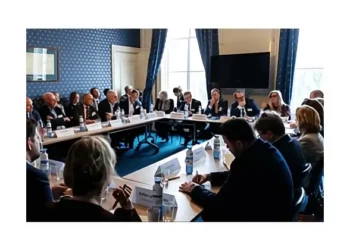
Speaking at the Munich Security Conference on 14 February 2026, the Prime Minister set out a vision for a more European NATO, urging closer UK–EU defence cooperation and greater shared responsibility for security.
He reaffirmed that the United States remains an indispensable ally while arguing that Europe must strengthen its own defence capability, supported by increased UK spending and expanded industrial collaboration across the continent.
Prime Minister’s Call for a More European NATO
The Prime Minister said Europe must shift from overdependence on the United States towards interdependence within NATO. He stated that while the US remains an indispensable ally, Europe must strengthen its own sovereign deterrence and hard power.
He told conference delegates that there is no British security without Europe and no European security without Britain. The remarks framed the UK as seeking deeper cooperation rather than withdrawal from transatlantic ties.
- Shift from overdependence to interdependence
- Reaffirmation of US as indispensable ally
- Emphasis on sovereign European deterrence
UK and EU Defence Cooperation
The Prime Minister argued that closer UK–EU defence and security ties are required in response to the threat from Russia. He said Europe’s security architecture must reflect shared responsibility and collective effort.
He described Europe as possessing economies that are collectively far larger than Russia’s. However, he said fragmented planning and procurement have reduced the overall impact of European defence capability.
Defence Spending and Industrial Integration
The Prime Minister said the UK defence budget is rising to record levels, delivering what he described as the biggest boost to defence spending since the Cold War. He confirmed that spending will total £270 billion during this Parliament.
He also highlighted the contribution of British companies to Europe’s defence industrial base, noting they account for over a quarter of the continent’s capability and employ around 239,000 people across the UK.
UK Defence Spending and Industrial Contribution
| Defence budget this Parliament | £270 billion |
| Industrial employment | Approx. 239,000 UK jobs |
| Share of European defence base | Over one quarter attributed to UK firms |
Bilateral Agreements and Joint Capability Development
The Prime Minister referenced existing bilateral defence cooperation as examples of practical collaboration. These include a £10 billion agreement with Norway to supply frigates and an £8 billion Typhoon aircraft deal with Turkey.
He also cited ongoing collaboration with Germany, Italy and France on next-generation long-range missiles. The remarks positioned these partnerships as evidence of what broader European coordination could achieve.
- £10 billion frigate deal with Norway
- £8 billion Typhoon agreement with Turkey
- Joint missile collaboration with Germany, Italy and France
Referenced Bilateral Defence Agreements
| Norway | Frigate supply agreement valued at £10 billion |
| Turkey | Typhoon aircraft deal valued at £8 billion |
| Germany, Italy, France | Collaboration on next-generation long-range missiles |
Political Context and Public Consent
The Prime Minister said leaders must build public consent for defence decisions and level with the public about security choices. He warned against what he described as simplistic answers offered by political extremes.
He said that defence investment and cooperation are intended to protect democracy, liberty and the rule of law. The remarks linked domestic resilience to broader European security coordination.
Stakeholder Comments
Ministerial Comments
The Rt Hon Sir Keir Starmer KCB KC MP, Prime Minister said;
“There is no British security without Europe, and no European security without Britain. That is the lesson of history – and it is today’s reality too. We must move from overdependence to interdependence, strengthening our own sovereign deterrence while remaining committed to our indispensable alliance with the United States.”
A Final Reflection
The Prime Minister’s address set out a call for a more European NATO based on interdependence and stronger UK–EU defence ties. He linked increased UK defence spending and industrial integration with broader European capability development, while reaffirming the role of the United States as an ally.
The speech positioned bilateral defence agreements and industrial cooperation as practical examples of shared responsibility. It framed European security as a collective effort grounded in higher investment and closer coordination.
Sources: Prime Minister’s Office.
Prepared by Ivan Alexander Golden, Founder of THX News, an independent news organisation delivering timely insights from global official sources. Combines AI-analysed research with human-edited accuracy and context.