U.S. Customs and Border Protection reported that the Border Patrol’s San Diego Sector recorded a 93 percent drop in apprehensions during the first two months of fiscal year 2026, reaching levels not seen since the 1960s. The figures, released in San Diego at the start of the new fiscal year, were attributed by sector leadership to policy changes, enforcement actions, and infrastructure upgrades aimed at reducing illegal crossings.
The release of early fiscal year data places the San Diego Sector within a broader nationwide decline in border encounters reported by U.S. Customs and Border Protection. The figures cover October and November 2025, the opening months of fiscal year 2026, and reflect operational outcomes following changes to border enforcement practices along the southwest border.
San Diego Sector FY2026 apprehension figures
According to statistics published by U.S. Customs and Border Protection, the San Diego Sector recorded 1,793 apprehensions during the first two months of fiscal year 2026. This represents a sharp reduction in activity along the sector’s area of responsibility. The figures were released as part of CBP’s official monthly reporting. The agency stated that such low levels have not been observed in the sector since the 1960s.
Comparison with prior years
CBP data shows that during the same period one year earlier, the San Diego Sector recorded 24,735 apprehensions. The current total therefore reflects a 93 percent year-on-year decrease. This decline aligns with broader southwest border trends cited by CBP in its national reporting. In practical terms, fewer apprehensions have reduced processing demands on agents in the sector.
| Indicator | Recent Movement | Context |
|---|---|---|
| San Diego Sector apprehensions | 93% decrease | CBP reports 1,793 apprehensions in Oct–Nov FY2026, down from 24,735 a year earlier. |
| Historical comparison | Lowest since 1960s | CBP notes activity levels not seen in the sector for several decades. |
Enforcement policies and operational changes
Chief Patrol Agent Justin De La Torre cited policy and operational adjustments as central to the reduction in illegal crossings. He stated that ending the practice of releasing individuals into the United States after illegal entry altered incentives along smuggling routes.
Additionally, he pointed to increased prosecutions for illegal entry. These measures were described as allowing agents to focus more on patrol and interdiction.
End of releases and expedited removals
De La Torre said that the sector no longer experiences large numbers of individuals entering illegally and surrendering with the expectation of release. According to his remarks, support from the U.S. Attorney’s Office for prosecutions and expedited removals has reinforced deterrence. As a result, Border Patrol agents have spent less time on processing duties. The operational effect has been greater coverage along high-risk corridors.
Infrastructure, partnerships, and technology
CBP credited physical infrastructure and technology investments with supporting enforcement outcomes in the San Diego Sector. De La Torre highlighted ongoing border wall construction in the eastern portion of the sector.
He also referenced collaboration with local, state, and federal agencies. Joint efforts with international partners and the Department of War were cited as contributing factors.
Barrier construction and interagency cooperation
The San Diego Sector is currently adding approximately 14 miles of new barrier infrastructure along the U.S.–Mexico border. CBP stated that these additions are paired with upgraded surveillance technology. Interagency coordination has supported information sharing and operational planning. Together, these measures have been presented as strengthening overall border security.
Narcotics seizures and broader security trends
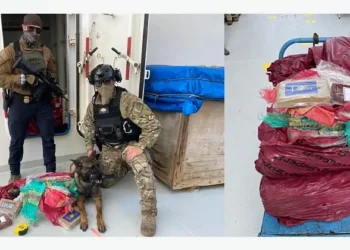
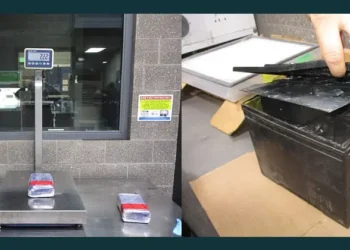
Alongside reduced apprehensions, CBP reported continued narcotics enforcement activity in the San Diego Sector. During fiscal year 2025, the sector seized a record 11,311 pounds of methamphetamine.
Early fiscal year 2026 figures indicate continued seizures of methamphetamine, cocaine, and fentanyl. CBP linked these outcomes to sustained enforcement pressure on smuggling networks.
Early FY2026 seizure results
During the first two months of fiscal year 2026, the San Diego Sector seized 970 pounds of methamphetamine, 555 pounds of cocaine, and 113 pounds of fentanyl, according to CBP data.
These figures reflect ongoing interdiction efforts despite reduced crossing volumes. CBP stated that disrupting drug trafficking remains a priority mission. The seizures demonstrate continued focus on contraband moving through border corridors.
- Operational confidence: De La Torre stated that reduced crossings allow agents to concentrate on patrol and interdiction, per CBP remarks.
- Deterrence effect: CBP attributes lower activity to policy changes that remove incentives for illegal entry.
National context and southwest border trends
CBP data indicates that the San Diego Sector’s experience mirrors broader nationwide declines in encounters at the southwest border. DHS and CBP reporting show that nationwide encounters in October and November reached record lows compared with prior years.
Average daily encounters across the southwest border fell sharply during this period. These trends have been attributed by CBP to unified enforcement policies and infrastructure investments.
Record-low nationwide encounter levels
According to DHS and CBP statistics, total nationwide encounters in October and November combined were approximately 60,940, well below previous record lows. USBP apprehensions averaged fewer than 10,000 per month nationwide during much of 2025.
The San Diego Sector’s figures were consistent with reductions reported in other southwest border sectors. CBP described the trend as a significant shift in border activity levels.
Bottom Line
The early fiscal year 2026 data from the San Diego Sector reflects a substantial decline in apprehensions compared with recent years. CBP attributes the reduction to enforcement policy changes, infrastructure investments, and interagency cooperation.
While the sector continues to focus on narcotics interdiction and border security, the reported figures place San Diego within a broader nationwide pattern of reduced border encounters.
Sources: U.S. Customs and Border Protection, Department of Homeland Security.
Prepared by Ivan Alexander Golden, Founder of THX News™, an independent news organization delivering timely insights from global official sources.
Combines AI-analyzed research with human-edited accuracy and context.