
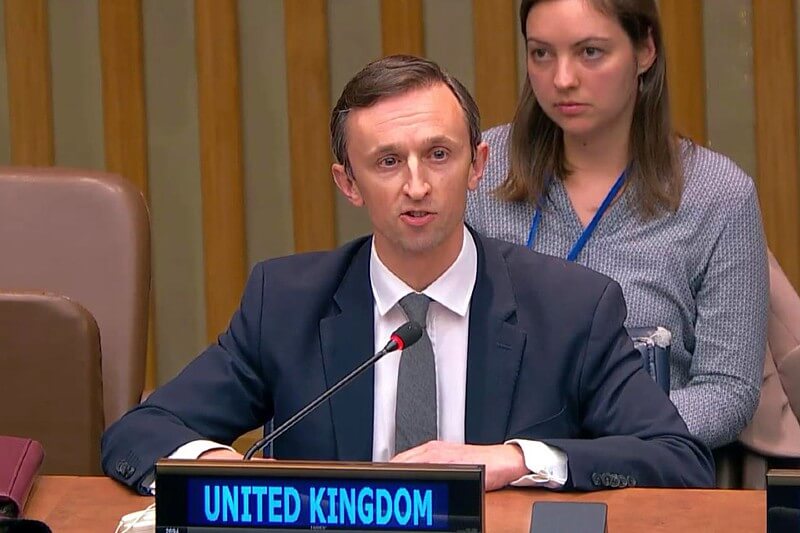
The United Kingdom has backed a new UN Security Council resolution renewing the African Union Support and Stabilisation Mission in Somalia, maintaining international security support for another year. The decision, explained by the UK’s Deputy Permanent Representative to the UN, Ambassador Archie Young, was delivered during a Security Council meeting in New York amid ongoing concerns about funding pressures and regional security threats.
The resolution confirms continued international backing for African Union-led security operations in Somalia, while also drawing attention to financial and logistical constraints that could affect mission effectiveness if left unresolved.
Renewal of the AUSSOM mandate
The Security Council resolution authorises the African Union Support and Stabilisation Mission in Somalia to continue operating through to the end of 2026. The UK described the vote as a clear signal of international resolve to maintain stability and support Somali authorities during an ongoing transition period.
The mandate ensures the continued presence of African Union personnel supporting Somali forces against militant threats, while reinforcing civilian protection and stabilisation efforts across the country.
- Mandate extended until 31 December 2026
- Continued support for Somali security forces
Connection to counter-terrorism efforts
The UK highlighted that the resolution follows closely after the unanimous extension of the UN sanctions regime targeting Al-Shabaab. Together, these decisions were presented as reinforcing a coordinated approach to limiting the group’s operational capacity.
By combining peace support operations with sanctions enforcement, the Security Council aims to reduce access to weapons, financing, and external assistance for militant networks operating in and around Somalia.
Security Measures Linked to the Resolution
| Peace support | Continued African Union deployment supporting Somali forces |
| Sanctions regime | Extended restrictions targeting Al-Shabaab activities and financing |
Funding pressures and operational risks
During the explanation of vote, the UK drew attention to chronic underfunding affecting both AUSSOM and the UN Support Office in Somalia. These financial constraints were described as posing practical risks to the delivery of logistics, transport, and medical support.
Without adequate funding, the mission could face operational limitations despite its renewed mandate, potentially affecting stability gains made over recent years.
- Identified liquidity shortfalls in UN support systems
- Risk of reduced operational capacity if funding gaps persist
Planned review of UN logistical support
The resolution establishes a formal process to review how the UN provides logistical backing to AUSSOM. The UK confirmed it will work with other Council members ahead of a scheduled assessment in mid-2026.
This review will consider the scale, configuration, and sustainability of support arrangements to ensure they remain aligned with conditions on the ground in Somalia.
Upcoming Review Milestones
| Review timing | Assessment planned for June 2026 |
| Focus areas | Logistics support, mission structure, and financing options |
Stakeholder Comments
Archie Young, UK Deputy Permanent Representative to the UN, said;
“This mandate creates a process to enable an informed review of the logistical support provided by the United Nations, ensuring our support to Somalia remains targeted and effective.”
Moving Forward
The UK said the renewed mandate reflects long-term international engagement in Somalia since 2007, while recognising evolving national conditions. Continued Council decisions will be guided by developments on the ground, Somali security capacity, and sustainable financing.
The outcome of the mid-2026 review is expected to shape how international support is structured in the following year.
Sources: Foreign, Commonwealth & Development Office and Archie Young CMG.
Prepared by Ivan Alexander Golden, Founder of THX News™, an independent news organisation delivering timely insights from global official sources. Combines AI-analysed research with human-edited accuracy and context.