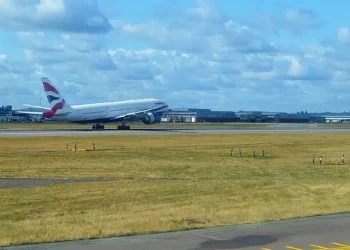

The UK government has confirmed that airlines are not currently experiencing a jet fuel shortage, stating on 24 April 2026 that passengers do not need to change travel plans while monitoring global supply risks following the reported closure of the Strait of Hormuz..
The update was issued jointly by the Department for Transport, the Department for Energy Security and Net Zero, and the Foreign, Commonwealth & Development Office. It reflects ongoing coordination with airlines, airports and fuel suppliers to maintain operations despite global disruption concerns.
Officials stated that UK airlines typically purchase jet fuel in advance and that airports maintain reserves to support operational resilience. The government continues to meet regularly with industry partners to monitor conditions and communicate with passengers as needed.
Government confirms current jet fuel position
UK airlines have indicated they are not currently experiencing a shortage of jet fuel, with existing supply arrangements supporting continued operations. Fuel is typically secured in advance, and airports maintain stocks to ensure resilience against short-term disruptions.
- Fuel procurement: Airlines purchase jet fuel ahead of time to manage supply risks
- Airport reserves: Stored fuel stocks provide operational stability during disruptions
- Industry coordination: Ongoing monitoring between government and aviation sector
Travel advice for passengers
Passengers are advised that there is no current need to change travel plans, although they should continue checking with airlines before departure. The government has also encouraged travellers to review official travel advice and ensure appropriate insurance coverage.
- Flight checks: Passengers should confirm schedules directly with airlines
- Travel advice: Latest updates available through official government channels
- Insurance cover: Travellers advised to hold valid travel insurance
Passenger rights during disruption
Under UK law, passengers are entitled to a full refund or alternative travel arrangements if their flight is cancelled. These protections apply depending on departure and arrival locations and the airline involved.
Passenger Rights Overview
| Indicator | Recent Movement | Context |
|---|---|---|
| UK departures | Protected | All flights departing UK airports covered under UK law |
| EU arrivals | Conditional | Applies to UK airlines arriving in EU destinations |
| Refund rights | Available | Passengers can claim refunds or re-routing if flights are cancelled |
Monitoring and response to global supply risks
The government has been monitoring jet fuel supply closely following the reported closure of the Strait of Hormuz. Officials are working with international partners and industry stakeholders to maintain fuel flows and support aviation operations.
Recent developments in the aviation sector have included flight cancellations, route adjustments and fare increases on some services, with airlines citing rising oil prices and fuel supply volatility in global markets, according to industry reports and airline communications. These changes reflect operational responses to cost pressures, even as current supply arrangements continue to support airline operations.
Supply Monitoring Measures
| Indicator | Recent Movement | Context |
|---|---|---|
| Global monitoring | Ongoing | Government coordinating with international partners on supply risks |
| Industry engagement | Active | Regular meetings with airlines and suppliers to assess conditions |
| Contingency planning | In place | Preparedness measures to respond to potential supply disruptions |
Support measures for airlines and airports
The government has confirmed that airlines will be able to retain airport slots even if they are unable to operate flights due to fuel-related disruption. This adjustment to slot usage rules allows airlines to focus on minimising disruption rather than maintaining schedules purely to protect future access.
UK authorities have stated that airlines are not facing a jet fuel shortage and that travel plans can continue without immediate changes. Ongoing monitoring and coordination with industry and international partners are in place to manage potential risks. Passenger rights remain protected under UK law, while temporary flexibility on airline slot usage supports operational continuity.
Sources: Department for Transport, Department for Energy Security and Net Zero and Foreign, Commonwealth & Development Office.
Prepared by Ivan Alexander Golden, Founder of THX News, an independent news organisation delivering timely insights from global official sources. Combines AI-analysed research with human-edited accuracy and context.