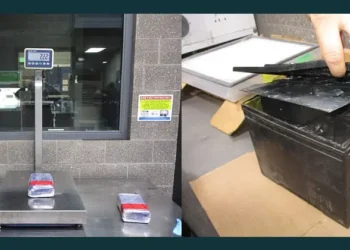

U.S. Customs and Border Protection reported that nationwide border encounters fell again in November 2025, marking the lowest start to a fiscal year on record. DHS also confirmed a seventh straight month in which Border Patrol released zero migrants into the interior while drug seizures rose sharply.
Preliminary DHS data shows sustained declines in encounters alongside increased narcotics interdictions, signaling a shift from crisis-level migration flows to enforcement-driven stabilization. While final November statistics are still pending, the early figures are already shaping policy debate around border security, public safety, and immigration enforcement heading into 2026.
Border Encounters Fall to Historic Lows
Nationwide CBP encounters totaled 30,367 in November, down from 30,573 in October, which itself had already been a historic low. Combined October–November encounters reached 60,940, the lowest opening two months of any fiscal year on record. However, DHS cautions these figures remain preliminary until final publication in coming weeks.
Additionally, Border Patrol reported zero releases for the seventh consecutive month, meaning all apprehended migrants were processed under existing enforcement authorities. The claim of sustained zero releases is supported by month-to-month operational briefings. For border communities, this has translated into fewer large-scale releases into local shelters and public facilities, easing short-term capacity pressures.
| Indicator | Recent Movement | Context |
|---|---|---|
| Total CBP Encounters (Nov) | Down from October | 30,367 nationwide, lowest November on record |
| Border Patrol Releases | Zero for seventh straight month | All apprehensions processed under enforcement authorities |
| Two-Month FY Total | Historic low | 60,940 combined October–November encounters |
DHS and CBP Leadership Response
DHS Secretary Kristi Noem said the results reflect what the department views as the “most secure border in history,” crediting sustained enforcement under the current administration. Meanwhile, CBP Commissioner Rodney Scott described the latest figures as evidence that operational tempo and deterrence efforts are reshaping border dynamics.
The leadership claims are supported by verifiable encounter totals released by CBP and independently reported by national media. On the ground, agents report lower daily apprehension volumes compared with recent years. Taken together, the data and field conditions indicate a measurable operational shift, while broader societal impacts remain under evaluation.
Enforcement Trends Driving the Decline
Since late January through November, total southwest border enforcement encounters reached 117,105, roughly 37 percent lower than the prior administration’s monthly average peak levels. USBP nationwide apprehensions have averaged under 10,000 per month during this period, an unusually low level by modern standards.
However, analysts note the comparisons selectively contrast the current low-flow period with the height of 2023 migration surges. Daily average apprehensions on the southwest border now stand near 245 per day, versus more than 5,100 per day during peak periods two years earlier. For frontline agents, this has reduced crowding in short-term holding facilities and shifted operational focus toward interdiction and investigations.
Drug Seizures and Criminal Interdiction
Drug interdictions rose sharply even as migrant encounters fell, underscoring a shift toward targeting transnational trafficking networks. In November alone, CBP seized 54,947 pounds of narcotics nationwide, a 33 percent increase from October. Fentanyl seizures reached 1,543 pounds, up 59 percent month over month and the highest monthly total in more than a year.
Methamphetamine and cocaine seizures also climbed significantly, with meth up 118 percent and cocaine up 40 percent. For border regions, the immediate effect has been increased coordination with federal prosecutors and local task forces. In broader terms, the data suggests that reduced migrant flows are allowing more enforcement resources to be redirected toward organized drug trafficking.
Public Opinion and Policy Implications
Public support for border enforcement remains high overall, though humanitarian concerns continue to shape the debate. Recent national polling shows majority approval for stricter border security measures, while interior deportation tactics divide opinion along partisan lines.
- Public Approval: Surveys show 56–62% approval for current border enforcement among the general public.
- Immigrant Voters: KFF/New York Times polling found 62% approval among immigrant voters, including high Republican immigrant support.
- Wall Expansion: Pew Research reports 56% now favor substantial border wall expansion.
- Humanitarian Concerns: Majorities of Democrats view deportation practices as too harsh despite falling encounters.
In Conclusion
November’s preliminary border data points to historically low encounter levels alongside rising narcotics seizures, signaling a shift in both migration pressure and enforcement posture.
While DHS credits sustained policy execution for the decline, independent analysts caution that longer-term crime trends and migration drivers remain influenced by economic and geopolitical forces beyond border control alone. As final figures are released in coming weeks, policymakers and professionals will be watching closely to assess whether these trends hold into 2026.
Sources: U.S. Customs and Border Protection, Department of Homeland Security, ABC News, and Pew Research Center.
Prepared by Ivan Alexander Golden, Founder of THX News™, an independent news organization delivering timely insights from global official sources.
Combines AI-analyzed research with human-edited accuracy and context.