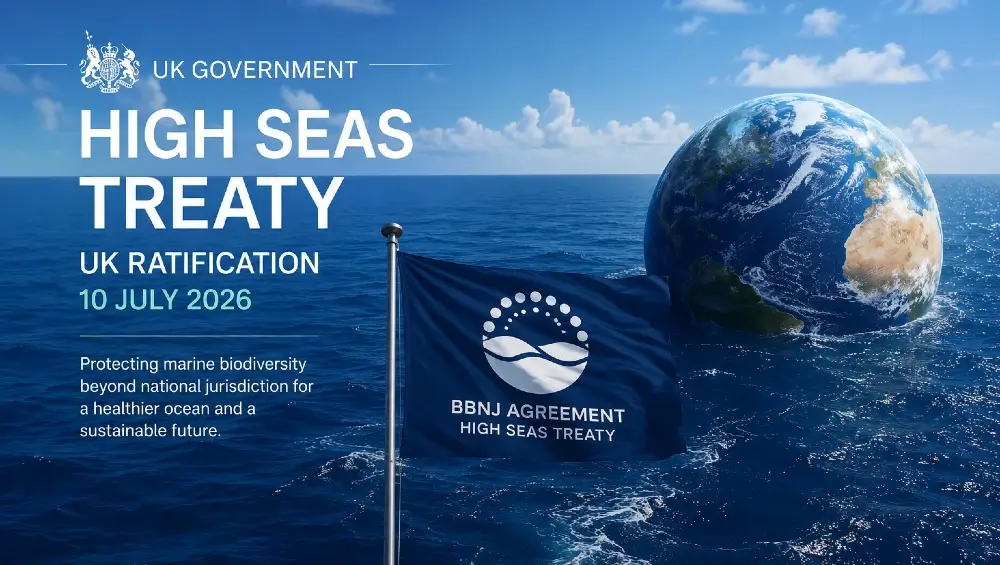
The UK ratified the High Seas Treaty on 10 July 2026 after depositing its instrument of ratification with the United Nations, becoming a party to the Biodiversity Beyond National Jurisdiction (BBNJ) Agreement covering nearly two-thirds of the world’s ocean.
The Foreign Secretary signed the formal ratification document before it was deposited with the United Nations in New York at 14:15 BST. This completed the final domestic and international steps required for the UK to become a party to the agreement.
The Biodiversity Beyond National Jurisdiction (BBNJ) Agreement—commonly known as the High Seas Treaty—applies to marine areas beyond national jurisdiction. It establishes international rules for conserving marine biodiversity, creating protected areas and managing marine resources outside national waters.
UK Completes Treaty Ratification
The UK was among the first countries to sign the agreement in 2023 after participating in negotiations lasting more than a decade. Ratification allows the UK to take a full role in the agreement’s implementation and future decision-making processes.
The required national legislation was completed before the ratification document was deposited. The Biodiversity Beyond National Jurisdiction Act 2026 received Royal Assent on 12 February 2026.
- Signature: The UK signed the international agreement in 2023.
- Legislation: Parliament approved the legal framework needed for ratification.
- Deposit: The formal document was submitted to the United Nations in New York.
Protecting Biodiversity Beyond National Waters
Areas beyond national jurisdiction are not governed by the laws of any single country. They contain marine habitats and species that can be affected by activity across international waters.
The agreement provides a shared framework for countries to strengthen protection of these ecosystems. It is intended to support biodiversity conservation while maintaining international cooperation over ocean use.
New Marine Protected Areas
The agreement establishes the first legal mechanism for creating marine protected areas on the high seas. These areas can be used to conserve vulnerable habitats and species outside national boundaries.
Marine protected areas may support wider efforts to reduce biodiversity loss and preserve ocean ecosystems for future generations. Their establishment will depend on decisions taken through the agreement’s international processes.
Sustainable Use of Marine Resources
The agreement introduces provisions for the sustainable management of marine resources in international waters. It also establishes rules for sharing benefits derived from marine genetic resources.
These resources may have applications across several areas of research and development. The framework seeks to ensure that benefits are shared fairly among participating countries.
- Medicine: Marine genetic material may support pharmaceutical research.
- Biotechnology: Ocean resources may contribute to new biological applications.
- Agriculture: Scientific discoveries may support agricultural research and development.
- Research: The agreement supports international access to scientific knowledge.
High Seas Treaty and the 30×30 Biodiversity Target
The agreement supports the Kunming-Montreal Global Biodiversity Framework, including the commitment to protect 30% of the world’s land and ocean by 2030. It also reinforces the UN Convention on the Law of the Sea as the basis for international ocean governance.
Healthy ocean ecosystems support food supplies, oxygen production and climate regulation. The agreement provides countries with an additional framework for coordinating action on biodiversity loss and marine conservation.
UK Role and Implementation
The UK played a leading role in negotiations before the agreement was adopted by United Nations member states in 2023. Its domestic legislation now enables ministers and public bodies to meet the obligations arising from ratification.
The agreement entered into force internationally in January 2026. The first Conference of Parties is scheduled for January 2027, when participating countries will begin formal collective decision-making under the new framework.
The High Seas Treaty is regarded as the first comprehensive international agreement governing biodiversity in areas beyond national jurisdiction since the UN Convention on the Law of the Sea.
Agreement Timeline
| Stage | Date | Development |
|---|---|---|
| Adoption | 2023 | UN members adopted the agreement |
| UK signature | 2023 | UK joined the first signatories |
| Royal Assent | 12 February 2026 | UK legislation was completed |
| Entry into force | January 2026 | Agreement became internationally active |
| UK ratification | 10 July 2026 | Document deposited with the UN |
| First conference | January 2027 | Parties will meet formally |
Treaty Measures
| Measure | Coverage | Purpose |
|---|---|---|
| Protected areas | High seas | Conserve habitats and species |
| Resource management | International waters | Support sustainable use |
| Benefit sharing | Marine genetic resources | Distribute benefits fairly |
| International governance | Participating countries | Coordinate ocean protection |
Stakeholder Comments
Ministerial Comments
Seema Malhotra MP, Parliamentary Under-Secretary of State at the Foreign, Commonwealth and Development Office said;
“The ocean is one of our planet’s greatest shared resources, supporting livelihoods, food security and biodiversity.
By ratifying the BBNJ Agreement, the UK is turning international ambition into action and helping to protect vulnerable marine habitats and species.
A healthy ocean is essential for food security and climate resilience in the UK and around the world. Today’s milestone demonstrates our commitment to protecting it for future generations.”
Emma Hardy MP, Marine Minister said;
“I’m proud that the UK has now ratified this landmark Agreement. For the first time, we have the global tools to create marine protected areas beyond national jurisdictions, helping deliver our commitment to protect 30% of the world’s ocean by 2030.”
The UK’s ratification of the High Seas Treaty completes the country’s accession to the Biodiversity Beyond National Jurisdiction Agreement, enabling participation in future decisions on marine protected areas, marine genetic resources and international ocean governance under the United Nations framework.
Sources: Foreign, Commonwealth & Development Office; Department for Environment, Food & Rural Affairs; Seema Malhotra MP; Emma Hardy MP; United Nations.
Prepared by Ivan Alexander Golden, Founder of THX News, an independent news organisation delivering timely insights from global official sources. Combines AI-analysed research with human-edited accuracy and context.