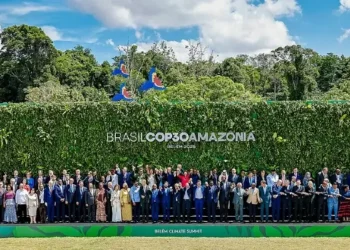
African climate solutions gained renewed international visibility as the African Development Bank Group adopted an informal, dialogue-driven approach at COP30 in Brazil. The initiative positioned Africa’s development priorities firmly within global climate discussions, despite the continent’s minimal contribution to global emissions.
Introduction
Africa’s climate challenges and opportunities were underscored at COP30 in Belém, Brazil, where the African Development Bank Group presented African climate solutions through interactive expert-led discussions, engaging policymakers, financiers, and civil society representatives on resilience, green finance, and sustainable development across the continent.
Reframing Africa’s Climate Voice at COP30
The African Development Bank Group introduced an unconventional format at COP30, replacing formal panels with coffee-style conversations that encouraged direct engagement between participants and Bank specialists. This approach enabled nuanced exchanges on Africa’s climate realities, while also fostering practical discussions on financing and implementation pathways.
Held from 10 to 21 November in Belém, the sessions reflected a deliberate effort to humanise complex climate policy debates. Participants were able to ask detailed questions, challenge assumptions, and explore Africa-specific solutions in a relaxed yet substantive setting.
Al-Hamndou Dorsouma
“At the African Development Bank, our role is to help unlock this potential through integrated and transformative action.”
Dorsouma, Climate and Green Growth Division Manager, emphasised that Africa contributes less than four percent of global greenhouse gas emissions, yet remains disproportionately exposed to rising temperatures, floods, droughts, and climate-driven economic shocks.
Leadership Perspectives on Climate Finance and Innovation
Several senior Bank officials contributed specialised insights during the dialogues, illustrating how African climate solutions are being embedded into financial systems, policy frameworks, and development planning.
Davinah Milenge, Chief Programme Coordinator for Climate Change and Green Growth, outlined initiatives supporting the circular economy across Africa. These programmes aim to reduce waste, increase resource efficiency, and promote sustainable industrialisation, particularly in fast-growing urban centres.
Meanwhile, Gareth Phillips, Manager for Climate and Environmental Finance, focused on green finance instruments and the African Green Banks Initiative. He explained how blended finance and risk-sharing mechanisms are being used to mobilise private capital into renewable energy, climate-smart agriculture, and resilient infrastructure.
James Kinyangi, Coordinator of the ClimDev Special Fund and Climate Action Window, further detailed how these financing windows support climate information services and adaptation planning. By strengthening data availability and institutional capacity, African countries are better positioned to meet their nationally determined contributions (NDCs).
Main African Development Bank Climate Initiatives
| Initiative | Focal Areas | Primary Impact |
| African Green Banks Initiative | Green finance mobilisation | Private sector climate investment |
| ClimDev Special Fund | Climate data and services | Improved adaptation planning |
| Circular Economy Programmes | Resource efficiency | Sustainable industrial growth |
West Africa and Integrated Climate Action
Regional perspectives also featured prominently, particularly from West Africa, a subregion identified as a global climate change hotspot. Arona Soumaré, Chief Regional Specialist on Climate Change for West Africa, led discussions on aligning national and regional climate strategies.
Soumaré highlighted the Bank’s commitment to creating synergies between the Rio Conventions on climate change, biodiversity, and desertification. This integrated approach is designed to ensure that climate investments deliver multiple environmental and socio-economic benefits simultaneously.
Within this context, African climate solutions increasingly focus on:
- Strengthening climate-resilient infrastructure and value chains.
- Aligning biodiversity protection with economic development goals.
Feedback From the Event
Participants from across Africa responded positively to the format. Kenyan visitors Reilo Idagiza Sirali and Lydia Wanjo described the sessions as accessible and substantive, noting how informal dialogue encouraged deeper understanding of policy and finance mechanisms.
Lydia Wanjo
“It was as if we had met over coffee to discuss serious issues about the future of the planet.”
Youth engagement also emerged as a key theme. Maria Micah Maua, part of the Kenyan youth delegation, highlighted the value of learning about just energy transitions and circular economy strategies within an African policy context.
Food for Thought
Africa’s presence at COP30 demonstrated how innovative engagement can elevate African climate solutions within global negotiations. By prioritising dialogue, finance, and integrated policy frameworks, the African Development Bank Group reinforced the continent’s strategic role in climate action.
As Africa continues to pursue climate-resilient growth, these approaches signal a shift toward solutions that combine investment, information, and institutional reform, ensuring that continental priorities remain central to the global climate agenda.
Sources: African Development Bank Group (AfDB), and APO Group distribution.
Prepared by Ivan Alexander Golden, Founder of THX News™, an independent news organization delivering timely insights from global official sources. Combines AI-analyzed research with human-edited accuracy and context.