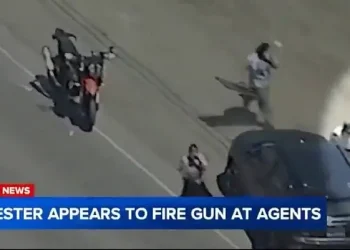
Federal Border Patrol agents came under fire and faced coordinated assaults across Chicago’s Little Village area on Saturday morning. The violence, involving gunfire, vehicle rammings, and thrown debris, has drawn national concern as Homeland Security officials blame sanctuary city politics and media rhetoric for emboldening aggression against law enforcement.
Multiple Assaults Target Federal Convoy
Around 9:30 a.m., Border Patrol agents conducting immigration enforcement operations in Little Village were surrounded by a hostile crowd. As officers detained a suspect, a man driving a black Jeep Wrangler opened fire before fleeing. Moments later, assailants on nearby rooftops hurled bricks and paint cans, damaging several federal vehicles.
Chicago Police Department (CPD) units responded swiftly, escorting agents to safety as additional projectiles rained down. No Border Patrol personnel were injured, though several vehicles sustained visible damage.
When agents attempted to regroup, a separate vehicle rammed their convoy near the intersection of Cermak and California. Officers deployed a Controlled Tire Deflation Device, stopping the attack. Two additional drivers later attempted to block or ram Border Patrol vehicles as the convoy approached an FBI facility, prompting one arrest and an ongoing investigation into the second suspect who fled the scene.
Escalation Near FBI Facility and Retail Parking Lot
As the convoy reached the FBI complex, rioters attempted to breach the perimeter. CPD reinforcements secured the area while federal agents withdrew toward a nearby Sam’s Club parking lot. Protesters pursued and again attacked the convoy, damaging another vehicle and leading to three arrests.
Later that afternoon, additional confrontations occurred near 26th and Kostner. A fourth vehicle ramming broke a convoy window before the suspect fled, evading capture. In total, authorities reported eight U.S. citizens and one undocumented individual arrested for assault or obstruction.
Incident Summary Overview
| Location | Type of Attack | Arrests | Status |
|---|---|---|---|
| Little Village | Gunfire, bricks thrown | 0 | Suspect fled |
| Cermak & California | Vehicle ramming | 1 | Driver arrested |
| FBI Facility | Riot attempt, breach | 0 | Crowd dispersed |
| Sam’s Club Lot | Assault, ramming | 3 | Suspects detained |
| 26th & Kostner | Vehicle ramming | 0 | Driver at large |
Federal Officials Condemn Violence
Assistant Secretary of Homeland Security Tricia McLaughlin denounced the attacks as “unprecedented acts of lawlessness” and directly accused Chicago officials of enabling an anti-law-enforcement atmosphere.
“JB Pritzker and Brandon Johnson have fueled an environment of lawlessness and assault on federal law enforcement,” McLaughlin said. “In less than three hours, Border Patrol faced gunfire, violent mobs, and four vehicle rammings. These attacks are the consequence of vitriolic smears from sanctuary politicians and the media.”
She added that Border Patrol “will continue its mission despite the violence” and warned that any future attacks would be met with swift federal response.
Growing Tensions in Sanctuary Cities
Chicago’s long-standing sanctuary policies have clashed sharply with federal enforcement priorities. The relationship between DHS and local officials has deteriorated amid an influx of more than 45,000 migrants since mid-2022. Residents in areas such as Little Village and Brighton Park have protested both migrant shelters and deportation raids.
Public frustration has grown as activists accuse federal agents of overreach while DHS cites rising hostility against officers. In recent months, local officials have denounced alleged raids in residential areas, while federal authorities claim that misinformation from local politicians has contributed to violent outcomes.
Rising Pattern of Assaults Nationwide
The Chicago assaults align with a broader national pattern. Federal data shows that charges for assaulting federal officers have risen roughly 25% year-over-year through mid-2025. Several of these incidents have involved firearms and vehicular attacks, marking a dangerous escalation in both scale and coordination.
The main contributing factors include:
Intensifying protests against immigration enforcement operations in sanctuary jurisdictions.
Growing online coordination between activist networks monitoring agent movements.
Border Patrol apprehensions along the U.S.–Mexico border have reached a 55-year low, yet operations within major cities have expanded. Federal officials argue that sanctuary city policies hinder cooperation and place officers at higher risk.
Political and Community Fallout
Chicago leaders have yet to release formal statements, though city hall sources confirm ongoing coordination between CPD and DHS to review tactical protocols. Analysts note that this incident may become a political flashpoint ahead of 2026 state elections, testing public sentiment on migration, urban safety, and federal-local cooperation.
Community members in Little Village remain divided—some decrying the violence as unacceptable, others warning that federal enforcement is heightening local fear and instability. Activists plan additional demonstrations this week, signaling that tensions are far from over.
Looking Ahead
The weekend’s events underscore a deepening divide between federal enforcement agencies and sanctuary jurisdictions nationwide. Chicago’s clashes could shape future discussions on immigration enforcement, public safety, and the limits of local autonomy.
Authorities have pledged continued investigation and security reassessments as the search continues for suspects still at large. Meanwhile, federal officials insist the mission will proceed, declaring that “lawlessness will not deter the rule of law.”
Sources: US Department of Homeland Security.
Prepared by Ivan Alexander Golden, Founder of THX News™, an independent news organization delivering timely insights from global official sources. Combines AI-analyzed research with human-edited accuracy and context.