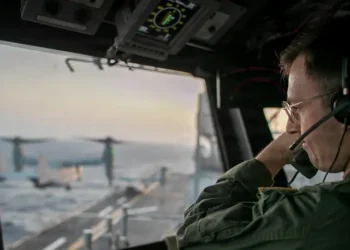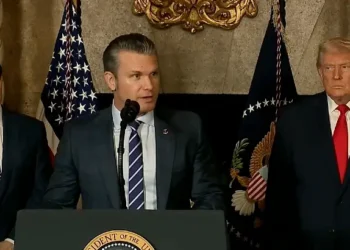

Secretary of War Pete Hegseth and Admiral Brad Cooper, Commander of U.S. Central Command, held a press briefing at CENTCOM headquarters in Tampa on March 5, 2026 to update reporters on Operation Epic Fury and related U.S. military operations in the Middle East.
The briefing matters because it set out named operational claims, including strike totals, reported declines in Iranian missile and drone attacks, and the stated U.S. objective of reducing Iran’s ability to threaten Americans and regional partners.
At the briefing, Hegseth and Cooper described the operation as a continuing U.S. military campaign directed through CENTCOM. The transcript focused on recent strike activity, force posture, air and maritime operations, and the official U.S. assessment of battlefield effects.
U.S. Officials Brief on Operation Epic Fury
According to the briefing transcript, Cooper said CENTCOM was entering its sixth day of the mission and described it as intended to eliminate Iran’s ability to threaten Americans.
Additionally, Hegseth said U.S. authorities, munitions, and force flow remained available for continued operations. That matters in practical terms because it signalled that Washington was presenting the campaign as sustained rather than limited to a single strike window, which shapes how partners and adversaries interpret U.S. intent.
Operation Overview and Military Objectives
According to Admiral Cooper’s remarks at the CENTCOM briefing, the campaign had reached its sixth day by March 5 and involved more than 50,000 uniformed personnel.
He said the mission was aimed at reducing Iran’s ability to threaten Americans, while Hegseth said the operation was being conducted under presidential authority and CENTCOM command structures.
The transcript also showed both men linking the campaign to degrading Iranian naval, missile, and air-defence capacity. In neutral terms, the briefing presented a multi-domain operation with stated military objectives, operational duration, and named command responsibility.
U.S. Strikes Target Iranian Military Capabilities
Admiral Cooper told reporters that U.S. bomber forces had struck nearly 200 targets inside Iran in the previous 72 hours, including around Tehran.
He also said B-2 bombers had dropped dozens of 2,000-pound penetrator bombs on deeply buried ballistic missile launchers within the last hour before the briefing.
Meanwhile, Cooper said U.S. forces had also struck what he described as Iran’s equivalent of Space Command.
The real-world effect of those claims, if accurate, is to show a campaign focused not only on fielded weapons but also on command, launch, and support systems, which would broaden the operational impact beyond individual strike sites.
Recent Operational Data
The briefing transcript included multiple numerical claims from Admiral Cooper about targets, bombs, and equipment losses. Set out together, those figures provide the clearest official snapshot in the record presented during the March 5 event.
| Indicator | Recent Movement | Context |
|---|---|---|
| Duration of operation | Entering day six | Admiral Brad Cooper told reporters at CENTCOM headquarters on March 5 that U.S. forces were starting the sixth day of Operation Epic Fury. |
| Targets struck | Nearly 200 in 72 hours | According to Cooper’s briefing remarks, U.S. bomber forces hit nearly 200 targets deep inside Iran, including areas around Tehran. |
| Penetrator bomb use | Dozens dropped in the last hour | Cooper said U.S. B-2 bombers dropped dozens of 2,000-pound penetrator bombs on deeply buried ballistic missile launchers. |
| Naval vessels hit | Over 30 ships | Cooper said the total had moved from 24 ships earlier in the day to more than 30 by the time of the briefing. |
Declining Iranian Missile and Drone Attacks
Admiral Cooper said ballistic missile attacks had fallen by 90 percent since day one of the operation and drone attacks had fallen by 83 percent over the same period. Those figures were presented by CENTCOM as evidence that the campaign was reducing immediate Iranian offensive activity.
However, Cooper also said U.S. forces remained vigilant, which indicates that CENTCOM was not describing the threat as eliminated. In practical terms, a reported drop of that scale would affect force protection, interception demand, and regional warning posture, while still leaving room for renewed attacks or adaptation by Iranian forces.
Operational Impact Assessment
The briefing linked recent strike activity to a measurable reduction in incoming attacks, using named percentages and a defined comparison point of “since day one.” That gives the public record a quantifiable operational claim tied directly to the CENTCOM commander’s remarks.
- Missile activity: Admiral Brad Cooper said ballistic missile attacks were down 90 percent since day one, indicating a reported reduction in Iranian launch activity.
- Drone activity: Cooper said drone attacks were down 83 percent since day one, suggesting a lower volume of aerial threats against U.S. and partner interests.
- Operational caution: Even with those reported declines, Cooper said CENTCOM remained vigilant, which keeps the official assessment measured rather than final.
Naval and Air Superiority Operations
The briefing described a combined air and maritime campaign intended to establish dominance over the operational environment. Cooper said U.S. and partner forces had destroyed Iranian air defences over several days and had intensified strikes against the Iranian Navy.
Additionally, Cooper said U.S. forces had hit an Iranian drone carrier ship “roughly the size of a World War II aircraft carrier” and that it was on fire during the briefing.
The practical effect of the maritime and air claims, as presented by CENTCOM, is to show an effort to limit Iran’s ability to launch attacks by sea and by air while expanding freedom of movement for U.S. forces.
Maritime and Air Operations Overview
According to the CENTCOM briefing transcript, air dominance and maritime strikes were described as mutually reinforcing parts of the campaign. Cooper said U.S. forces were continuing to hunt air-defence systems while also increasing pressure on Iranian naval assets and missile production capacity.
He also said the next phase would aim to dismantle Iran’s ballistic missile industrial base, not just destroy launchers already in use. In neutral terms, the briefing presented a widening operational scope across air defence, naval power, and missile production infrastructure.
Official Statements from U.S. Leadership
Hegseth and Cooper used the briefing to restate the U.S. operational narrative, including readiness, available munitions, and continued support from named command structures.
Hegseth also rejected reports that an American F-15 had been shot down, saying CENTCOM regarded those reports as false.
Meanwhile, both men tied the campaign to U.S. command authority and presidential direction. That matters because the briefing was not only an operational update but also an official messaging event in which named leaders set out how the administration wanted the campaign understood by domestic and international audiences.
Stakeholder Comments
Secretary of War Pete Hegseth said;
“Our forces are executing with unmatched skill, and the mission is advancing decisively.”
Admiral Brad Cooper, Commander of U.S. Central Command, said;
“In just the last 72 hours, America’s bomber force has struck nearly 200 targets deep inside of Iran, including around Tehran.”
In Conclusion
The March 5 briefing at CENTCOM headquarters presented Operation Epic Fury as a sustained U.S. campaign combining air, maritime, and missile-targeting operations.
Using named figures and command-level remarks, Hegseth and Cooper said U.S. forces had expanded strike activity while Iranian missile and drone attacks had fallen from day-one levels.
The official record from the event therefore offers a clear administration account of operational progress, stated objectives, and battlefield effects. It also shows that U.S. messaging is closely tied to CENTCOM’s reported data points and command-level assessments as the campaign continues.
Sources: U.S. Department of Defense, U.S. Central Command.
Prepared by Ivan Alexander Golden, Founder of THX News, an independent news organization delivering timely insights from global official sources. Combines AI-analyzed research with human-edited accuracy and context.