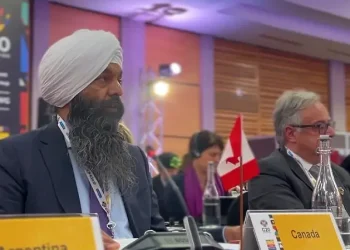
At this year’s Prospectors & Developers Association of Canada (PDAC) convention in Toronto, Ottawa signalled that international development and mining policy are no longer operating in separate silos. Instead, they are moving in tandem—linking economic resilience, gender equality and responsible resource governance.
With $8.1 million in new funding announced for artisanal and small-scale mining projects in Sub-Saharan Africa, Canada reinforced its commitment to ethical supply chains while strengthening its global economic footprint.
Canada’s Strategic Presence at PDAC 2026
PDAC remains the world’s largest international mining gathering, drawing roughly 27,000 participants from 125 countries each year. As a result, it serves not only as a trade show but also as a diplomatic platform where Canada advances both economic and development priorities.
Throughout the convention, Secretary of State Sarai engaged with international counterparts, African ministers and private sector leaders.
Moreover, he joined Parliamentary Secretary Robert Oliphant in discussions with the Mining Association of Canada, emphasizing collaboration as a pathway to long-term economic resilience.
Mining is not just about extraction—it is increasingly about governance, inclusion and shared prosperity.
Funding for Artisanal Mining Communities
At the 27th Annual African Mining Breakfast, Sarai announced $8.1 million in funding for three projects focused on improving stability and governance in artisanal and small-scale mining (ASM).
These initiatives build on Canada’s G7 development priorities and efforts to unlock responsible critical minerals supply chains.
The projects are designed to reduce conflict, strengthen regulatory frameworks and enhance local participation—particularly for women and marginalized groups.
The funded initiatives include:
- $2 million for stability and security initiatives in mining communities in the Democratic Republic of Congo (2026–2028)
- $3 million to strengthen artisanal mining governance in Côte d’Ivoire and Burkina Faso (2026–2028)
- $3.1 million to support inclusive management of Burkina Faso’s Mining Fund for Local Development (2024–2027)
Canada-Funded Mining Development Projects (PDAC 2026)
| Project Focus | Country / Region | Funding |
| Stability & Security of Mining Communities | Democratic Republic of Congo | $2 million |
| Artisanal Mining & Community Resilience | Côte d’Ivoire & Burkina Faso | $3 million |
| Inclusive Mining Fund Management | Burkina Faso | $3.1 million |
Formalizing Artisanal Mining and Strengthening Governance
Artisanal and small-scale mining remains a vital income source across parts of Africa. However, without regulation and oversight, these operations can be vulnerable to conflict, corruption and unsafe working conditions.
Therefore, Canada is supporting projects that:
- Promote conflict prevention and peaceful coexistence between artisanal miners and industrial operations
- Advance transparency and regulatory compliance within local mining sectors
- Increase women’s participation in economic decision-making within mining communities
In addition, Sarai participated in a World Gold Council roundtable on ASM in the gold sector. He highlighted Canada’s backing of the Gold Processing Initiative, which seeks to formalize and regulate artisanal gold production while addressing illicit trade and associated violence.
Mining, Development and Canada’s Global Footprint
Canada’s mining sector is deeply embedded in both domestic employment and international investment. In fact, the minerals sector accounted for approximately 724,000 direct and indirect jobs in 2024 across urban, rural and remote communities.
Meanwhile, Canadian companies hold more than $220 billion in overseas mining assets. Over the past 15 years, Global Affairs Canada has provided close to $800 million in international assistance within the natural resources sector.
Consequently, Ottawa’s approach increasingly integrates mining expertise with development programming. By aligning technical capacity with community resilience initiatives, Canada aims to support sustainable supply chains and inclusive growth abroad.
Strengthening Sustainable Supply Chains
Through its engagement at PDAC, Canada reaffirmed its commitment to ethical mining standards, gender equality and human rights. At the same time, it positioned responsible mineral development as part of a broader economic resilience agenda.
Furthermore, Sarai delivered opening remarks at the African Mining Breakfast and Investing in African Mining Seminar, attended by African ministers and industry leaders. There, he reiterated Canada’s role as a reliable partner in strengthening supply chains and supporting inclusive economic development.
Industry Collaboration and International Dialogue
Beyond funding announcements, the convention facilitated high-level dialogue between government and industry. Sarai and Oliphant met with representatives from the Mining Association of Canada, reinforcing the importance of coordinated public-private efforts.
As global markets adjust to shifting energy priorities and supply disruptions, such collaboration remains central to Canada’s economic strategy.
In other words, mining policy now intersects directly with international development, trade diversification and geopolitical stability.
From Bay Street boardrooms to remote mining communities, the message was clear: responsible resource development must benefit people on the ground.
Looking Ahead
Canada’s $8.1 million funding announcement at PDAC 2026 underscores a deliberate alignment between mining leadership and international development objectives.
By supporting artisanal mining governance in Africa, Ottawa is reinforcing responsible supply chains while contributing to stability and inclusive growth.
As global demand for critical minerals rises, Canada continues to position itself as both a mining powerhouse and a development partner committed to sustainable outcomes.
Sources: Global Affairs Canada.
Prepared by Ivan Alexander Golden, Founder of THX News, an independent news organisation delivering timely insights from global official sources. Combines AI-analysed research with human-edited accuracy and context.