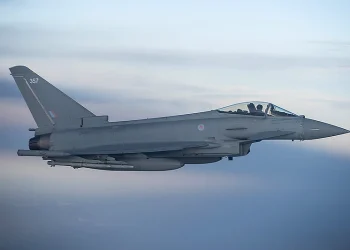

Royal Air Force patrols over Syria have continued to deter Daesh activity and prevent the group from rebuilding capability after its territorial defeat in 2019. The Ministry of Defence announced that RAF aircraft completed successful strikes against a Daesh underground facility in a joint operation with France on 3 January 2026.
The Ministry of Defence said Royal Air Force Typhoon FGR4 aircraft, supported by a Voyager refuelling tanker, joined French aircraft to strike a Daesh underground facility in Syria on Saturday 3 January 2026.
The target, located in mountainous terrain north of Palmyra, was assessed through intelligence analysis as a former Daesh site used to store weapons and explosives. UK officials said the strike was designed to reduce the risk of Daesh regrouping and to support ongoing coalition efforts to keep the UK secure.
Introduction
The Ministry of Defence said RAF aircraft have continued patrols over Syria to prevent any attempted resurgence of Daesh following the group’s military defeat in March 2019. It said these patrols are conducted to identify threats and respond when targets are confirmed.
On 3 January 2026, the Ministry of Defence said a Daesh underground facility north of Palmyra was identified through intelligence analysis as a likely weapons and explosives storage site. It said the area around the facility had no civilian habitation.
UK–France Joint Air Operation
The Ministry of Defence said RAF Typhoon FGR4 aircraft took part in a joint strike with French aircraft against an underground facility assessed to have been occupied by Daesh. It said the strike took place on the evening of Saturday 3 January and formed part of continued UK patrol activity over Syria.
The Ministry of Defence said the target was located in mountainous terrain north of Palmyra and was selected following careful intelligence analysis. It said the aim was to disrupt infrastructure that could support Daesh activity and reduce the risk of any regrouping.
Military Details of the Strike
The Ministry of Defence said the RAF contribution involved Typhoon FGR4 aircraft supported by a Voyager refuelling tanker. It said UK aircraft used Paveway IV guided bombs to target several access tunnels leading down to the underground facility.
According to the Ministry of Defence, detailed assessment of the results was still underway, but initial indications were that the target was engaged successfully. It said there was no indication that civilians were placed at risk and that all UK aircraft returned safely.
- Typhoon FGR4 aircraft
- Voyager refuelling support
- Paveway IV guided bombs
Operational Summary
| Date | Saturday 3 January 2026 evening strike |
| Location | Mountainous area north of Palmyra, Syria |
| Target | Underground facility assessed as weapons and explosives storage |
| Safety | MoD said no indication of civilian risk; UK aircraft returned safely |
Counter-Daesh Security Context
The Ministry of Defence said RAF patrols over Syria are intended to prevent Daesh from attempting a resurgence following the group’s defeat at Baghuz Fawqani in March 2019. It said current operations focus on identifying facilities and activity that could support renewed threat networks.
The Ministry of Defence said the strike was carried out after intelligence analysis identified a remote facility likely used to store weapons and explosives. It said the surrounding area had no civilian habitation, supporting the assessment that the target could be engaged without posing risk to civilians.
- Prevent resurgence
- Disrupt weapons storage
- Maintain patrol coverage
Allied and Political Messaging
The Ministry of Defence said the strike was conducted jointly with France as part of continued allied activity against Daesh in Syria. It said the operation demonstrated continued readiness to act against confirmed targets when intelligence supports action.
The Defence Secretary linked the operation to UK security objectives and allied cooperation. The Ministry of Defence said the strike took place during a period when thousands of UK personnel were deployed over Christmas and New Year.
Stated Objectives and Assurances
| Objective | MoD said the strike aimed to prevent any attempted Daesh resurgence |
| Allied coordination | MoD said RAF aircraft joined French aircraft in a joint operation |
| Civilian protection | MoD said the target area was uninhabited and posed no indicated civilian risk |
| Assessment status | MoD said detailed assessment was ongoing, with initial indications of success |
Ministerial Comments
John Healey MP, Defence Secretary said;
“This action shows our UK leadership, and determination to stand shoulder to shoulder with our allies, to stamp out any resurgence of Daesh and their dangerous and violent ideologies in the Middle East.”
John Healey MP, Defence Secretary said;
“I want to thank all the members of our Armed Forces involved in this operation – for their professionalism and their courage.”
John Healey MP, Defence Secretary said;
“They were among thousands of British personnel deployed over Christmas and New Year. This operation, to eliminate dangerous terrorists who threaten our way of life, shows how our Armed Forces are ready to step up, all year round, keeping Britain secure at home and strong abroad.”
To Sum Up
The Ministry of Defence said RAF aircraft conducted a joint strike with France against a Daesh underground facility north of Palmyra on 3 January 2026. It said UK aircraft used Paveway IV guided bombs to target access tunnels and that initial indications were the target was engaged successfully. The Ministry of Defence said there was no indication of civilian risk and that all RAF aircraft returned safely, with assessment continuing.
Sources: Ministry of Defence: Strikes on Daesh (3 January 2026), and GOV.UK: Daesh UK government response.
Prepared by Ivan Alexander Golden, Founder of THX News, an independent news organisation delivering timely insights from global official sources. Combines AI-analysed research with human-edited accuracy and context.