
In a world-first scientific advance, researchers at the UK Atomic Energy Authority (UKAEA) have stabilised fusion plasma using 3D magnetic coils within the MAST Upgrade experiment in Oxfordshire. The achievement marks a significant step toward creating reliable, safe, and sustainable fusion energy.
A Major Step in Fusion Research
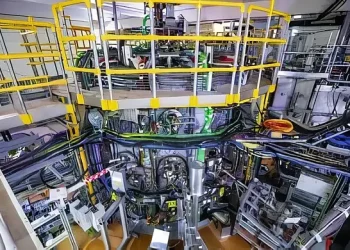
The Mega Amp Spherical Tokamak (MAST) Upgrade, the UK’s flagship fusion research facility, has made history by using magnetic coils to apply a controlled three-dimensional field around its plasma. This precise control allowed scientists to suppress Edge Localised Modes (ELMs)—tiny but potentially damaging plasma bursts that challenge the integrity of future power-plant components.
This marks the first successful ELM suppression in a spherical tokamak, a compact device shaped like a cored apple rather than the traditional ring-shaped tokamak. The result shows that techniques once exclusive to conventional machines can now be adapted to smaller, more efficient configurations, offering a faster route toward commercial fusion.
“Suppressing ELMs in a spherical tokamak is a landmark achievement,” said James Harrison, Head of MAST Upgrade Science at UKAEA. “It demonstrates that advanced control methods can be adapted for compact configurations, building the foundation for future power plants like STEP.”
What Is Fusion and Why It Matters
Fusion power replicates the energy process of the Sun by fusing light atomic nuclei into heavier ones, releasing vast amounts of energy without producing greenhouse gases. However, keeping plasma stable at more than 100 million °C is one of fusion’s greatest engineering challenges.
The MAST Upgrade findings are critical to ensuring that energy released during the reaction remains confined safely—turning experimental success into practical, continuous fusion power.
Advancing Plasma Control
In addition to ELM suppression, UKAEA scientists have achieved another world-first: the ability to independently control the plasma exhaust in both the upper and lower divertors—the exhaust systems that direct heat and particles away from the plasma.
This capability allows researchers to finely balance plasma performance while reducing wear on critical reactor components. According to UKAEA, managing plasma exhaust efficiently is essential to making future reactors both safe and cost-effective.
Performance Milestones and Research Highlights
| Achievement | Details | Impact |
|---|---|---|
| ELM Suppression | Full elimination of edge plasma bursts | Demonstrates stable operation for compact fusion devices |
| Divertor Control | Independent top/bottom exhaust management | Enables robust power handling and longer component life |
| Power Injection | 3.8 MW via neutral-beam heating | Supports higher plasma temperature and density |
| Plasma Shape | Elongation ratio 2.5 (height ÷ width) | Improves confinement and performance stability |
These combined results demonstrate that MAST Upgrade is not only a testing platform but also a direct stepping-stone to STEP (Spherical Tokamak for Energy Production), the UK’s prototype fusion power plant under design.
Engineering the Future of Fusion
By manipulating the plasma’s shape and controlling how heat is dispersed across the reactor, scientists are developing strategies that bring fusion energy closer to commercial viability. The most recent experiments have also explored nitrogen injection at the plasma’s edge, helping to spread energy more evenly and prevent excessive heat damage to internal walls.
This breakthrough aligns spherical tokamaks with the advanced exhaust control seen in larger machines, enhancing both safety and performance. It reflects a new era of precision control in fusion research—combining physics insight with engineering innovation.
The Road Ahead
Further experimental campaigns are planned to verify and extend these findings. UKAEA intends to apply lessons from MAST Upgrade to the design of future ELM control systems for STEP and other fusion initiatives worldwide.
“These achievements reinforce the UK’s leadership in fusion research,” said Dr Fulvio Militello, Executive Director of Plasma Science and Fusion Operations at UKAEA. “They bring us closer to realising fusion as a clean, safe and abundant energy source for the future.”
Why It Matters for the UK and the World
Fusion energy could redefine global power generation, offering virtually limitless energy from simple fuels like hydrogen without long-lived radioactive waste. The MAST Upgrade breakthroughs demonstrate that the UK is playing a key role in solving the remaining technical barriers to clean energy independence.
These innovations strengthen the UK’s position as a leader in advanced energy technologies—driving economic growth, supporting STEM careers, and inspiring the next generation of physicists and engineers.
Sources: UK Atomic Energy Authority.
Prepared by Ivan Alexander Golden, Founder of THX News™, an independent news organisation delivering timely insights from global official sources. THX News combines AI-analysed research with human-edited accuracy and context.