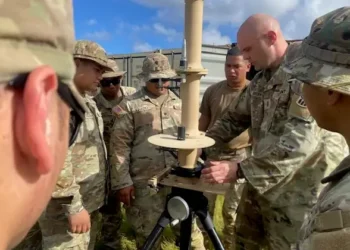

The War Department announced the first round of Fiscal Year 2026 Accelerate the Procurement and Fielding of Innovative Technologies projects, surpassing $1 billion awarded to small businesses nationwide.
The announcement, released in Washington, highlights a continued effort to move mature technologies rapidly from development into fielding and early production to support U.S. warfighter readiness and industrial base resilience.
FY 2026 APFIT awards announced
The War Department confirmed the initial slate of FY 2026 APFIT selections as part of its ongoing defense innovation strategy. The program is designed to accelerate the transition of advanced technologies into operational use across the military services.
This first round marks a milestone for APFIT, reflecting expanded scale and broader service participation. Additionally, officials indicated that further FY 2026 selections will be announced later in the fiscal year.
Program scale and funding threshold
APFIT has now awarded more than $1 billion to small businesses and non-traditional defense contractors since its launch, according to War Department data. For FY 2026, the average award exceeds $30 million per project, with the largest single award reaching $49.7 million, just below the statutory cap.
These figures indicate increased confidence in the program’s ability to scale proven technologies. In real terms, this level of funding supports faster production timelines and earlier operational availability for the services.
| Indicator | Recent Movement | Context |
|---|---|---|
| Total APFIT funding | Surpassed $1 billion | War Department program data shows cumulative awards to small businesses since FY2022. |
| Average FY 2026 award | Above $30 million | War Department reports larger, more mature projects entering production phases. |
| Largest single award | $49.7 million | Army project reached near the $50 million statutory maximum, per War Department announcement. |
Focus on small businesses and non-traditional contractors
The FY 2026 selections continue APFIT’s emphasis on expanding participation beyond traditional prime contractors. The War Department stated that awards are distributed across multiple regions, including states that historically receive limited defense procurement funding.
This approach is intended to diversify the defense industrial base while maintaining delivery speed. However, officials also noted the need for continued performance monitoring as award sizes increase.
Regional and industrial base impact
APFIT funding supports workforce expansion, supplier development, and manufacturing capacity in communities linked to awarded projects. The War Department highlighted that small firms are now moving directly from advanced prototypes to initial production, bypassing longer procurement cycles.
As a result, the industrial base benefits from earlier revenue stability and longer-term sustainment prospects. These effects are positioned as complementary to broader defense acquisition reform goals.
- Small business participation: Expanded access to large-scale defense funding, according to War Department procurement data.
- Geographic reach: Awards span multiple regions, including underrepresented and remote states, per program briefings.
Operational priorities and selected technologies
The first FY 2026 APFIT round targets urgent capability gaps across autonomy, communications, command and control, and resilient navigation. Projects are aligned with operational needs identified by the Army, Navy, Air Force, Marine Corps, and Space Force.
The War Department reported that many selected technologies are at Technology Readiness Levels 7 to 9, enabling rapid transition. Consequently, several capabilities are expected to reach fielding up to two years faster than under traditional procurement pathways.
Highest-value and high-impact projects
Among the largest awards are the Army’s Real-Time Command and Control at the Tactical Edge project at $49.7 million and the Space Force’s Augmented Maneuver Vehicle for Satellites at $48.5 million. War Department program documentation links these awards to high-priority requirements in contested and denied environments.
Additional projects include low-cost munitions, unmanned ground and maritime systems, and high-bandwidth communications pods. Collectively, these investments aim to enhance distributed operations and joint all-domain capabilities.
APFIT’s role in defense procurement strategy
APFIT remains a central element of the War Department’s approach to bridging the gap between research and procurement. Under the leadership of Under Secretary of War for Research and Engineering Emil Michael, the program is structured to reduce delays associated with traditional budget cycles.
The department states that APFIT-funded projects have already unlocked billions in follow-on procurement across the services. This model reflects a shift toward faster, outcome-focused acquisition mechanisms.
Oversight, scaling, and future selections
As award sizes grow, congressional oversight bodies have continued to monitor APFIT’s execution, according to publicly available National Defense Authorization Act discussions. The War Department has emphasized internal controls and reporting requirements to manage risk while preserving speed.
Officials confirmed that additional FY 2026 APFIT projects will be announced throughout the year as selections are finalized. This phased approach is intended to balance agility with accountability.
To Sum Up
The first round of FY 2026 APFIT awards marks a notable expansion in the scale and maturity of the program, with more than $1 billion now directed to small business defense innovation. By pairing larger awards with accelerated fielding, the War Department is advancing capabilities aligned with current operational demands.
Looking ahead, the continued rollout of FY 2026 selections will test APFIT’s ability to sustain performance at scale while maintaining oversight. The program’s trajectory suggests an enduring role in shaping how the U.S. military sources and fields emerging technologies.
Sources: War Department.
Prepared by Ivan Alexander Golden, Founder of THX News™, an independent news organization delivering timely insights from global official sources.
Combines AI-analyzed research with human-edited accuracy and context.