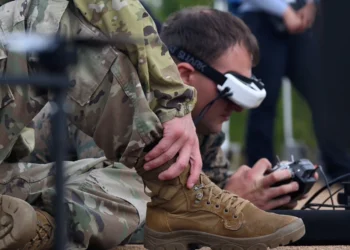
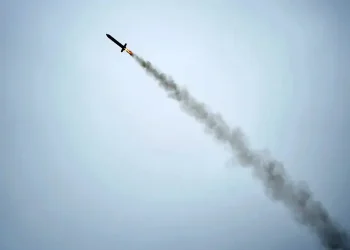
The War Department, through Joint Interagency Task Force 401, announced on May 6 the selection of five US military installations for a directed-energy counter-drone pilot program authorized under the Fiscal Year 2026 National Defense Authorization Act. The initiative will evaluate high-energy laser and microwave systems designed to counter unlawful or adversarial drone activity while supporting homeland defense and critical infrastructure protection.
The pilot program expands recent US military efforts to integrate counter-drone technology into domestic counter-unmanned aircraft operations. The program follows joint testing and safety assessments conducted with the Federal Aviation Administration and US Northern Command, including demonstrations at White Sands Missile Range in New Mexico.
Pentagon Announces Directed-Energy Counter-Drone Pilot Program
The Defense Department said Joint Interagency Task Force 401 selected the installations to participate in a new counter-unmanned aircraft systems initiative included in the FY2026 National Defense Authorization Act. The program is intended to accelerate operational testing and deployment planning for directed-energy defense technologies across varied mission environments.
Army Brig. Gen. Matt Ross, director of Joint Interagency Task Force 401, said the systems form part of a broader layered counter-drone strategy. The Defense Department stated the pilot program will support homeland security missions, military installation protection, and critical infrastructure defense against unlawful drone activity.
Program Goals and Homeland Security Mission
According to the Defense Department, the pilot program is designed to integrate high-energy laser and high-powered microwave systems into operational defense frameworks. The technology aims to disrupt or defeat adversarial drones while reducing risks to nearby personnel and infrastructure.
The department also confirmed the initiative was coordinated with military services, US Northern Command, and the Federal Aviation Administration. Additionally, officials stated that operational planning with installation commanders will continue over the next 180 days before deployments begin later this year.
Military Installations Selected for Initial Deployment
The selected installations were chosen to support testing across multiple operational conditions and geographic environments. Meanwhile, the locations include military bases connected to border security missions, strategic air operations, and naval infrastructure protection.
Defense Department officials stated the pilot program includes installations in Arizona, Texas, Washington, North Dakota, and Missouri. Several locations were selected because of their relevance to homeland security and national defense operations.
Selected Bases and Locations
| Indicator | Recent Movement | Context |
|---|---|---|
| Fort Huachuca, Arizona | Selected for pilot program | Defense Department identified the installation as a southern border operational site supporting homeland missions. |
| Fort Bliss, Texas | Selected for pilot program | Joint Interagency Task Force 401 included the installation because of its role in border-related operational environments. |
| Naval Base Kitsap, Washington | Added to deployment list | The Defense Department said the naval installation will support maritime-focused operational assessments. |
| Grand Forks Air Force Base, North Dakota | Added to deployment list | The Air Force installation will participate in operational testing under the pilot initiative. |
| Whiteman Air Force Base, Missouri | Selected for evaluation phase | The Defense Department said the base will support testing across varied mission conditions. |
Directed-Energy Systems and Counter-Drone Technology
The Defense Department stated the pilot program will evaluate both high-energy laser systems and high-powered microwave technologies. Officials described the systems as part of a layered counter-UAS defense structure intended to respond to evolving drone threats.
According to Joint Interagency Task Force 401, the systems can disable or disrupt drones while minimizing physical damage risks associated with traditional intercept methods. The department said these technologies may improve defensive response times against low-cost unmanned aircraft threats.
Operational Capabilities Against Drone Threats
Defense officials stated the systems are intended to counter unlawful or adversarial drone operations targeting military installations or critical infrastructure. The technology is being evaluated for operational effectiveness, safety integration, and deployment readiness.
- Directed-Energy Systems: The Defense Department said laser and microwave technologies are designed to reduce collateral risks while engaging drone threats.
- Layered Defense Strategy: Joint Interagency Task Force 401 described the pilot program as part of a broader counter-UAS operational framework.
- Homeland Protection: Officials stated the systems may support border missions, infrastructure security, and military installation defense operations.
FAA Coordination and Safety Assessments
The Defense Department said the pilot program builds on recent coordination with the Federal Aviation Administration involving domestic airspace safety reviews. Officials referenced demonstrations and operational assessments conducted at White Sands Missile Range in New Mexico.
According to the department, a joint Defense Department-FAA demonstration validated that laser and microwave technology did not pose undue risk to passenger aircraft during testing. Officials confirmed that recent FAA safety assessments established procedures intended to protect national airspace during future operational deployments.
Safety and Testing Milestones
| Indicator | Recent Movement | Context |
|---|---|---|
| White Sands Missile Range Test | Joint demonstration completed | The Defense Department and FAA said testing validated operational safety near civilian air traffic. |
| Southern Border Operations | Systems employed operationally | Defense officials confirmed counter-drone technology supported southern border security missions. |
| FAA Safety Assessment | Procedures established | The FAA and Defense Department created operational procedures intended to protect national airspace. |
Stakeholder Comments
Army Brig. Gen. Matt Ross, Joint Interagency Task Force 401 director said,
“Countering unlawful and adversarial drone activity is a homeland defense imperative. There is no ‘silver bullet’ to address this challenge, and this pilot program integrates cutting-edge technology into the department’s broader counter-drone toolkit.”
Army Col. Scott McLellan, deputy director of the task force
“Our collaboration with the FAA and the successful demonstration at White Sands were pivotal steps forward in our counter-UAS efforts. We showed that directed-energy systems can counter drone threats while preserving the safety of air travelers. This pilot program now allows us to translate that progress into evolving operational capability for the homeland.”
The Defense Department’s directed-energy counter-drone pilot program marks a significant expansion of domestic operational testing for advanced military defense technologies. The initiative reflects growing focus on protecting military installations, border operations, and critical infrastructure from evolving unmanned aerial threats.
Officials stated deployment planning will continue during the next 180 days before operational activity begins later this year. The program will continue under coordination with military services, US Northern Command, and the Federal Aviation Administration.
Sources: US Department of Defense, Federal Aviation Administration, US Northern Command.
Prepared by Ivan Alexander Golden, Founder of THX News, an independent news organization delivering timely insights from global official sources.
Research combines AI-assisted analysis with human-edited accuracy and context.