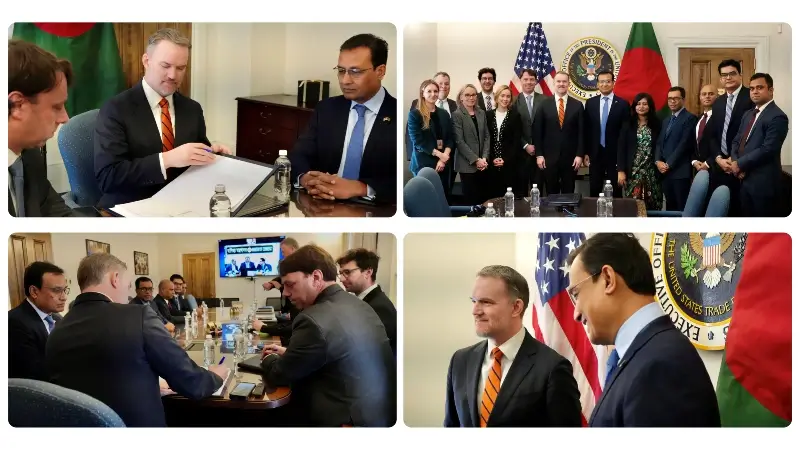
The United States and Bangladesh signed a reciprocal trade agreement in Washington, establishing preferential market access, reciprocal tariff adjustments under named executive orders, and sector-specific trade commitments. The signing was conducted by U.S. Trade Representative Ambassador Jamieson Greer and Bangladesh Commerce Adviser Sheikh Bashir Uddin under a joint government framework.
The agreement was announced through a joint government statement and a release from the Office of the United States Trade Representative describing reciprocal tariff measures, regulatory commitments, and commercial purchase plans. It builds on the 2013 U.S.–Bangladesh Trade and Investment Cooperation Forum Agreement framework.
Opening Summary — Announcement and scope of the US–Bangladesh trade agreement
According to the Office of the United States Trade Representative (USTR), the United States and Bangladesh concluded a reciprocal trade agreement covering tariffs, goods access, and regulatory standards.
The USTR announcement states the pact expands bilateral market access for exporters in both countries. Meanwhile, the signing took place in Washington with named officials from both governments. Taken together, the scope combines tariff schedules, standards recognition, and sector purchase commitments.
Reciprocal Trade Framework — What the agreement establishes
The joint statement says the agreement creates preferential access for US industrial and agricultural goods across multiple categories including chemicals, machinery, ICT equipment, and food products. Additionally, the text confirms the deal builds on the 2013 TICFA framework between the two governments.
The USTR release identifies this as the first reciprocal trade agreement signed with a South Asian partner under the current policy structure. Therefore, the framework links legacy cooperation mechanisms with new reciprocal tariff and access terms.
Tariff Changes and Executive Orders — US reciprocal tariff adjustments
According to USTR and the joint statement, the United States will reduce the reciprocal tariff rate on originating Bangladeshi goods to 19 percent. The tariff authority is tied to Executive Order 14257 of April 2025 and product adjustments listed under Executive Order 14346 of September 2025, as cited in the government text.
Meanwhile, certain listed products may receive a zero percent reciprocal tariff rate under Annex III procedures. As a result, the tariff change is grounded in named executive orders, numeric rates, and a defined legal mechanism.
Market Access Commitments — Industrial and agricultural goods coverage
The joint statement reports that Bangladesh will grant preferential market access for US goods including medical devices, vehicles and parts, ICT equipment, soy, dairy, beef, poultry, nuts, and fruit.
Additionally, Bangladesh commits to accept US Federal motor vehicle safety and emissions standards and US Food and Drug Administration certificates for medical devices and pharmaceuticals. These recognitions represent specific regulatory data points that can shorten approval timelines for exporters. Consequently, the real-world effect is reduced compliance friction alongside tariff preferences.
Textile and Apparel Mechanism — Zero-tariff quota structure
USTR states the agreement establishes a mechanism allowing certain Bangladeshi textile and apparel goods to enter the United States at a zero reciprocal tariff rate. The joint statement specifies that eligible import volumes will be linked to the quantity of US textile inputs such as cotton and man-made fibers exported to Bangladesh.
Meanwhile, the structure uses a volume-based formula rather than an unlimited exemption. Therefore, the mechanism pairs a numeric quota concept with a reciprocal sourcing requirement and a defined trade effect.
| Indicator | Recent Movement | Context |
|---|---|---|
| US reciprocal tariff rate on Bangladesh | Set to 19% | USTR cites reduction under Executive Order 14257 (April 2025) |
| Selected product tariffs | Eligible for 0% | Joint statement references Annex III of Executive Order 14346 (September 2025) |
| Textile/apparel entries | Zero-rate quota mechanism | USTR describes volume-linked zero tariff tied to US textile input exports |
Non-Tariff and Regulatory Measures — Standards, certifications, customs reform
The joint statement says Bangladesh will address non-tariff barriers by accepting US vehicle standards and FDA certifications and by removing import licensing requirements on US remanufactured goods. Additionally, Bangladesh commits to digitalizing customs procedures and adopting good regulatory practices.
The agreement text also references removal of insurance market barriers and science-based food import approvals. In synthesis, these steps combine named regulatory recognitions with procedural reforms and a defined trade facilitation effect.
Digital, Labor, and Environmental Provisions — Governance and compliance terms
According to the joint statement, Bangladesh commits to permit cross-border data transfers, support a WTO moratorium on customs duties on electronic transmissions, and strengthen intellectual property enforcement. Meanwhile, the agreement lists labor obligations including prohibitions on forced labor imports and legal protections for freedom of association and collective bargaining.
Environmental provisions require enforcement of domestic environmental laws and higher protection standards. Together, the clauses link governance commitments, treaty references, and compliance outcomes.
Financing and Commercial Deals — EXIM, DFC, and sector purchases
The joint statement notes that US institutions including the Export-Import Bank of the United States and the U.S. International Development Finance Corporation may consider eligible financing support for projects in Bangladesh.
Additionally, the governments referenced commercial deals covering aircraft procurement, approximately $3.5 billion in US agricultural purchases, and energy purchases estimated at $15 billion over 15 years.
These figures are explicitly listed in the government release as forward-looking commercial data points. Consequently, the effect is defined investment and purchase scale tied to named institutions.
- Signing authority: USTR confirms Ambassador Jamieson Greer signed with Bangladesh Commerce Adviser Sheikh Bashir Uddin in Washington
- Regional scope: USTR states this is the first reciprocal trade agreement signed with a South Asian partner under current policy
- Framework base: Joint statement cites 2013 TICFA as the prior bilateral trade platform
In Conclusion
The US–Bangladesh reciprocal trade agreement sets defined tariff rates, quota mechanisms, regulatory recognitions, and governance commitments under named executive orders and agency authorities. Each major provision is tied to published USTR and joint statement text rather than anonymous attribution.
Meanwhile, both governments state they will complete domestic formalities before the agreement enters into force, keeping implementation anchored to official procedures and documented commitments.
Sources: Office of the United States Trade Representative, and White House Joint Trade Statement.
Prepared by Ivan Alexander Golden, Founder of THX News, an independent news organization delivering timely insights from global official sources.
Combines AI-analyzed research with human-edited accuracy and context.