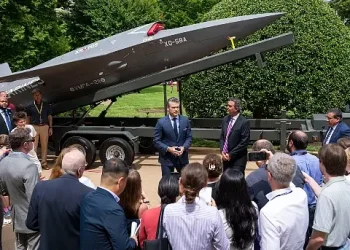

Air Force Secretary Troy Meink outlined the Department of the Air Force’s strategic priorities during the Air and Space Forces Association’s 2026 Warfare Symposium in Aurora, Colorado, emphasizing readiness, modernization, homeland defense, nuclear deterrence and personnel development. He said the focus reflects evolving global threats, particularly China’s rapid military expansion in the Indo-Pacific region.
Meink’s remarks at the annual industry and defense gathering come as the United States accelerates modernization programs across air, nuclear and space domains. The Department of the Air Force, which oversees both the Air Force and Space Force, faces pressure from Congress and defense planners to sustain deterrence while rebuilding industrial capacity.
Air Force Priorities Outlined by Secretary Meink
Speaking at the Air and Space Forces Association’s Warfare Symposium on February 23, 2026, Meink said readiness remains the department’s top priority alongside modernization and homeland defense.
He added that protecting the entire hemisphere, including border security and missile defense, forms part of that mission. Additionally, nuclear deterrence and investment in personnel were identified as foundational elements.
He stated that the Air Force and Space Force must be prepared for threats across the full spectrum of conflict at any time. Meanwhile, the department is balancing operational readiness with long-term modernization, including new weapons systems and advanced capabilities.
| Indicator | Recent Movement | Context |
|---|---|---|
| Strategic focus | Expanded priorities | Outlined by Air Force Secretary Troy Meink at the Air and Space Forces Association’s 2026 Warfare Symposium |
| Homeland defense scope | Includes hemisphere | Department of the Air Force stated defense responsibility extends across the Western Hemisphere |
| Personnel emphasis | Elevated priority | Meink highlighted workforce empowerment as central to mission success |
Industrial Base and Nuclear Modernization
Meink said scaling production of weapons systems and munitions remains a major challenge due to decades of decline in the defense industrial base.
However, he noted that production of advanced aircraft and munitions increased beginning in 2025, according to Department of the Air Force statements at the symposium. This ramp-up aims to support sustained readiness while replacing aging platforms.
The secretary also confirmed progress on the LGM-35A Sentinel intercontinental ballistic missile program, which will replace the LGM-30 Minuteman III. According to the Department of Defense, the Sentinel represents modernization of the land-based leg of the nuclear triad, a cornerstone of U.S. deterrence strategy.
- Industrial capacity: Meink said production growth is underway but still below required levels, reflecting long-term supply constraints
- Nuclear modernization: Sentinel ICBM testing progressing to replace Minuteman III, according to Department of Defense briefings
Space Capability and Workforce Empowerment
Meink said increased rocket launches have placed more capability into orbit than ever before, supported by commercial partnerships, other military services and the National Reconnaissance Office. These launches expand surveillance, communications and operational resilience in space, according to Department of the Air Force statements.
He emphasized that acquisition reform aims to deliver mission-effective capabilities faster, requiring innovation ahead of potential adversaries. Meanwhile, workforce empowerment was described as essential, with Meink stating personnel must be able to take initiative with leadership support.
Comments
“Given that threat environment, the Air Force and the Space Force must be ready at any time for any threat across the entire spectrum of conflict,”
Meink said.
In Conclusion
The Air Force secretary’s remarks outline a comprehensive strategy centered on readiness, modernization and deterrence across air, nuclear and space domains. By highlighting industrial capacity, emerging threats and workforce development, the Department of the Air Force signaled priorities shaping U.S. defense planning in the coming years.
The focus reflects ongoing efforts to maintain strategic stability while adapting to rapid technological and geopolitical change.
Sources: U.S. Air Force, U.S. Space Force, Air and Space Forces Association.
Prepared by Ivan Alexander Golden, Founder of THX News, an independent news organization delivering timely insights from global official sources.
Combines AI-analyzed research with human-edited accuracy and context.