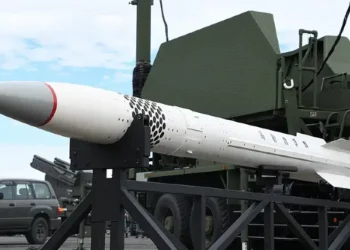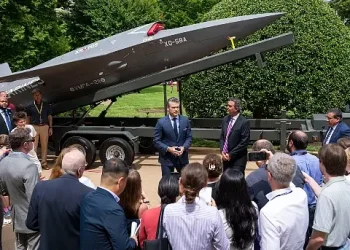

The Department of War announced new framework agreements with Anduril, CoAspire, Leidos, Zone 5 and Castelion on May 13 to rapidly expand low-cost cruise missile and hypersonic strike production for the Joint Force. The agreements support large-scale procurement beginning in 2027 and form part of the Department’s broader effort to strengthen domestic strike capacity and accelerate weapons production timelines.
The announcement outlines a new acquisition approach focused on commercial defense innovators, scalable production pathways and lower-cost kinetic strike systems. The initiative aligns with directives from President Trump and Secretary Hegseth to expand military readiness and industrial production capacity.
Department launches new missile production agreements
The Department of War said new framework agreements with Anduril, CoAspire, Leidos and Zone 5 will establish the Low-Cost Containerized Missiles program, known as LCCM. The agreements are designed to support rapid experimentation, assessment and procurement of affordable cruise missile systems capable of being produced at scale.
Additionally, the agreements establish terms for future firm-fixed-price production contracts between 2027 and 2029. Officials said the effort is intended to create repeatable production pathways while accelerating delivery timelines for operational strike capabilities.
LCCM program structure and procurement timeline
The Department said the experimentation campaign will culminate in a Military Utility Assessment led by sponsoring Service Components. Meanwhile, procurement planning includes the acquisition of more than 10,000 low-cost cruise missiles across participating portfolios within three years beginning in 2027.
| Indicator | Recent Movement | Context |
|---|---|---|
| LCCM procurement target | More than 10,000 missiles planned | The Department of War said procurement would begin in 2027 under framework agreements with four defense firms |
| Initial testing phase | Test missile procurement begins June 2026 | The Office of the Under Secretary of War for Research and Engineering will oversee experimentation and assessment activities |
| Production contract structure | Firm-fixed-price agreements planned through 2029 | The Department said the contracts are intended to accelerate scalable and repeatable production pathways |
The Department added that procurement activity will begin with test missile purchases from all four participating companies starting in June 2026. The Army Program Acquisition Executive Fires will serve as the acquisition lead for procurement operations during the transition process.
Hypersonic missile initiative advances with Castelion
Separately, the Department announced an agreement with Castelion to support the expansion of low-cost hypersonic missile production. The initiative centers on the Blackbeard missile platform and forms part of a broader effort to expand hypersonic strike capability through commercial-sector partnerships.
However, full production contracts remain contingent on successful testing and validation milestones. Once validation is complete, officials said the Department plans to award a two-year procurement contract for a minimum of 500 Blackbeard missiles annually.
Production targets and scaling objectives
The Castelion agreement includes options extending procurement for up to five years. Officials also stated the Department is seeking authority and funding to purchase thousands of additional hypersonic missiles to support future force requirements.
- Industrial expansion: Several participating companies are scaling production without direct Department investment, relying instead on private capital expansion
- Procurement pathway: Multi-year purchasing commitments are intended to create predictable industrial demand signals
- Testing threshold: Castelion’s production contracts remain dependent on successful missile testing and operational validation according to the Department announcement
Officials said encouraging self-funded manufacturing expansion could reduce long-term government infrastructure costs while increasing production flexibility. Meanwhile, officials described the approach as part of a broader strategy to expand the domestic munitions industrial base.
Pentagon shifts toward commercial partnership model
Department officials said the initiative reflects a deliberate move beyond traditional defense prime contractors toward newer commercial entrants capable of accelerating weapons production. According to the Department, the agreements are intended to reward companies that can deliver rapid manufacturing scale, research investment and cost-efficient production.
Additionally, several vendors participating in the agreements are reaching production scale without direct government financing. Officials described this as a commercial-style acquisition model designed to increase operational speed and strengthen industrial resilience.
Industrial base expansion and private investment
The Office of the Under Secretary of War for Research and Engineering said the LCCM experimentation campaign will be coordinated with the United States Air Force Program Acquisition Executive Weapons, the Test Resource Management Center and acquisition offices across the Department.
Meanwhile, Under Secretary of War for Research and Engineering Emil Michael said the framework agreements commit industry partners to “on-time, on-cost delivery” while supporting investment in facilities and research development. Michael added that the acquisition model aligns with Secretary Hegseth’s Acquisition Transformation Strategy.
Testing and acquisition operations begin in 2026
The Department confirmed that procurement of test missiles from participating LCCM companies will begin in June 2026 ahead of broader operational assessments. The assessment phase will determine military utility before long-term procurement decisions are finalized.
Additionally, acquisition coordination involves multiple operational and procurement offices across the military. The initiative is intended to support faster integration of scalable strike systems into Joint Force planning.
Assessment leadership and acquisition coordination
The Army Program Acquisition Executive Fires will oversee procurement transition responsibilities under the program, according to the Department announcement. Meanwhile, coordination efforts also involve the Office of the Under Secretary of War for Acquisition and Sustainment alongside Air Force acquisition leadership.
| Indicator | Recent Movement | Context |
|---|---|---|
| Participating LCCM vendors | Four companies selected | Anduril, CoAspire, Leidos and Zone 5 were included in the Department framework agreements |
| Blackbeard procurement target | Minimum 500 missiles annually | The Department said production contracts will begin after testing and validation milestones are completed |
| Assessment leadership | Research and Engineering office designated lead | The Office of the Under Secretary of War for Research and Engineering will oversee experimentation operations |
The Department said the broader objective is to create scalable production systems capable of increasing output rapidly during future operational demand periods. Officials also stated the agreements are intended to provide long-term industrial certainty while reducing acquisition delays. The agreements are intended to shorten procurement timelines and expand domestic missile production capacity.
Stakeholder Comments
Emil Michael, Under Secretary of War for Research and Engineering, said the Department intends to deliver “affordable mass” to military forces at accelerated speed through commercial partnerships and predictable procurement structures.
Meanwhile, Michael Duffey, Under Secretary of War for Acquisition and Sustainment, said the agreements demonstrate the Department’s effort to expand the defense industrial base beyond traditional contractors. Duffey stated that accelerating testing timelines and creating long-term demand signals are central components of the Department’s acquisition transformation strategy.
The Department of War’s new agreements with defense technology firms represent a significant expansion of planned cruise missile and hypersonic production capacity beginning in 2027. Officials said the strategy combines commercial manufacturing partnerships with long-term procurement commitments to accelerate operational readiness.
Additionally, the initiative reflects a broader effort to increase scalable strike production while strengthening the United States defense industrial base through newer commercial entrants and fixed-cost acquisition structures.
Sources: Department of Defense, Defense Innovation Unit, Department of Defense News.
Prepared by Ivan Alexander Golden, Founder of THX News, an independent news organization delivering timely insights from global official sources.
Research combines AI-assisted analysis with human-edited accuracy and context.