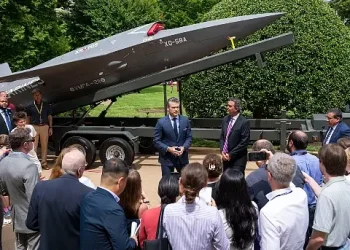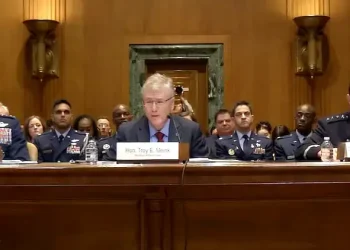
President Donald J. Trump, Secretary of War Pete Hegseth, and Air Force Gen. Dan Caine confirmed on April 6, 2026, the successful rescue of two U.S. airmen downed in Iran during Operation Epic Fury, with both recovered within 48 hours through large-scale combat search and rescue operations.
The operation occurred during an active U.S. military campaign and involved coordinated rescue efforts across multiple air assets in hostile territory. The announcement underscores the operational scope of U.S. Central Command and its personnel recovery doctrine during high-risk missions.
F-15 Downing and Incident Overview
Details of aircraft loss, mission context, and initial isolation of personnel behind enemy lines
An F-15E Strike Eagle was downed by enemy forces in Iran on April 3 while supporting Operation Epic Fury, according to statements delivered at the White House and operational details provided by U.S. Central Command leadership. Both crew members ejected safely, triggering an isolated personnel event declaration by the joint personnel recovery center.
The classification of an isolated personnel event reflects established U.S. military doctrine requiring immediate recovery action, particularly in contested environments. The incident marked the only confirmed manned aircraft loss to enemy fire since the operation began on February 28, according to remarks attributed to the President.
Video
https://www.dvidshub.net/video/embed/1001820
Launch of Rescue Operations
Timeline and structure of first rescue mission including aircraft types and entry into Iranian airspace
Shortly after the downing, U.S. Central Command initiated a rescue operation involving 21 aircraft, including A-10 Thunderbolt attack planes, KC-130 search and rescue aircraft, and HH-60W Jolly Green II helicopters. Air Force special warfare personnel were also deployed to locate and extract the isolated airmen.
Gen. Dan Caine also stated that the rescue task force entered Iranian airspace under protection from a fighter strike package while under enemy fire. This demonstrates the coordinated use of air superiority and rescue assets, a key component of U.S. combat search and rescue doctrine.
Recovery of First Airman
Extraction under fire and condition of pilot following successful recovery
The first airman was located and extracted by an HH-60W helicopter during the initial rescue phase, according to statements delivered by President Trump and confirmed through operational briefings. The extraction occurred under active hostile fire but resulted in no casualties among the rescue personnel.
However, the successful recovery under fire highlights both the capability and risk profile of such missions. The absence of injuries despite equipment damage was noted during the press conference, indicating operational effectiveness under adverse conditions.
Second Airman Evasion and Rescue
Description of injuries, evasion tactics, terrain challenges, and large-scale second rescue mission
The second airman, who landed at a distance from the crash site, sustained injuries and evaded capture in terrain described as mountainous and hostile. According to presidential remarks, the individual navigated cliffs and elevated terrain while avoiding Iranian military militia and Islamic Revolutionary Guard Corps elements.
The subsequent rescue mission expanded significantly, involving approximately 155 aircraft, including decoy operations designed to misdirect enemy forces. This reflects the scale and complexity of the recovery effort, combining deception tactics with coordinated air operations to secure the extraction.
Scale and Complexity of Military Operation
Operational scale and deployment overview
| Indicator | Recent Movement | Context |
|---|---|---|
| Initial Rescue Force | 21 aircraft deployed | U.S. Central Command-led operation including A-10, KC-130, and HH-60W assets |
| Expanded Rescue Mission | 155 aircraft involved | Decoy and extraction operations described in White House press briefing |
| Personnel Recovery Time | Under 48 hours | Timeline confirmed during White House press conference remarks |
- Operational Doctrine: U.S. Central Command maintains personnel recovery protocols prioritizing rapid extraction in hostile zones, as reflected in the mission execution
- Command Coordination: Joint personnel recovery center declared the isolated personnel event, triggering multi-asset deployment according to military briefings
- Strategic Messaging: White House statements emphasized the “leave no American behind” policy guiding military decision-making
Official Statements and Military Significance
Stakeholder Comments summarising remarks from Trump, Hegseth, and Caine on mission success and doctrine
President Trump described the operation as “risky,” noting that deploying a large rescue force into hostile territory could have endangered additional U.S. personnel. He emphasized that the decision aligned with long-standing U.S. military policy to recover service members regardless of risk.
Secretary of War Pete Hegseth characterized the missions as demonstrating “skill, courage and precision,” while Gen. Dan Caine detailed the operational sequence and coordination under fire. These statements collectively highlight the strategic and symbolic importance of personnel recovery within U.S. military doctrine.
Mission outcome and operational implications
The successful recovery of two downed airmen in Iran illustrates the scale, coordination, and risk tolerance of U.S. combat search and rescue operations under U.S. Central Command. The mission combined rapid deployment, deception tactics, and sustained air support to achieve personnel recovery within a constrained timeframe.
The operation also reinforces stated U.S. military doctrine prioritizing personnel recovery, with senior officials framing the outcome as both an operational success and a demonstration of institutional capability.
Sources: White House press conference briefing, U.S. Department of Defense, U.S. Central Command.
Prepared by Ivan Alexander Golden, Founder of THX News, an independent news organization delivering timely insights from global official sources.
Research combines AI-assisted analysis with human-edited accuracy and context.