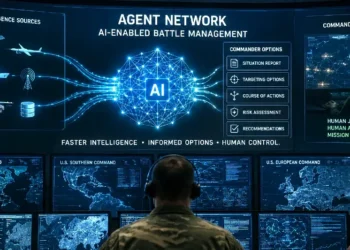
The U.S. Army’s Combined Arms Doctrine Directorate is adopting artificial intelligence tools to accelerate the traditionally years-long process of producing doctrine, while maintaining strict human oversight and accuracy standards. Leaders say the initiative aims to deliver updated guidance to soldiers faster without allowing AI to replace expert authors.
Army doctrine shapes how forces plan, train, and operate, making timely publication critical during rapid technological and operational change. The Combined Arms Doctrine Directorate, part of U.S. Army Combined Arms Command, is testing approved digital tools and training programs to modernize how manuals are researched, written, and updated.
Army AI Doctrine Effort Speeds Guidance Development
The Combined Arms Doctrine Directorate reported that AI-enabled tools are reducing administrative burdens and research time for doctrine writers.
According to CADD Director Richard Creed Jr., the organization began evaluating large language model capabilities as commercial tools matured, identifying personnel with prior experience to test practical uses. As a result, routine tasks such as searching historical references can now be completed in minutes instead of days.
Meanwhile, Army Lt. Col. Scott McMahan explained that the goal is not automated authorship but enhanced productivity for human experts. Writers use AI to generate ideas, locate sources, and overcome initial drafting challenges, while final content remains subject to expert review. This approach aims to shorten development timelines without compromising doctrinal accuracy.
Training and Integration Strategy
CADD implemented a four-part plan to ensure consistent adoption across doctrine divisions. All staff receive foundational training in approved AI tools, while selected specialists—described as “master gunners”—develop advanced expertise to support their teams. Additionally, AI practices are being incorporated into the Doctrine Developer’s Course for future writers.
Leaders are also collaborating with the Combined Arms Command and industry partners to develop a purpose-built AI application tailored to doctrinal work. The tool is expected to assist Centers of Excellence, where staffing constraints often slow publication schedules. Officials emphasized that human oversight remains mandatory for all outputs.
Human Oversight and Accuracy Safeguards
Army officials acknowledged that AI systems can produce incorrect or outdated information, a risk known as “hallucination.” In one documented case described by CADD personnel, an AI-generated test question relied on an obsolete manual, an error identified only because the reviewer was a subject-matter expert. This underscores the requirement for line-by-line human validation.
However, leaders stated that even incremental efficiency gains accumulate across multiple projects. Tools assisting with grammar, readability, and document tracking allow authors and editors to focus on complex doctrinal issues.
The Combined Arms Doctrine Directorate reported that digital workflow improvements have also streamlined publication management and certification preparation.
| Indicator | Recent Movement | Context |
|---|---|---|
| Doctrine development timeline | Potential reduction from years | CADD modernization effort using AI-enabled tools |
| Research efficiency | Days reduced to minutes | Internal search tools across doctrinal databases |
| Quality control | Mandatory human review | Army policy requiring expert validation of AI output |
- Operational relevance: Combined Arms Doctrine Directorate stated faster doctrine delivery supports soldiers in rapidly evolving combat environments
- Workforce training: AI instruction integrated into Doctrine Developer’s Course for future authors
- Technology posture: Leadership described AI as a tool to assist experts, not replace them
Combined Arms Doctrine Directorate Trains Writers in AI Tools
Officials emphasized that doctrine writing remains a human-led process requiring deep operational knowledge. AI tools are treated as assistants comparable to junior staff support, helping draft material and locate information while experts ensure accuracy and coherence.
This model reflects a broader military approach to adopting emerging technologies cautiously.
Additionally, leaders noted that improvements in administrative efficiency free personnel to focus on strategic analysis and doctrinal innovation. Automated forms, publication tracking systems, and business intelligence tools have reduced manual workloads across the organization. These changes collectively aim to deliver guidance to field units more quickly while preserving institutional standards.
Parting Shot
The Army’s adoption of artificial intelligence for doctrine development represents a modernization effort focused on speed, efficiency, and information access rather than automation of decision-making. Officials stress that expert oversight remains central to maintaining the credibility of doctrinal publications.
By combining digital tools with established review processes, the initiative seeks to ensure soldiers receive timely guidance while safeguarding accuracy and institutional knowledge. The approach reflects incremental transformation rather than a wholesale shift in how doctrine is produced.
Sources: U.S. Army, U.S. Army Training and Doctrine Command, Combined Arms Center.
Prepared by Ivan Alexander Golden, Founder of THX News, an independent news organization delivering timely insights from global official sources.
Combines AI-analyzed research with human-edited accuracy and context.