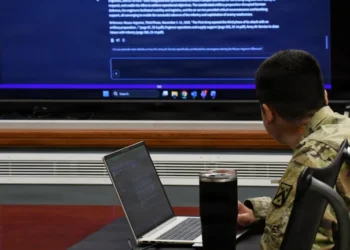

The Department of Defense Chief Information Officer, Kirsten Davies, outlined a strategy during congressional hearings in March 2026 to transform technology and cybersecurity into a warfighting advantage.
Speaking before the Senate Armed Services Committee on March 24 and the House Armed Services Committee on March 25, Davies detailed plans to unify IT and cyber capabilities to strengthen U.S. military readiness and decision-making.
The strategy was presented during formal congressional oversight hearings on Capitol Hill, where the Department of Defense outlined its approach to modernising digital infrastructure. The initiative reflects ongoing efforts to align technology, cybersecurity, and operational performance across U.S. armed forces.
Pentagon CIO outlines new cyber and technology strategy
Kirsten Davies, sworn in as Department of Defense Chief Information Officer in December 2025, told the Senate Armed Services Committee on March 24 and the House Armed Services Committee the following day that her office is pursuing “data supremacy” and “decision dominance.” The strategy aims to improve operational outcomes by accelerating digital capability across military systems.
Meanwhile, Davies stated that modern battlefields require rapid data integration and secure communications, supported by scalable infrastructure. This reflects a shift toward using technology as a direct enabler of warfighting effectiveness, with congressional oversight framing the initiative as part of broader defence modernisation.
Strategy to unify IT and cybersecurity under one framework
Davies told both congressional committees that the CIO’s office is consolidating enterprise IT and cybersecurity programmes into a unified structure. The plan is designed to eliminate inefficiencies, reduce technical debt, and standardise cybersecurity practices across the Department of Defense.
Additionally, the consolidation is expected to improve coordination between military services and defence agencies, enabling faster decision-making. By aligning systems under one framework, the department aims to enhance operational resilience while maintaining oversight through congressional reporting channels.
Four pillars driving digital transformation across the military
Davies outlined four strategic pillars during her testimony to the Senate Armed Services Committee: enduring digital foundation, agile digital capabilities, cybersecurity for the warfighting ecosystem, and skills and partnerships. Each pillar supports different aspects of modernisation across defence operations.
| Indicator | Recent Movement | Context |
|---|---|---|
| Digital foundation | Infrastructure transformation | Network upgrades spanning undersea cables to satellite systems, as outlined in congressional testimony |
| Agile capabilities | Software modernisation | Shift from legacy systems to agile delivery models reported to House Armed Services Committee |
| Cybersecurity approach | Risk-based framework | Transition from compliance-driven standards to continuous monitoring, per DoD CIO briefing |
| Skills and partnerships | Workforce expansion | Increased recruitment and training initiatives discussed during congressional hearings |
Infrastructure, software and cybersecurity modernization plans
Davies told lawmakers that the enduring digital foundation pillar includes upgrades to network infrastructure, spanning terrestrial fibre, undersea cables, and satellite communications. This supports global military installations and operational systems.
However, she added that cybersecurity is shifting toward a risk-based model aligned with national defence strategies, moving away from checklist-driven compliance. This change is intended to reduce vulnerabilities while enabling continuous monitoring and resilience across defence networks.
- Infrastructure upgrades: expansion of network and communications systems supporting global operations, as described in congressional testimony
- Cybersecurity model: transition to continuous monitoring and risk reduction frameworks reported to Senate Armed Services Committee
Workforce development and partnerships to support strategy
Davies told the House Armed Services Committee that the CIO’s office is prioritising recruitment and retention of cyber professionals, alongside expanding training and certification programmes. The initiative includes partnerships with industry and academic institutions to develop workforce capability.
Meanwhile, the department is also working with allies and partners to align digital transformation efforts, supporting coalition readiness. This reflects a broader effort to ensure interoperability and shared technological standards across joint operations.
Stakeholder Comments
Davies told both congressional committees that “the race for data superiority and decision dominance is won or lost every day,” highlighting the urgency of the strategy.
She added that the initiative is intended to ensure “resilience, readiness and lethality” across all operational domains.
To Summarize
The Department of Defense’s strategy, as presented to the Senate and House Armed Services Committees in March 2026, outlines a structured approach to integrating technology and cybersecurity into military operations.
By focusing on unified systems, infrastructure upgrades, and workforce development, the plan aims to enhance operational capability while maintaining oversight through congressional processes.
Sources: Department of Defense.
Prepared by Ivan Alexander Golden, Founder of THX News, an independent news organization delivering timely insights from global official sources.
Research combines AI-assisted analysis with human-edited accuracy and context.