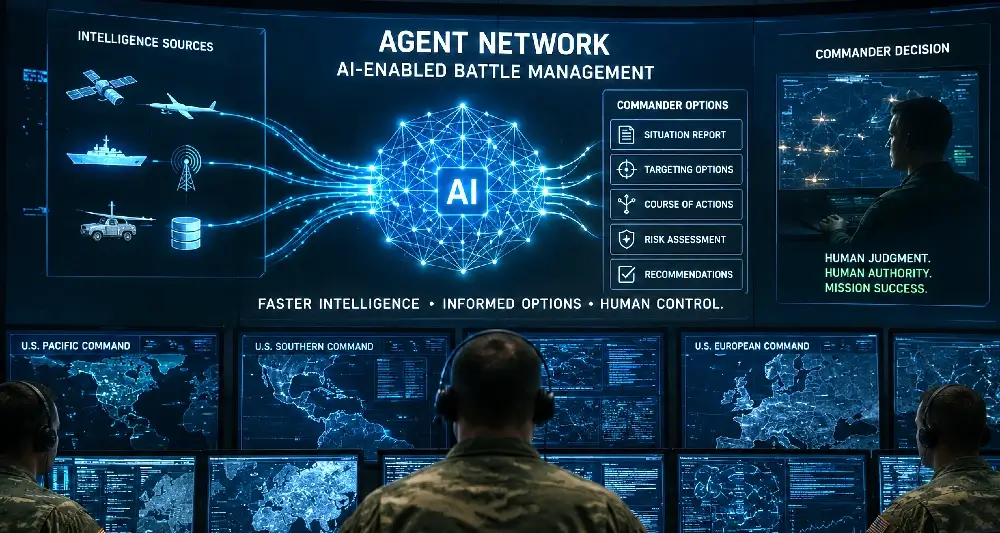
The Department of War launched “Agent Network” on June 25, 2026, as the second Pace-Setting Project under its Artificial Intelligence Acceleration Strategy. The AI-enabled capability is intended to speed battle management, decision support and targeting while keeping commanders responsible for final decisions.
Agent Network is being led by the Department’s Chief Digital and Artificial Intelligence Office with U.S. Pacific Command, U.S. Southern Command and U.S. European Command. The project moves AI-enabled targeting support from experimentation toward operational command workflows.
Department of War Launches Agent Network
Agent Network was announced as PSP 2, the second Pace-Setting Project under the Department of War’s Artificial Intelligence Acceleration Strategy. The project uses AI-enabled tools to shorten the time between intelligence collection and informed command options.
The project is intended for operational use across combatant commands rather than remaining a research or demonstration programme. Its stated purpose is to help commanders move faster from a critical development to a decision pathway, while retaining human control over the final decision.
| Indicator | Recent Movement | Context |
|---|---|---|
| Program status | Agent Network launched as PSP 2 | The Department of War identified Agent Network as the second Pace-Setting Project under its Artificial Intelligence Acceleration Strategy. |
| Command participation | Three combatant commands named | U.S. Pacific Command, U.S. Southern Command and U.S. European Command are listed as project partners. |
| Operational purpose | Faster intelligence-to-option workflow | The release says AI-enabled agents will scan defense intelligence and operational systems and present commander options within seconds. |
| Targeting control | Human decision authority retained | The announcement states that Agent Network does not autonomously select or strike targets. |
Command Partners Involved
The Chief Digital and Artificial Intelligence Office is leading the project. U.S. Pacific Command, U.S. Southern Command and U.S. European Command are named as partners.
The involvement of three combatant commands places the system close to operational command needs. The project is framed around battle management, decision support and targeting, rather than a standalone AI demonstration.
AI Battle Management Capability
Agent Network is designed to support battle management, decision support and targeting by scanning intelligence and operational systems. According to the announcement, the system can translate findings into clearly presented commander options within seconds.
However, the capability is not described as an autonomous strike system. The release states that Agent Network does not select or strike targets on its own, keeping the project within a commander-led decision model.
The project aims to reduce the time between intelligence collection and commander decision-making while preserving human control over targeting decisions. That distinction matters because targeting support, operational timing and legal accountability remain tied to commander authority.
How Agent Network Processes Intelligence
AI-enabled agents will continuously scan defense intelligence and operational systems for critical developments. The system is intended to convert those findings into options that commanders can review.
The release frames the project as a shift from slower traditional targeting processes toward faster identification and response options. The tool is presented as advisory, with commanders reviewing options before any decision is made.
Human Oversight in Targeting Decisions
The announcement draws a clear boundary around the new capability: Agent Network does not autonomously select or strike targets. That statement is central to the project’s legal and operational framing.
Additionally, development and fielding are expected to include testing, operational evaluation and oversight. The stated purpose is to strengthen mission performance while upholding U.S. legal and ethical obligations.
- Human judgment: Commanders remain responsible for every targeting decision, with Agent Network presenting options rather than selecting or striking targets.
- Operational evaluation: Development and fielding will include testing, operational evaluation and oversight before broader operational use.
- Legal and ethical obligations: The project is framed around U.S. legal and ethical obligations, precision, accountability and reduced collateral risk.
Commander Control Safeguards
The central safeguard is direct commander control. Agent Network is presented as a system for faster access to better information, not as a replacement for human targeting judgment.
However, the announcement also links speed with accountability. The project is intended to deliver combat-credible AI capabilities on aggressive timelines while prioritizing precision and reduced collateral risk.
Technology Partners and AI Strategy
PSP 2 combines established frontier AI companies with newer entrants, described in the release as a core principle of the Artificial Intelligence Acceleration Strategy. The project builds on Command and Control innovation by Palantir Technologies, which underpins the Maven Smart System program.
Additionally, Lumbra is named for AI orchestration technology operating on U.S. Government systems. The company is described as being led by veteran warfighters and intelligence professionals.
Agent Network is being presented as an interoperable system rather than a single isolated software product. Existing defense AI foundations are being connected with newer operational AI tools under an accelerated fielding model.
Program and Industry Foundations
Palantir Technologies and Lumbra are the named industry participants in the announcement. Palantir is linked to foundational Command and Control innovation and Maven Smart System, while Lumbra is linked to AI orchestration on U.S. Government systems.
Cameron Stanley, the Department’s Chief Digital and AI Officer, said;
“Agent Network delivers on the Department’s commitment to field AI capabilities with speed and accountability. By pairing established defense technology leaders with innovative new entrants, we are building an interoperable network of AI agents that gives commanders faster access to better information while keeping human judgment at the center of every targeting decision. This is warfighting AI at operational scale”
Testing, Oversight and Operational Evaluation
Agent Network will be subject to testing, operational evaluation and oversight during development and fielding. The oversight framework is tied to mission performance, U.S. legal obligations and ethical standards.
The announcement links the project to precision, accountability and reduced collateral risk. However, the public release does not provide performance data on reliability, accuracy, error rates or operational advantage under live battlefield conditions.
Agent Network moves AI-enabled battle management from experimentation toward operational command workflows. The Department of War said the project is designed to accelerate intelligence-to-decision timelines while keeping commanders responsible for all targeting decisions. Testing and operational evaluation will determine how the capability is expanded across combatant commands.
Sources: Department of War release.
Prepared by Ivan Alexander Golden, Founder of THX News, an independent news organization delivering timely insights from global official sources.
Research combines AI-assisted analysis with human-edited accuracy and context.