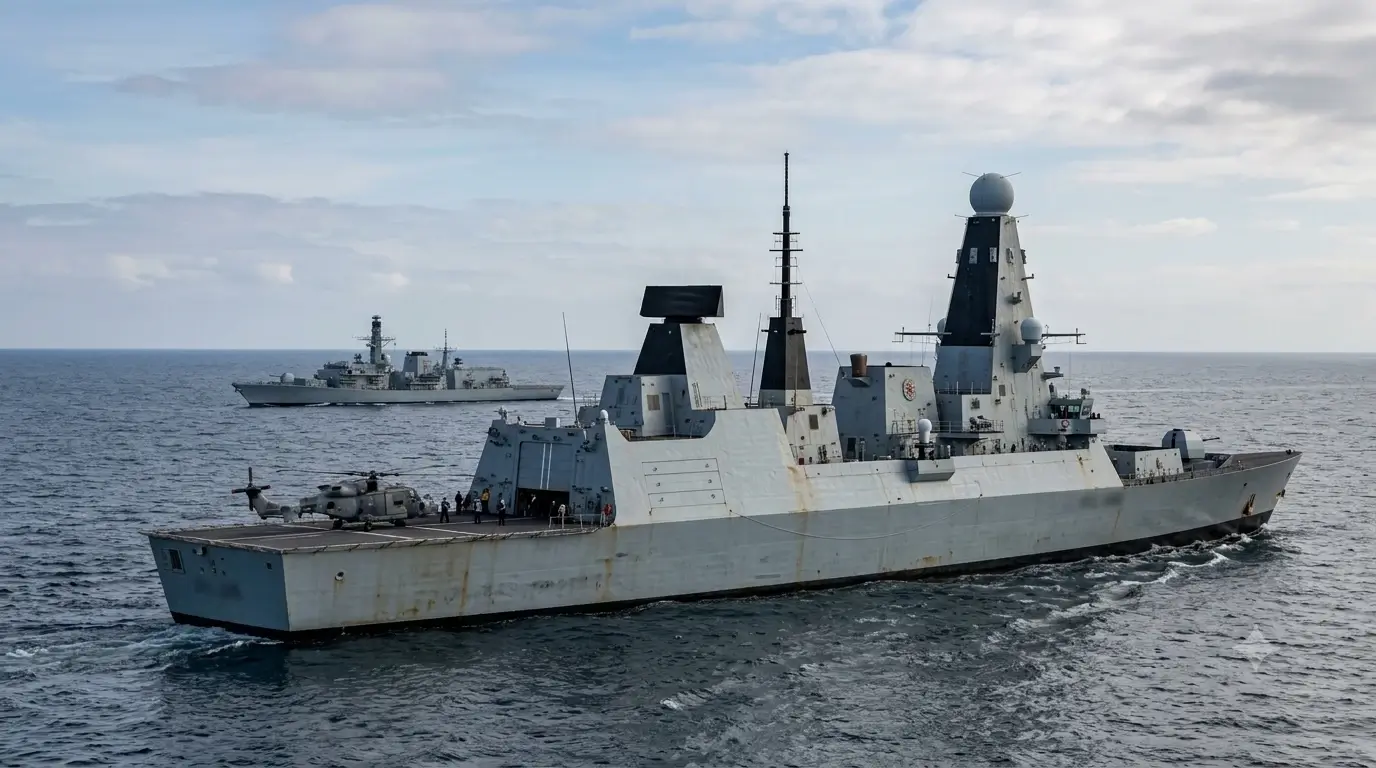
The Ministry of Defence and Defence Secretary Dan Jarvis have announced plans to procure at least six Common Combat Vessels for the Royal Navy under the Defence Investment Plan.
The announcement was published on 29 June 2026 and sets out the next stage of maritime air defence planning for the Royal Navy. The new ships will replace the current fleet of six Type 45 destroyers, with delivery expected from the early 2030s.
The programme is due to be outlined in the forthcoming Defence Investment Plan. It covers naval capability, uncrewed systems, UK shipbuilding, export opportunities and new Atlantic programmes linked to NATO deterrence.
Air Defence Warships Announced For Royal Navy
The Ministry of Defence said the Royal Navy will procure at least six Common Combat Vessels. The ships will form part of the system that replaces the current Type 45 destroyers.
The vessels are intended to deliver the UK’s most advanced maritime air defence capability. The Ministry of Defence said the programme is intended to sustain UK shipbuilding capacity and skilled employment for decades.
- Fleet replacement: the vessels will replace the current six Type 45 destroyers.
- Delivery period: the first ships are expected from the early 2030s.
- Industrial scope: the programme is intended to sustain UK shipyard work and skills.
Common Combat Vessels To Replace Type 45 Fleet
The Common Combat Vessel will replace earlier plans for a Type 83 destroyer. The Common Combat Vessel replaces the earlier Type 83 concept, reflecting a shift towards a more distributed maritime force rather than concentrating capability in a smaller number of large ships.
The department said the Defence Investment Plan funding allows the National Armaments Director Group to begin design work. That work will support a shift in how air defence is delivered at and from the sea.
Common Combat Vessel Programme
| Indicator | Recent Movement | Context |
|---|---|---|
| New ships | At least six | Planned for the Royal Navy |
| Fleet replaced | Type 45 | Current destroyer fleet |
| Delivery | Early 2030s | Expected service timeframe |
| Previous plan | Type 83 | Replaced by CCV approach |
Hybrid Warships To Coordinate Uncrewed Systems
The Ministry of Defence said the Common Combat Vessel will be the Royal Navy’s first hybrid warship. It will coordinate uncrewed systems in the air, on the surface and under the sea.
The department said the vessel will act as a control hub for uncrewed systems. This is intended to extend the Navy’s reach, resilience and firepower without a proportional increase in crew or cost.
The Royal Navy’s hybrid navy model will mix crewed and uncrewed capabilities. Officials said this approach is more suited to the pace and nature of modern warfare.
New Ships To Support Wider Maritime Capability
When in service, the Common Combat Vessels will operate alongside eight Type 26 frigates and five Type 31 crewed frigates. They will also work with new uncrewed platforms across missile, underwater sensing and sensor roles.
The Ministry of Defence described this as a once in a generation investment in maritime capability. The wider system includes Type 91 uncrewed missile platforms, Type 92 uncrewed underwater sensing platforms, Type 93 Extra-Large Uncrewed Underwater Vehicles and Type 94 uncrewed sensor platforms.
- Crewed frigates: eight Type 26 and five Type 31 ships are listed alongside the programme.
- Uncrewed missile platforms: Type 91 systems are included in the future capability mix.
- Underwater systems: Type 92 and Type 93 platforms are part of the planned operating model.
- Sensor platforms: Type 94 systems are included in the maritime capability package.
Wider Maritime Capability
| Platform | Role | Context |
|---|---|---|
| Type 26 | Crewed frigate | Eight planned alongside CCV |
| Type 31 | Crewed frigate | Five planned alongside CCV |
| Type 91 | Missile platform | Uncrewed maritime system |
| Type 93 | Underwater vehicle | Extra-large uncrewed system |
Shipbuilding Programme To Support UK Industry
The Ministry of Defence said the wider Defence Investment Plan is expected to support tens of thousands of jobs across UK shipbuilding and defence manufacturing while strengthening export opportunities for British-designed naval platforms.
The platform is being positioned for global export potential. The Ministry of Defence pointed to the Type 26 frigate, selected by Australia, Canada and Norway, as evidence of international demand for British-built warships.
Atlantic Programmes To Strengthen NATO Deterrence
The programme will anchor three new Atlantic programmes named Atlantic Bastion, Atlantic Shield and Atlantic Strike. These programmes are designed to counter Russian activity in the North Atlantic and High North.
The department said the programmes will also protect critical underwater infrastructure and enhance NATO deterrence. The announcement places the Common Combat Vessel within a wider maritime security and allied defence setting.
Ministerial Comments
Defence Secretary Dan Jarvis MBE MP said;
“Our Royal Navy is a formidable force, operating to protect our nation and our allies in the Atlantic and beyond. These Common Combat Vessels will provide our dedicated sailors with hybrid ships that are designed and built for the increasing threats we face.”
“Developed with exceptional British innovators, the new ships will be British-built, supporting jobs across the nation and giving the Royal Navy a capability built for modern warfare.”
The Common Combat Vessel programme marks the next stage of Royal Navy air defence modernisation, replacing the Type 45 fleet with hybrid warships designed to integrate crewed and uncrewed capabilities. The Ministry of Defence said the programme also supports UK shipbuilding, NATO maritime security and future Atlantic operations focused on protecting critical infrastructure and deterring hostile activity.
Sources: Ministry of Defence, Defence Secretary Dan Jarvis MBE MP.
Prepared by Ivan Alexander Golden, Founder of THX News, an independent news organisation delivering timely insights from global official sources. Combines AI-analysed research with human-edited accuracy and context.