The City of Tucson has retained high bond credit ratings ahead of planned borrowing in mid-July, including General Obligation bonds and Tucson Water revenue obligations. City officials said the ratings could help reduce borrowing costs for voter-approved parks projects and water infrastructure investment.
Tucson is preparing to enter the bond market following reviews by Fitch Ratings, S&P Global Ratings and Moody’s Ratings. The planned borrowing will fund voter-approved Prop 407 Parks + Connections projects and capital improvements for Tucson Water.
Tucson Prepares For New Bond Issuance
The City of Tucson said the latest ratings review was initiated before the planned issuance of General Obligation bonds and water revenue obligations. The city said it expects to enter the market in mid-July.
The borrowing plan includes $114 million in GO bonds and $79 million in water revenue obligations. Additionally, the city said the GO bonds will support completion of the voter-approved Tucson Delivers Prop 407 Parks + Connections program.
General Obligation And Water Revenue Financing
| Indicator | Recent Movement | Context |
|---|---|---|
| GO bond sale | $114 million planned | The City of Tucson said the borrowing will finance completion of the voter-approved Prop 407 Parks + Connections program. |
| Water revenue obligations | $79 million planned | The City of Tucson said the obligations will finance about 40% of the Tucson Water capital improvement program over the next two years. |
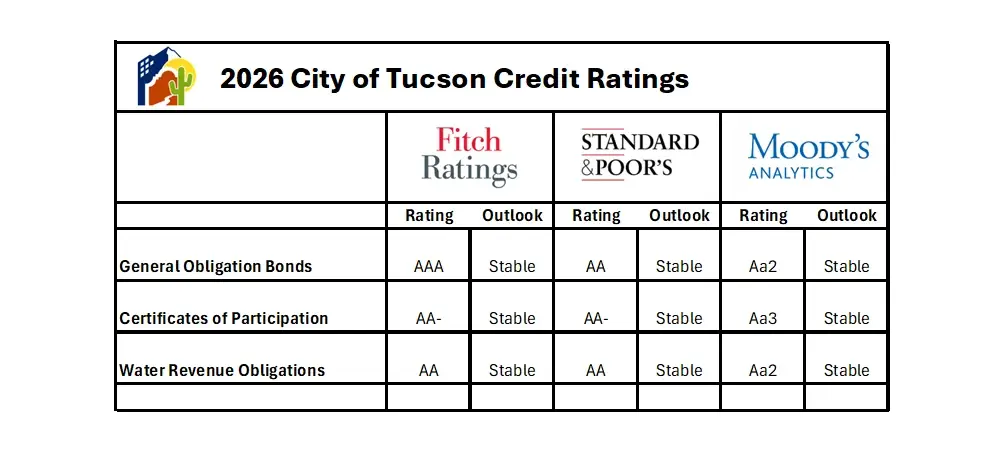
| Fitch GO rating | AAA assigned | Fitch Ratings assigned a AAA rating to Tucson’s upcoming $114 million General Obligation bond sale. |
| S&P water rating | AA assigned | S&P Global Ratings assigned an AA long-term rating to Tucson’s anticipated $79 million 2026 water system revenue obligations. |
| Moody’s city ratings | Several upgrades reported | The City of Tucson said Moody’s Ratings upgraded the issuer rating, GOULT bonds, and outstanding certificates of participation. |
The borrowing supports long-term capital investment rather than day-to-day operations. Although debt repayments remain part of future city and utility budgets, stronger credit ratings can reduce financing costs over the life of the bonds.
Lower borrowing costs can reduce pressure on future city budgets and water rates, making the ratings relevant to both public infrastructure delivery and household costs.
Credit Agencies Confirm Tucson’s Financial Strength
According to the city, Fitch Ratings, S&P Global Ratings and Moody’s Ratings also reaffirmed or upgraded several outstanding debt ratings following their latest reviews.
Fitch Ratings assigned a AAA rating to the upcoming GO bond sale, while the city said various AA ratings held by Tucson and the water utility retained stable outlooks. Meanwhile, Moody’s Ratings upgraded several city debt categories, according to Tucson.
Ratings Highlights And Moody’s Upgrade
Moody’s Ratings said the upgrade reflected Tucson’s large and growing economic base and stable operating reserves, according to the city release. Moody’s also revised the outlook to stable, citing an expectation that the city’s financial position would remain sound.
Higher credit ratings generally improve investor confidence and may reduce borrowing costs. The reviews therefore reflect both Tucson’s financial position and the expected cost of financing future infrastructure projects.
Lower Borrowing Costs Support Public Investment
The City of Tucson said high bond credit ratings can help attract investors and allow the organization to secure lower interest rates when issuing bonds and water revenue obligations. The specific borrowing plan totals $193 million across GO bonds and water revenue obligations.
The practical effect is lower financing costs when the city issues debt to fund major infrastructure projects.
Debt Costs And Water Rate Pressure
The City of Tucson said the $79 million in water revenue obligations will finance about 40% of Tucson Water’s capital improvement program over the next two years. Additionally, the city said lower debt payments can decrease future pressure on water rates.
Because water infrastructure is financed through utility revenues, lower borrowing costs can help reduce future pressure on customer rates. Stronger credit ratings do not remove debt, but they can improve the terms under which Tucson finances required infrastructure work.
Reports Cite Tucson’s Economic And Fiscal Position
S&P Global Ratings described Tucson’s economy as stronger than its headline metrics alone suggest, according to the city. S&P cited Tucson’s role as southern Arizona’s economic center, stabilizing anchors, low industry and taxpayer concentration, steady population and tax base growth, and expected gross county product expansion.
S&P Global Ratings also highlighted Tucson’s financial framework. The report cited conservative budgeting, multiyear forecasting, active budget monitoring, a $127.5 million fixed operating reserve requirement, and integrated capital and debt planning.
Economic Base, Reserves, And Budget Management
S&P Global Ratings said Tucson’s fiscal framework and broad revenue base have supported favorable budgetary variance and sizable reserves, according to the city release. However, S&P also noted planned one-time uses of excess fund balance that are expected to drive a projected 2026 net operating deficit.
The city said it adopted a structurally balanced 2027 budget. Overall, the agencies recognised both future budget pressures and the city’s financial management while maintaining strong credit ratings ahead of the planned bond sale.
City Leaders Respond To The Ratings
Tucson Mayor Regina Romero said the ratings come as the city looks to continue investing in parks, greenways, and water security. She also said the mayor and council have prioritised fiscal responsibility despite revenue challenges imposed from federal and state levels.
City Manager Tim Thomure said the city and water utility continue to be attractive for private-sector lending and investment. Additionally, he said Tucson is focusing on financial management, data-informed decision-making, and agile expenditure management.
Stakeholder Comments
Tucson Mayor Regina Romero stated,
“I am very pleased that our City has retained extremely high bond credit ratings as we look to continue investing in our community’s parks, greenways, and water security. Despite revenue challenges imposed from the federal and state levels, my council colleagues and I continue to prioritize fiscal responsibility. I am pleased that Tucson’s continued economic growth, including my efforts as Mayor to sharpen our focus on prosperity and economic mobility for all Tucsonans, has resonated with the private sector.”
City Manager Tim Thomure stated,
“Our City and our water utility continue to be attractive for private sector lending and investment. While we have limited influence over our revenue streams, we focus on what we can control.”
Tucson’s retained and upgraded credit ratings strengthen the city’s position ahead of approximately $193 million in planned borrowing for parks, connections and water infrastructure projects. While the financing will add to the city’s long-term debt obligations, stronger ratings can reduce borrowing costs and support investment in voter-approved capital programmes.
Sources: Fitch Ratings, S&P Global Ratings, City of Tucson ACFR.
Prepared by Ivan Alexander Golden, Founder of THX News, an independent news organization delivering timely insights from global official sources.
Research combines AI-assisted analysis with human-edited accuracy and context.