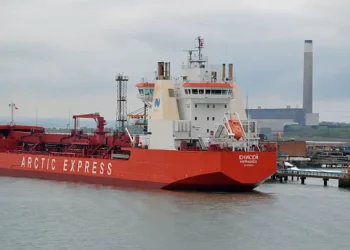

The U.S. Department of the Treasury announced sanctions against Iran’s so-called Persian Gulf Strait Authority, accusing the entity of extorting vessels transiting the Strait of Hormuz on behalf of the Islamic Revolutionary Guard Corps. Treasury stated the action forms part of the Trump administration’s “Economic Fury” campaign targeting Iranian oil revenues, maritime operations, and sanctions evasion activity.
The sanctions action follows growing U.S. pressure on Iranian maritime and financial networks linked to oil exports, shipping operations, and regional security activity. According to the U.S. Department of the Treasury’s Office of Foreign Assets Control, the designation targets what it describes as an Iranian-controlled mechanism used to impose illegitimate tolls on commercial vessels operating through the Strait of Hormuz.
Treasury Targets Iranian Maritime Operations
The U.S. Department of the Treasury’s Office of Foreign Assets Control announced sanctions against the Persian Gulf Strait Authority under Executive Order 13224, the counterterrorism authority originally issued in September 2001 and amended in later administrations. Treasury stated the authority allegedly supports the Islamic Revolutionary Guard Corps by coordinating maritime traffic and collecting payments from vessels seeking passage through the Strait of Hormuz.
Treasury Secretary Scott Bessent said,
“The Iranian military’s latest attempt to extort global maritime trade is proof that Economic Fury has left the regime desperate for cash.”
Sanctions Campaign Expansion
Treasury stated the sanctions action forms part of the administration’s enforcement effort pressure campaign targeting Iranian oil exports and sanctions evasion systems. According to OFAC, the broader enforcement effort has included actions against shipping companies, shadow banking networks, oil transport intermediaries, and cryptocurrency-linked financial activity associated with Iran.
| Indicator | Recent Movement | Context |
|---|---|---|
| Persian Gulf Strait Authority | Sanctioned by OFAC | Treasury designated the entity under Executive Order 13224 for alleged support to the IRGC |
| Iranian Maritime Payments | Increased sanctions scrutiny | OFAC warned vessels and financial institutions about risks linked to toll-style payments and vessel coordination |
| Cryptocurrency Networks | Nearly $500 million frozen | Treasury stated enforcement actions disrupted regime-linked digital asset holdings connected to Iranian financial activity |
The campaign targets financial transfers, maritime payments and sanctions evasion systems linked to Iranian oil-export activity. Meanwhile, OFAC said foreign financial institutions facilitating significant transactions for sanctioned entities may face secondary sanctions exposure under existing U.S. enforcement authorities.
Strait of Hormuz Transit Dispute
The Persian Gulf Strait Authority allegedly required vessels transiting the Strait of Hormuz to submit operational information and follow Iranian-designated maritime routes in exchange for passage approval. Treasury stated the authority coordinated with the IRGC Navy to direct vessel movement near Iran’s coastline while collecting fees linked to transit activity.
OFAC warned that payments connected to Strait of Hormuz transit arrangements may include fiat transfers, digital assets, offsets, informal swaps, or in-kind contributions. Treasury stated these activities could expose shipping operators and commercial entities to sanctions liability if transactions benefit designated organizations.
Maritime Compliance and Sanctions Risks
The Treasury said U.S. persons are generally prohibited from conducting transactions involving blocked entities unless authorized through OFAC licensing procedures. Treasury also warned that non-U.S. companies and financial institutions could face secondary sanctions if they knowingly facilitate significant transactions involving designated parties.
- Shipping Operators: Treasury warned maritime firms against sharing sensitive vessel information with sanctioned Iranian-linked authorities.
- Financial Institutions: OFAC stated banks facilitating prohibited transactions may face correspondent account restrictions in the United States.
- Sanctions Enforcement: Treasury said violations may result in civil or criminal penalties under U.S. sanctions regulations.
The enforcement framework also applies to entities owned 50 percent or more by blocked organizations. Meanwhile, OFAC noted that enforcement actions are intended to change sanctioned behavior rather than function solely as punitive measures.
IRGC Financial and Operational Links
The Persian Gulf Strait Authority materially assisted the Islamic Revolutionary Guard Corps through maritime coordination and financial activity connected to vessel transit operations. The IRGC was designated as a Foreign Terrorist Organization by the U.S. State Department in April 2019, while OFAC separately maintains sanctions against the organization under terrorism-related authorities.
The authority allegedly routed collected fees and operational support toward IRGC-controlled structures involved in oil transport, maritime enforcement, and regional operations. The sanctions action aims to limit Iran’s ability to use commercial vessel transit routes through the Strait of Hormuz to generate revenue supporting sanctioned activities.
Enforcement Authorities and Legal Basis
The designation was issued pursuant to Executive Order 13224, which authorizes sanctions targeting terrorism-related entities and financial support networks. Additionally, the department referenced National Security Presidential Memorandum 2, which restored and expanded maximum economic pressure measures targeting Iran’s oil sector and international financial activity.
Treasury stated all property and interests in property belonging to designated persons within U.S. jurisdiction are blocked under the sanctions action. Meanwhile, OFAC warned foreign institutions that knowingly facilitating significant transactions for sanctioned parties may face additional restrictions under secondary sanctions authorities.
The Treasury Department’s sanctions action against the Persian Gulf Strait Authority expands U.S. pressure on Iranian maritime and financial networks linked to the IRGC and oil export activity. Treasury stated the move is intended to restrict revenue generation connected to vessel transit operations in the Strait of Hormuz while increasing enforcement pressure on sanctions evasion mechanisms.
Additionally, the action highlights continued U.S. focus on maritime sanctions enforcement, financial compliance obligations and secondary sanctions exposure involving commercial vessel activity in the Persian Gulf.
Sources: U.S. Department of the Treasury, Office of Foreign Assets Control, U.S. Department of State.
Prepared by Ivan Alexander Golden, Founder of THX News, an independent news organization delivering timely insights from global official sources.
Research combines AI-assisted analysis with human-edited accuracy and context.