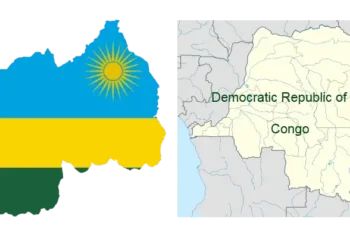

The Democratic Republic of the Congo (DRC) and the Republic of Rwanda have taken a significant step toward strengthening regional stability.
Meeting in Washington, D.C., both nations reaffirmed their commitments under the Washington Peace Agreement and initialed a new Regional Economic Integration Framework (REIF) that links peace to sustainable economic growth across Central Africa.
Commitment to Lasting Peace and Progress
On November 7, 2025, representatives from the DRC and Rwanda gathered with delegates from the United States, Qatar, Togo (as African Union mediator), and the African Union Commission for the fourth meeting of the Joint Oversight Committee.
The high-level session reviewed the implementation of the Peace Agreement signed in June 2025. U.S. Under Secretary Hooker and Senior Advisor Boulos oversaw the proceedings, emphasizing the importance of continued diplomatic engagement and the tangible dividends of peace for millions living in the Great Lakes region.
The Regional Economic Integration Framework
During the meeting, both nations formally initialed the Regional Economic Integration Framework (REIF) — a landmark agreement designed to promote bilateral trade, infrastructure development, and cross-border investment. The framework highlights areas such as mineral trade regulation, energy cooperation, and infrastructure modernization.
The REIF’s implementation depends on the successful execution of the Concept of Operations (CONOPS) and Operational Order (OPORD) under the broader peace plan, ensuring that security improvements directly translate into economic opportunity.
Overview of the Washington Peace Agreement
| Peace Accord Component | Implementation Focus |
|---|---|
| Rwandan troop withdrawal | Redeployment of forces from eastern DRC within 90 days |
| Joint coordination mechanism | Establishment of security command within 30 days |
| Disarmament of armed groups | FDLR and M23 disarmament and conditional reintegration |
| Economic framework | REIF to advance trade and mineral investment partnerships |
Security Measures and Renewed Momentum
The Committee acknowledged lagging progress in several areas but committed to redoubling collective efforts. Key outcomes from the session included:
-
Concrete timelines for disarmament and troop withdrawals.
-
Agreement on mechanisms for neutralizing the FDLR and other armed factions.
-
Renewed pledges to avoid inflammatory rhetoric or actions undermining the peace process.
The Parties reaffirmed their responsibility to translate commitments into practical action, maintaining a focus on stability, demobilization, and community recovery.
Diplomatic Support and International Mediation
The State of Qatar provided an update on ongoing Doha negotiations between the DRC government and AFC/M23 representatives. The discussions, which included progress on prisoner exchanges and ceasefire arrangements, were supported by the first meeting of the Doha Ceasefire Monitoring Mechanism on November 5, 2025.
The Joint Committee expressed strong support for the Doha process, calling it an “essential bridge” between peace commitments and real-world implementation. The Republic of Togo, acting as African Union mediator, was also recognized for maintaining continuity and trust among stakeholders.
Economic Cooperation as a Path to Stability
By integrating peacebuilding with economic strategy, the REIF serves as a forward-looking model for regional development. Both governments underscored that lasting peace depends on shared prosperity, equitable resource use, and transparent governance.
The framework includes initiatives aimed at:
-
Facilitating cross-border trade through modernized customs corridors.
-
Expanding access to energy and digital infrastructure.
-
Encouraging international investment in critical minerals central to renewable technologies.
These measures seek to transform the DRC–Rwanda border from a conflict zone into a corridor of commerce.
U.S. and African Union Roles
The United States reaffirmed its long-term commitment to African peacebuilding and economic partnership. U.S. officials highlighted that the Washington Peace Agreement aligns with broader American goals of regional stability, energy transition, and supply chain diversification through ethical sourcing of critical minerals.
Meanwhile, the African Union continues to act as guarantor of the agreement, ensuring accountability and promoting joint monitoring through its diplomatic and security institutions.
The Humanitarian Impact
Decades of violence in eastern DRC have displaced hundreds of thousands and disrupted essential services. The Joint Oversight Committee emphasized that peace implementation must directly benefit local populations through employment opportunities, social reintegration programs, and secure trade networks.
Although progress has been uneven, optimism remains strong among stakeholders. The DRC and Rwanda both expressed gratitude to the United States, Qatar, and the African Union for their continued mediation and support.
The Takeaway
As peace and economic cooperation advance in parallel, the success of the REIF could become a regional blueprint. Its effective implementation would not only stabilize the Great Lakes region but also strengthen Africa’s role in global trade and sustainable development.
The Joint Oversight Committee’s latest session reinforces that peace in Central Africa is inseparable from prosperity — a principle now at the heart of both nations’ shared agenda.
Sources: US Department of State, Wikipedia, American Society of International Law, and Democracy Now.
Prepared by Ivan Alexander Golden, Founder of THX News™, an independent news organization delivering timely insights from global official sources. Combines AI-analyzed research with human-edited accuracy and context.