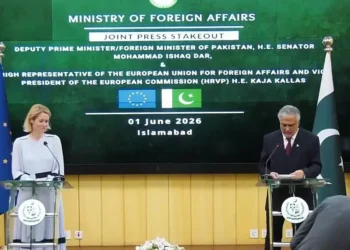
EU High Representative Kaja Kallas addressed diplomats in The Hague as Europe moved closer to formalising a new International Claims Commission for Ukraine. Speaking alongside Council of Europe Secretary General Alain Berset, she described the process as an essential step toward accountability for war damage caused by Russia. The conference brought together states determined to ensure financial responsibility is not avoided. Moreover, the focus remained firmly on people affected across Ukraine.
Kaja Kallas stressed that more than 86,000 claims have already been filed, reflecting homes destroyed and lives disrupted by years of conflict. She highlighted that justice takes time but history shows such mechanisms can work. Meanwhile, the European Union confirmed direct financial backing for the commission. The remarks set a clear tone for coordinated European action and long-term pressure.
Europe formalises accountability framework
The Diplomatic Conference in The Hague marked a formal step toward adopting the convention establishing an International Claims Commission for Ukraine. The initiative builds on work by the Council of Europe to register and process claims linked to war damage caused by Russia’s invasion.
Additionally, the EU views the commission as a practical legal tool rather than a symbolic gesture. Kaja Kallas underlined that the aim is to calculate losses suffered by individuals, families, and communities, not abstract national figures. As a result, the process focuses on verified damage to civilian property and infrastructure.
Furthermore, European officials see this framework as central to reinforcing international law. It signals that financial accountability remains part of Europe’s broader response to the war.
Scale of destruction and human impact
Claims already reflect widespread damage
According to figures cited by Kaja Kallas, more than 200,000 buildings in Ukraine have been damaged or destroyed since the war began. In addition, around 2.5 million homes are currently unfit for habitation.
Moreover, these numbers represent only one category within the wider registry of claims. Each submission reflects an individual disruption, whether loss of shelter, community services, or basic security. Meanwhile, European institutions continue to expand technical capacity to handle the growing volume of cases.
Why the commission matters
The Claims Commission for Ukraine is designed to assess compensation owed, even if payment is not immediate. History offers precedents, including post-conflict mechanisms in Kuwait and Bosnia and Herzegovina. However, implementation is expected to be complex and lengthy.
Additionally, EU officials acknowledge that Russia is unlikely to cooperate voluntarily. As a result, broad international participation remains essential to sustain pressure and legitimacy.
- Legal recognition of civilian losses across Ukraine
- Structured assessment of verified damage claims
- International coordination through European institutions
Overview of Claims Process
| Claims filed | Over 86,000 submissions |
| Housing damage | 2.5 million homes affected |
| EU financial support | €1 million initial contribution |
EU support and wider pressure strategy
Kaja Kallas announced that the European Union will contribute €1 million to support the establishment of the Claims Commission for Ukraine. Additionally, she confirmed that EU sanctions targeting Russian oil traders and shadow fleet vessels were expanded this week.
Moreover, these measures aim to limit funding available for continued military action. As a result, legal accountability and economic pressure are being pursued in parallel. Furthermore, the EU continues work on frameworks addressing war crimes and the crime of aggression.
Meanwhile, questions from journalists highlighted the political complexity of using frozen Russian assets. Kaja Kallas noted that decision-making among 27 democracies is challenging, but emphasised that a unified European approach would reduce national-level pressure and legal uncertainty.
Message to victims and future deterrence
In response to questions about victims in Ukraine, Kaja Kallas stated that accountability remains essential for lasting peace. She emphasised that justice is not only about compensation, but about recognition and responsibility.
Furthermore, she argued that Europe’s actions send a broader message. If aggression leads to legal and financial consequences, future conflicts may be deterred. Additionally, European unity on Ukraine continues to shape the EU’s role as a defender of international norms.
The establishment of the Claims Commission for Ukraine therefore represents both a practical mechanism and a statement of long-term European resolve.
Sources: EEAS press remarks, Council of Europe conference materials, and EU audiovisual service.
Prepared by Ivan Alexander Golden, Founder of THX News™, an independent news organization delivering timely insights from global official sources. Combines AI-analyzed research with human-edited accuracy and context.