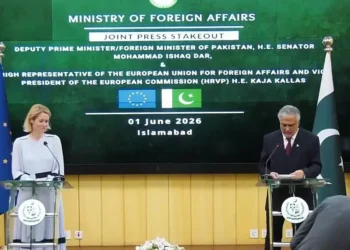
EU High Representative Kaja Kallas placed EU competitiveness at the centre of Europe’s power and security outlook on arrival at the informal leaders’ retreat. Moreover, remarks tied EU competitiveness directly to defence production capacity and access to finance.
Capital Markets Union reform was described as a barrier issue. Economic security was framed as a shared concern. Defence production scale was presented as dependent on market tools. Trade diversification was also highlighted.
Kaja Kallas said EU competitiveness must grow if Europe wants to act as a geopolitical power. Furthermore, Capital Markets Union gaps were cited by defence ministers as slowing defence production investment.
Economic security concerns were linked to trade exposure and coercive practices. EU competitiveness was presented as a policy priority. Capital Markets Union reform and defence production financing were named together. Economic security and open trade were both referenced.
Introduction
Kaja Kallas told reporters that EU competitiveness underpins Europe’s geopolitical weight and policy autonomy. Additionally, she said economic strength and defence production capacity now sit closer together in EU planning. EU competitiveness, Capital Markets Union reform, defence production funding, and economic security were repeatedly linked in her remarks.
Moreover, the comments were delivered at an informal EU leaders’ retreat focused on competitiveness and economic direction. Capital Markets Union performance and defence production financing were raised following a defence ministers’ discussion. Economic security and EU competitiveness were presented as shared cross-sector concerns.
EU competitiveness tied to geopolitical capacity
Kaja Kallas said EU competitiveness is the base layer for Europe’s global role. Furthermore, she stated that geopolitical influence depends on either military strength or economic strength, and the EU’s starting point is economic power. EU competitiveness was therefore described as a policy foundation for economic security and defence production resilience.
Additionally, EU competitiveness was linked to regulatory simplification and better operating conditions for companies. Capital Markets Union reform was referenced as part of the same environment. Defence production scale and economic security planning were both connected to EU competitiveness outcomes.
Business environment and simplification
Moreover, simplification processes were presented as supportive tools for EU competitiveness. Capital Markets Union access and defence production investment were described as dependent on fewer structural barriers. Economic security planning was also connected to company performance across the EU market.
Capital Markets Union and defence production financing
Kallas said defence ministers highlighted Capital Markets Union weaknesses as a real obstacle to defence production expansion. Furthermore, access to capital was described as hindered, limiting defence production ramp-up. Capital Markets Union reform was therefore positioned as part of economic security policy.
Additionally, defence production needs were presented as tied to private and cross-border finance. EU competitiveness and Capital Markets Union depth were again mentioned together. Economic security and defence production were framed as linked through funding channels.
- EU competitiveness depends on capital access
- Capital Markets Union affects defence production funding
- Economic security links to investment scale
Policy Links Highlighted by Kallas
| EU competitiveness | Presented as the base for geopolitical influence and economic security capacity across the Union. |
| Capital Markets Union | Described as not working effectively enough to support defence production investment needs. |
| Defence production | Linked to financing barriers and cross-border capital access within EU markets. |
| Economic security | Connected to competitiveness, trade diversification, and resilience against coercive practices. |
Trade openness and economic security balance
Kaja Kallas rejected broad protectionism when asked about “Made in Europe” approaches. Moreover, she said open export conditions support EU competitiveness over the long term. Economic security, however, was described as requiring responses to coercive economic practices.
Furthermore, she pointed to economic coercive practices from China as damaging for European companies. Capital Markets Union strength and defence production capacity were again indirectly tied to EU competitiveness in this context. Economic security and open trade were presented as parallel tracks.
Partnerships and diversification
Additionally, Kallas said partnerships and diversified trade portfolios support EU competitiveness. Defence production supply chains and economic security planning were linked to diversification. Capital Markets Union reform was implied as supportive of cross-border investment in these areas.
Leaders’ retreat focus areas
The informal retreat agenda centred on EU competitiveness and growth capacity. Moreover, discussions connected Capital Markets Union performance with defence production scaling needs. Economic security and EU competitiveness appeared repeatedly in the policy framing.
Additionally, defence production obstacles and capital access limits were cited from ministerial discussions held the previous day. Capital Markets Union reform, EU competitiveness, defence production funding, and economic security were treated as interdependent themes.
What to watch next
Kaja Kallas’s remarks show EU competitiveness is being treated as a practical condition for economic security and defence production readiness. Additionally, the link to Capital Markets Union reform signals that leaders are likely to revisit how investment flows support cross-border industrial scale-up.
Meanwhile, the stance against broad protectionism, alongside concern about coercive practices, points to a continued balance between open trade and targeted economic security tools.
Sources: European Union, Intelli News, Reuters and Wikipedia.
Prepared by Ivan Alexander Golden, Founder of THX News, an independent news organization delivering timely insights from global official sources. Combines AI-analyzed research with human-edited accuracy and context.