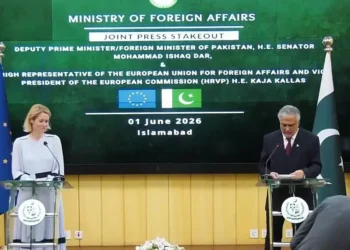
EU High Representative Kaja Kallas said the EU–Egypt strategic partnership is delivering practical cooperation, as she met Foreign Minister Badr Abdelatty in Cairo. Discussions covered regional security, Gaza, Syria, Lebanon, and economic ties, reflecting a shared focus on stability and reform. Moreover, the talks followed last year’s first EU–Egypt Summit, which opened a new phase in relations.
Kallas highlighted ongoing EU financial support and upcoming security dialogue under the EU–Egypt strategic partnership framework. Additionally, she stressed Egypt’s diplomatic role across the Middle East and the EU’s commitment to humanitarian access in Gaza. Furthermore, she said closer coordination is essential as conflicts continue to affect Europe’s neighbourhood.
Deepening the EU–Egypt strategic partnership
Kallas described Egypt as an indispensable partner under the EU–Egypt strategic partnership, pointing to cooperation across trade, security, science, and investment. Moreover, she confirmed the EU is providing €5 billion in loans to support competitiveness and the green transition, reinforcing the EU–Egypt strategic partnership in practical terms.
Additionally, both sides confirmed plans to hold the first EU–Egypt Security and Defence Dialogue in Cairo in March. The dialogue will address maritime security in the Red Sea, cyber security, and counter-terrorism. As a result, the EU–Egypt strategic partnership is expected to expand beyond diplomacy into operational coordination.
Priority areas discussed
- Security cooperation across maritime, cyber, and counter-terrorism domains.
- Economic reform support through EU financial assistance and expertise.
- Green transition investment aligned with European climate priorities.
Gaza, humanitarian access, and governance
Gaza featured prominently in the talks, with Kallas describing the humanitarian situation as severe. Moreover, she said Hamas’s refusal to disarm is blocking progress, while Israeli restrictions on international NGOs are limiting aid delivery. As a result, humanitarian access remains under strain despite the EU–Egypt strategic partnership’s emphasis on stability.
Additionally, Kallas said there is no justification for the deterioration of conditions in Gaza. She underlined that NGOs are essential to delivering aid at scale. Furthermore, discussions covered Gaza’s recovery and governance, including plans for a technocratic administration and a stabilisation force.
The EU remains the largest donor in Gaza and continues to support Palestinian Authority reforms. Moreover, the EU is working to expand its missions on the ground, including training Palestinian police. In addition, Kallas said cooperation with Egypt under the EU–Egypt strategic partnership could be strengthened further in this area.
EU engagement across key regional files
| Gaza | Humanitarian access, governance planning, EU aid leadership |
| Syria | Sanctions easing, reforms, rule of law, investor confidence |
| Lebanon | Internal security forces, state authority, risk of escalation |
Syria and Lebanon: security and reform
Turning to Syria, Kallas said recent clashes in Aleppo show how fragile the situation remains. Moreover, she noted the EU was the first to ease sanctions after Assad’s fall, aiming to support rebuilding. However, she stressed that sanctions relief alone is not enough. Investors also need trust, which depends on reforms and the rule of law.
Additionally, EU foreign ministers have agreed to move forward with a new EU–Syria political partnership. Discussions in Cairo focused on governance and security sector reforms, reflecting shared interests between Europe and Egypt. As a result, stability in Syria remains central to the EU–Egypt strategic partnership.
On Lebanon, Kallas warned the country faces a dangerous moment. Hezbollah’s limited disarmament efforts and continued Israeli strikes risk renewed escalation. Furthermore, the EU is considering options to strengthen Lebanon’s internal security forces, supporting state authority nationwide.
Wider geopolitical concerns and Ukraine
Beyond the region, Kallas said discussions also touched on the war in Ukraine. Moreover, she said the EU continues to explore ways to bring peace and encourage Russia to engage in negotiations. In addition, she stressed that respect for international law and sovereignty remains central to EU policy, whether in Europe or the Middle East.
As a result, the EU–Egypt strategic partnership was framed as part of a broader effort to promote stability in an interconnected neighbourhood. Furthermore, Kallas said cooperation with Egypt supports both regional security and Europe’s wider interests.
Economic reform and investment outlook
Economic cooperation formed another core theme. Kallas said the EU is finalising decisions on macro-financial assistance to Egypt, linked to reform progress. Moreover, the EU is providing expertise alongside funding, reinforcing the EU–Egypt strategic partnership’s economic dimension.
Additionally, she highlighted opportunities for European investment, particularly in the green transition. The recent EU–Egypt Investment Conference in Brussels aimed to showcase these opportunities. As a result, while investment decisions rest with private companies, the EU believes conditions are increasingly favourable.
Sources: European External Action Service press remarks, Cairo, 8 January 2026.
Prepared by Ivan Alexander Golden, Founder of THX News, an independent news organization delivering timely insights from global official sources. Combines AI-analyzed research with human-edited accuracy and context.